Which SMR Companies Are Building Small Modular Reactors in 2026, and Who Is Hiring?
Leading SMR companies in 2026: GE Vernova Hitachi, TerraPower, Rolls-Royce SMR, Kairos, X-energy and NuScale. See each stage and who is hiring now.
The leading SMR companies in 2026 are GE Vernova Hitachi (BWRX-300), TerraPower (Natrium), Rolls-Royce SMR, Kairos Power, X-energy, NuScale Power, Oklo, Holtec and Terrestrial Energy. As of November 2026, BWRX-300 units at Darlington and Clinch River, and TerraPower's Natrium plant, have construction approval, which makes these the biggest SMR employers right now.
View current SMR and nuclear roles at TRX or send your CV to the TRX team.
Key takeaways
- More than 70 SMR designs are in development worldwide, but only a handful of SMR companies have a licence to build as of November 2026.
- Companies with construction permits (GE Vernova Hitachi and its utility customers, TerraPower, Kairos Power) are hiring the most construction, commissioning and quality roles today.
- Companies still in licensing (X-energy, Holtec, NuScale, Rolls-Royce SMR, Terrestrial Energy) hire heavily for safety case, licensing, design and supply chain roles.
- Microreactor developers such as Oklo, NANO Nuclear Energy, Antares Nuclear, Last Energy, Deep Fission and Hadron Energy are smaller, faster-moving employers.
- The job you can get depends on the stage a company has reached, so use the table below to match your skills to the right employer.
What is an SMR company?
An SMR company designs, licenses or builds small modular reactors: nuclear reactors that generally produce up to about 300 MWe per unit and are built largely in factories, then shipped to site. Some SMR companies are reactor vendors; others are utilities or developers that buy and operate the designs.
A small modular reactor (SMR) is smaller than a conventional nuclear reactor. According to the US Energy Information Administration (April 2026), large nuclear designs typically range from 550 MW to 1,500 MW per unit, SMRs have about 300 MW per unit or less, and micro reactors generally have 20 MW or less. Some designs sit above the 300 MWe mark but are still marketed as SMRs because of their modular construction, such as the 470 MWe Rolls-Royce SMR. Microreactors are the smallest sub-group, aimed at remote communities, military bases, mines and data centers. If you want the basics first, read our explainer on the rise of small modular reactors and what it means for the workforce.
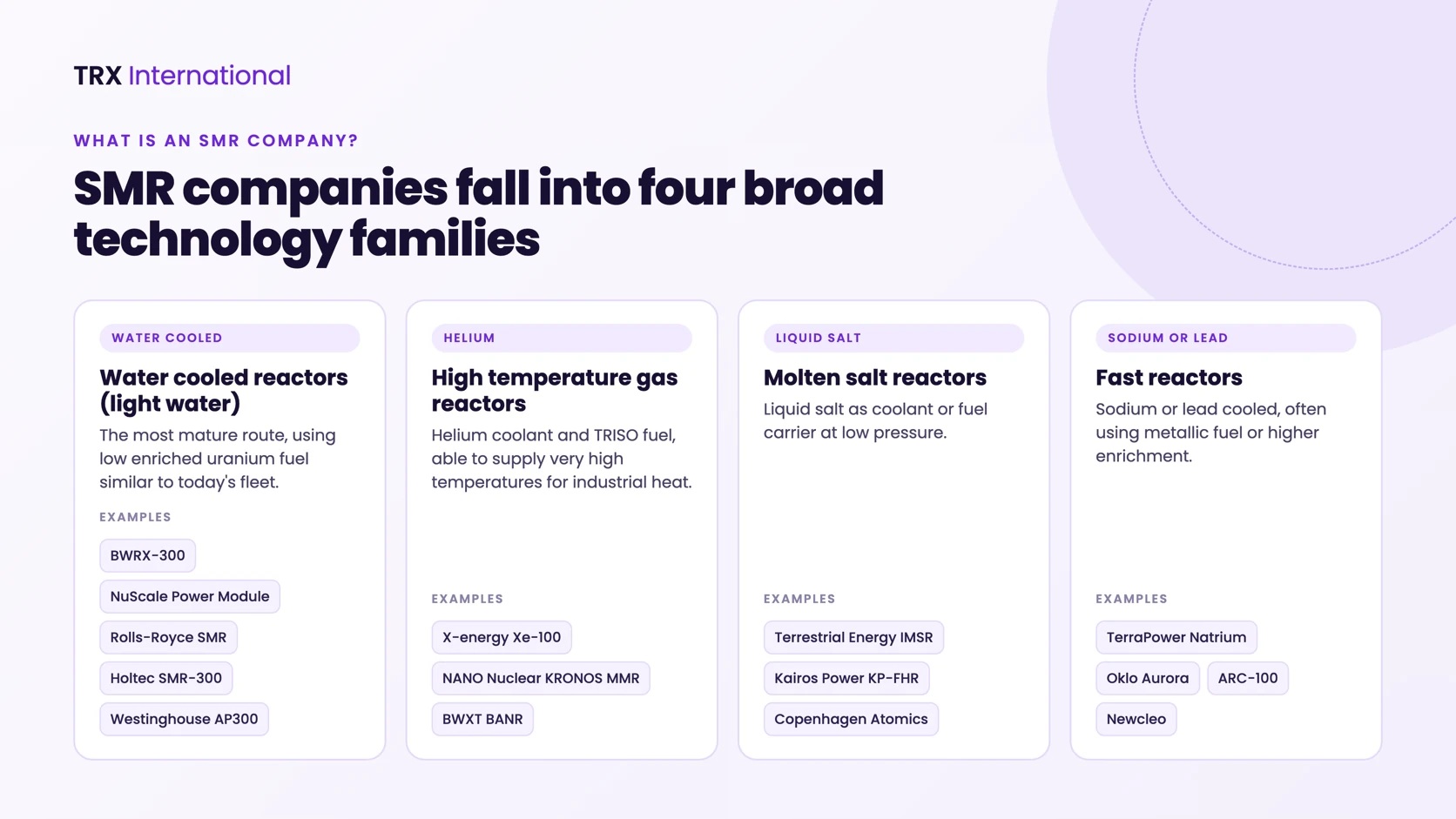
SMR companies fall into four broad technology families:
- Water cooled reactors (light water): the most mature route, using low enriched uranium fuel similar to today's fleet. Examples: BWRX-300, NuScale Power Module, Rolls-Royce SMR, Holtec SMR-300, Westinghouse AP300.
- High temperature gas reactors: helium coolant and TRISO fuel, able to supply very high temperatures for industrial heat. Examples: X-energy Xe-100, NANO Nuclear KRONOS MMR, BWXT BANR.
- Molten salt reactors: liquid salt as coolant or fuel carrier at low pressure. Examples: Terrestrial Energy Integral Molten Salt Reactor (IMSR), Kairos Power KP-FHR (salt-cooled with solid fuel), Copenhagen Atomics.
- Fast reactors: sodium or lead cooled, often using metallic fuel or higher enrichment. Examples: TerraPower Natrium, Oklo Aurora, ARC-100, Newcleo.
Why are SMR companies attracting so much investment?
SMR companies attract investment because large nuclear plants have become very expensive to build, and smaller, factory-built reactors promise lower upfront cost, shorter schedules and less financial risk per project. That case is still being proven, which is why the first projects matter so much for jobs.
The EIA notes that high capital costs are one of the main limits on US nuclear expansion. The two new large units at Plant Vogtle in Georgia cost more than $30 billion in total by 2024, according to Green Stocks Research. SMR companies respond in three ways:
- Factory fabrication: building modules in a factory and shipping them to site, so more work happens in controlled conditions and less on a construction site. Capitalizing on factory-built components can reduce financial risk because each unit costs less and can be added in stages.
- Smaller cheaper units: some microreactor developers target very low construction costs. According to Wikipedia's list of SMR designs, Last Energy's PWR-20 targets under $100 million per unit and the OPEN100 design aims for about $300 million per reactor. These are developer targets, not proven costs.
- New markets: SMRs can serve remote areas with high power distribution costs, industrial sites that need heat, data centers and military bases.
History is a useful reality check. NuScale's first plant was once expected to operate by 2018, and early SMR projects have often slipped. For a job seeker, that means choosing employers with real permits and customers, which the table below shows.
How do small modular reactor designs compare on fuel and coolant?
SMR companies differ mainly in coolant and fuel: water cooled designs use conventional low enriched uranium fuel and face the shortest licensing path, while gas cooled, molten salt and fast reactors offer higher temperatures but often need advanced fuels such as TRISO or HALEU. The technology a company picks shapes how quickly it can reach commercial deployment and which specialists it hires.
| Technology | Coolant | Typical fuel | Example SMR companies | What it means for jobs |
|---|---|---|---|---|
| Light water (water cooled) | Ordinary water | Low enriched uranium fuel (below 5% U-235) | GE Vernova Hitachi, NuScale Power, Rolls-Royce SMR, Holtec, Westinghouse Electric Company | Closest to today's nuclear power fleet, so existing plant experience transfers directly |
| High temperature gas reactors | Helium | TRISO fuel, often HALEU | X-energy, NANO Nuclear Energy, BWX Technologies | Demand for fuel, graphite and high temperature materials specialists |
| Molten salt reactors | Molten fluoride salt | Fuel dissolved in salt, or solid TRISO fuel | Terrestrial Energy Inc, Kairos Power, Moltex, Copenhagen Atomics | Salt chemistry, corrosion and materials skills |
| Fast reactors | Sodium or lead | Metallic fuel, higher enrichment; some can use spent fuel | TerraPower, Oklo, ARC Clean Technology, Newcleo | Sodium systems, fuel cycle and fast reactor physics skills |
HALEU (high-assay low-enriched uranium) is uranium enriched to between 5% and under 20% uranium-235, as defined by the EIA. Supply of this more highly enriched fuel is one of the main constraints on advanced reactor designs, which is why several SMR companies, including X-energy, run their own fuel business lines.
Each design relies on passive safety features, such as natural circulation, to remove heat without pumps or operator action. That changes reactor operation and the safety case, and creates demand for engineers who understand passive power systems. High temperature designs such as X-energy's Xe-100 can also supply industrial heat alongside electricity, which opens jobs with chemical and industrial customers.
Who funds SMR deployment?
Governments are the biggest backers of SMR deployment, through funding, regulatory reform and military demand. The US Department of Energy reissued a tender for $900 million in federal funding for SMRs in March 2025, and the US Army launched its Janus programme for microreactors in October 2025, according to the EIA. The US military is adopting commercial microreactors for its installations; the US Air Force plans a microreactor at Eielson Air Force Base in Alaska using Oklo's Aurora design.
In the UK, government funding supports Rolls-Royce SMR at Wylfa, and in Canada, OPG's Darlington project is the first of a planned fleet. Projects with this backing tend to offer longer, more secure contracts.
SMR companies list 2026: designs, stage and who is hiring
This table lists the main SMR companies, their reactor designs, country, development stage as of November 2026 and the roles each is most likely to hire for. It is free to use and cite with a link to this page. Stages come from regulator and company announcements reported in the sources linked under the table.
| Company | Reactor design | Type and output per unit | Country | Stage (as of November 2026) | Roles most in demand now |
|---|---|---|---|---|---|
| GE Vernova Hitachi with OPG | BWRX-300 at Darlington | Boiling water reactor, 300 MWe | Canada | Licence to construct (April 2025), under construction; operating licence applied for March 2026 | Construction, commissioning, QA/QC, operations training |
| GE Vernova Hitachi with TVA | BWRX-300 at Clinch River | Boiling water reactor, 300 MWe | US | NRC construction permit issued 30 September 2026 | Project controls, licensing, site engineering, construction management |
| TerraPower | Natrium at Kemmerer | Sodium fast reactor, 345 MWe (500 MWe with molten salt storage) | US | NRC construction permit 4 March 2026; nuclear construction under way; completion targeted 2030 | Construction, mechanical and civil engineering, quality, project management |
| Kairos Power | Hermes 1 and Hermes 2 | Fluoride salt-cooled high temperature reactor; Hermes 2 about 50 MWe | US | Both units hold construction permits and are under construction in Oak Ridge, Tennessee | Engineering, manufacturing, construction, salt chemistry |
| X-energy | Xe-100 at Long Mott (Dow) | High temperature gas reactor, 4 x 80 MWe | US | Construction permit under NRC review; environmental review completed May 2026 | Licensing, safety analysis, fuel (TRISO), design engineering |
| Holtec International | SMR-300 at Palisades | Pressurised water reactor, 2 x 340 MWe | US | Construction permit application (part 1) docketed February 2026 | Licensing, design, manufacturing, project controls |
| NuScale Power | US460 (NuScale Power Module) | Integral pressurised water reactor, 77 MWe modules | US | NRC Standard Design Approval May 2025; awaiting first firm project | Design engineering, licensing, supply chain |
| Oklo | Aurora at Idaho National Laboratory | Fast reactor with metallic fuel, about 15 to 75 MWe | US | Building under the DOE pilot pathway since September 2025 | Engineering, fuel fabrication, construction, licensing |
| Rolls-Royce SMR | Rolls-Royce SMR at Wylfa | Pressurised water reactor, 470 MWe | UK | Contract signed with Great British Energy - Nuclear in April 2026 for three units; UK Generic Design Assessment in final step; final investment decision expected 2029 | Safety case, design, site licensing, supply chain, manufacturing |
| Westinghouse | AP300 | Pressurised water reactor, about 300 MWe | US/UK | NRC pre-application, with certification expected around 2027; UK GDA under way | Design, licensing, safety analysis |
| Terrestrial Energy | Integral Molten Salt Reactor | Molten salt reactor, 195 MWe per unit | Canada/US | Completed phase 2 of the CNSC vendor design review in April 2023; NRC pre-licensing; early 2030s target | Molten salt chemistry, licensing, design |
| NANO Nuclear Energy | KRONOS MMR | High temperature gas microreactor, 15 MWe | US | NRC accepted construction permit application for a University of Illinois unit in May 2026 | Licensing, design, project management |
| CNNC | Linglong One (ACP100) | Integral pressurised water reactor, 125 MWe | China | Pre-commissioning; start-up tests reported in August 2026 | Mostly domestic hiring |
Sources: World Nuclear News on the Clinch River permit, ANS Nuclear Newswire on the Natrium permit, World Nuclear News on the Rolls-Royce SMR contract, Energy Note 2026 SMR licensing map, Wikipedia's list of SMR designs and Green Stocks Research on listed SMR companies, all checked November 2026. Project dates change often, so confirm with the company before you apply.
Looking for a role on one of these projects? Browse TRX nuclear roles.
Which SMR companies are leading in 2026?
As of November 2026, GE Vernova Hitachi leads on real-world progress because its BWRX-300 is under construction in Canada and has a US construction permit, followed by TerraPower, whose Natrium plant is under construction in Wyoming. Rolls-Royce SMR leads in Europe with a signed contract for three units at Wylfa.
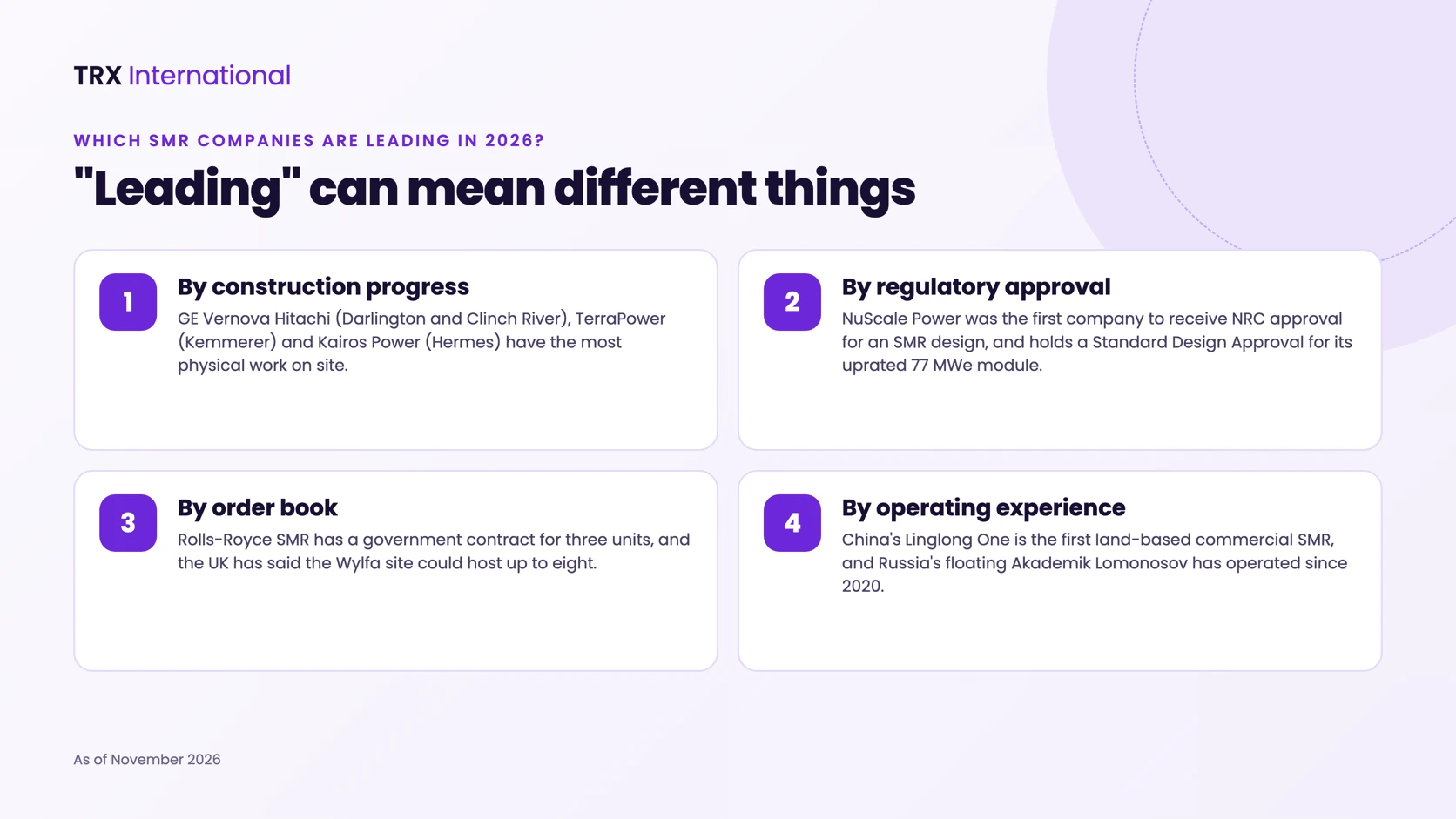
"Leading" can mean different things depending on whether you are an investor, a utility or a job seeker:
- By construction progress: GE Vernova Hitachi (Darlington and Clinch River), TerraPower (Kemmerer) and Kairos Power (Hermes) have the most physical work on site.
- By regulatory approval: NuScale Power was the first company to receive NRC approval for an SMR design (its earlier design certification), and holds a Standard Design Approval for its uprated 77 MWe module.
- By order book: Rolls-Royce SMR has a government contract for three units, and the UK has said the Wylfa site could host up to eight.
- By operating experience: China's Linglong One is the first land-based commercial SMR, and Russia's floating Akademik Lomonosov has operated since 2020.
For job seekers, the best measure is construction approval, because that is when hiring moves from tens of design staff to hundreds of site, commissioning and quality roles. Industry trackers expect the first commercial SMR plants in the West to come online from about 2028 to 2030, so the hiring peak for construction and commissioning is now.
Leading SMR companies in the United States
The US has the largest number of SMR companies, supported by the Department of Energy and an increasingly active Nuclear Regulatory Commission. The US Nuclear Regulatory Commission has now issued construction permits to TerraPower, TVA and Kairos Power, and is reviewing X-energy and Holtec.
GE Vernova Hitachi (BWRX-300)
The BWRX-300 is a 300 MWe boiling water reactor that relies on natural circulation and passive cooling. TVA received the first US construction permit for a BWRX-300 at Clinch River, Tennessee, on 30 September 2026. It is the same design OPG is building at Darlington. Hiring is spread across GE Vernova, the utilities and their construction partners.
TerraPower (Natrium)
TerraPower, backed by Bill Gates, is building the Natrium sodium fast reactor at Kemmerer, Wyoming, on a retiring coal site. The NRC approved its construction permit on 4 March 2026, its first approval of a commercial non-light-water reactor in more than 40 years. The plant pairs a 345 MWe reactor with molten salt storage that can boost output to 500 MWe, and completion is targeted for 2030.
Kairos Power (Hermes)
Kairos Power is building its Hermes test reactor and the larger Hermes 2 in Oak Ridge, Tennessee. Its design uses solid TRISO fuel cooled by molten fluoride salt at low pressure. Kairos manufactures many components in-house, so it hires manufacturing and fabrication staff as well as engineers.
X-energy (Xe-100)
X-energy's Xe-100 is a pebble-bed high temperature gas reactor with helium coolant and TRISO fuel, designed to supply both power and industrial steam. Its first four-unit plant at Dow's Long Mott site in Texas is under NRC review. X-energy also runs a TRISO fuel business, which creates fuel fabrication and chemical engineering jobs.
NuScale Power
NuScale Power's NuScale Power Module is a 77 MWe integral pressurised water reactor that uses natural circulation, with no reactor coolant pumps. Its US460 design received NRC Standard Design Approval in May 2025. NuScale has projects planned in Romania and partnerships with ENTRA1 Energy and Doosan Enerbility for manufacturing.
Oklo (Aurora)
Oklo's Aurora is a fast reactor using metallic fuel, designed for off grid and data centers customers. It broke ground at Idaho National Laboratory in September 2025 under the DOE reactor pilot programme. Oklo is publicly listed, so roles often include equity.
Holtec International (SMR-300)
Holtec plans two units (two reactors of the SMR-300 design) at its Palisades site in Michigan, next to a plant it is returning to service. Its construction permit application was docketed in February 2026. Holtec also has a large decommissioning business, so it hires across licensing, manufacturing and decommissioning.
Microreactor companies: NANO Nuclear, Antares, Last Energy, Deep Fission and Hadron Energy
Microreactor companies build reactors of roughly 1 to 20 MWe for remote sites, defence and data centers, and several reached key milestones in 2026. Four pilot reactors (Antares Nuclear, Valar, Deployable and Aalo) reached criticality by 4 July 2026 under the DOE pilot programme, according to Energy Note's 2026 licensing map.
- NANO Nuclear Energy: developing the 15 MWe KRONOS MMR high temperature gas reactor; the NRC accepted its construction permit application in May 2026.
- Antares Nuclear: a compact microreactor developer that reached criticality under the DOE pilot pathway.
- Last Energy: a microreactor developer whose PWR-20 targets a construction cost under $100 million, listed among 2026's leading new entrants by Nuclear News Network.
- Deep Fission: designing a pressurised water reactor placed about a mile underground in a borehole, targeting an NRC application in 2027. It became publicly listed in 2026.
- Hadron Energy: developing the 10 MWe Hadron Halo light-water microreactor, with first-unit operation targeted for 2030.
Smaller companies offer broad roles and fast learning, but more risk. Check funding and regulatory progress before you join.
Leading SMR companies in the United Kingdom
Rolls-Royce SMR is the UK's leading SMR company, with a contract signed in April 2026 to deliver three 470 MWe units at Wylfa in North Wales. The National Wealth Fund committed up to £599 million to support the work, and Rolls-Royce SMR said the contract gives it certainty to ramp up recruitment (World Nuclear News, April 2026).
The Rolls-Royce SMR design is in the final step of the UK Generic Design Assessment, the joint review by the Office for Nuclear Regulation and the environment agencies. Westinghouse's AP300 and GE Vernova Hitachi's BWRX-300 have also entered the UK process. UK SMR companies hire safety case engineers, design engineers, environmental specialists and supply chain staff. If you hold or can obtain UK security clearance, you will be in demand. See our guide to European nuclear power stations for the wider market.
Key SMR companies in Canada
Canada hosts North America's first SMR construction project: OPG's BWRX-300 at Darlington, licensed by the Canadian Nuclear Safety Commission in April 2025. OPG applied for an operating licence in March 2026, which signals a move from construction to commissioning hiring.
Other Canadian SMR companies include Terrestrial Energy, whose Integral Molten Salt Reactor completed phase 2 of the CNSC vendor design review in April 2023 and integrates the primary reactor components into a sealed, replaceable vessel; Moltex Energy (Stable Salt Reactor) in New Brunswick; and ARC Clean Technology (ARC-100 sodium fast reactor). The CNSC's vendor design review is the usual first step for these companies. SMR regulatory approval processes vary by country, so a design reviewed in Canada still needs separate approval in the US or UK. Canada's SMR projects are among the strongest sources of commissioning and operations jobs for engineers with CANDU experience.
SMR companies in Europe and Asia
Outside North America and the UK, the most advanced SMR companies are China's CNNC with Linglong One, Russia's ROSATOM with RITM-200 reactors, and South Korea's KAERI with the SMART100 design. European utilities in Poland, Romania, Sweden and Estonia are also selecting SMR vendors.
- CNNC (China): Linglong One, a 125 MWe integral pressurised water reactor on Hainan Island, was in pre-commissioning as of August 2026.
- ROSATOM (Russia): RITM-200 reactors power icebreakers, and a land-based RITM-200N is planned in Yakutia.
- KAERI (South Korea): SMART100 received Standard Design Authorization in September 2024; the larger i-SMR is under review.
- Newcleo (UK/Italy/France): a lead-cooled fast reactor developer targeting the early 2030s.
- Copenhagen Atomics (Denmark): a molten salt reactor developer that plans to test its prototype in 2028.
Most hiring for Chinese and Russian SMRs is domestic, so international candidates should focus on North American, UK and European SMR companies.
What jobs are SMR companies hiring for?
SMR companies hire across engineering, licensing, construction, manufacturing and operations, and the mix changes as a project moves from design to construction to commissioning. The biggest shortages are in safety case and licensing, nuclear-grade quality assurance, commissioning and project controls. Nuclear professionals can take these as permanent or contract roles, and contractors are often brought in first when a permit lands.
| Project stage | Typical SMR companies at this stage | Roles most in demand |
|---|---|---|
| Design and pre-licensing | Terrestrial Energy, Westinghouse AP300, Deep Fission, Hadron Energy, Copenhagen Atomics | Reactor physics, thermal hydraulics, mechanical design, safety analysis |
| Licensing and design approval | X-energy, Holtec, NuScale, Rolls-Royce SMR, NANO Nuclear | Licensing engineers, safety case authors, regulatory affairs, PSA specialists |
| Construction | GE Vernova Hitachi customers (OPG, TVA), TerraPower, Kairos Power, Oklo | Construction managers, civil and structural engineers, QA/QC, welding inspectors, planners |
| Commissioning and start-up | OPG Darlington, CNNC Linglong One | Commissioning engineers, I&C engineers, operators, radiation protection |
| Fleet manufacturing | Rolls-Royce SMR, Kairos Power, NuScale and Doosan | Manufacturing engineers, supply chain, nuclear-grade quality |
Many of these roles pay a premium. See our nuclear engineering salary benchmarks and our guide to the highest paying nuclear jobs. For licensing work, read nuclear licensing and policy jobs, and for site inspection roles see nuclear safety inspector careers.
Ready to move into SMRs? Send your CV to TRX and tell us which companies interest you.
How do you get a job at an SMR company?
To get a job at an SMR company, target companies at the stage that matches your experience, show transferable nuclear or high-hazard skills on your CV, and apply through company career pages and specialist nuclear recruiters. Many SMR roles are filled through referrals and recruiters before they are advertised.
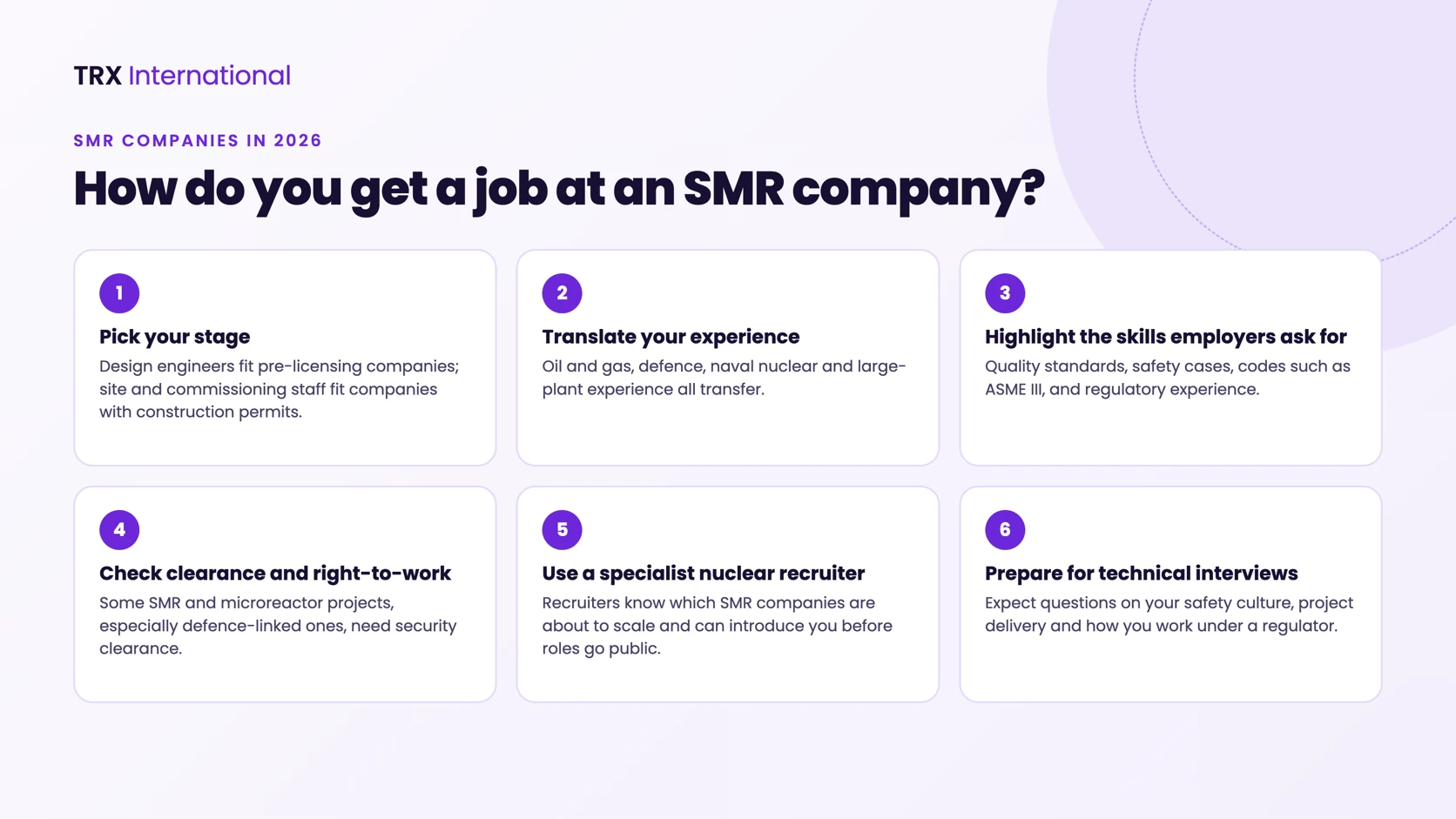
- Pick your stage. Design engineers fit pre-licensing companies; site and commissioning staff fit companies with construction permits.
- Translate your experience. Oil and gas, defence, naval nuclear and large-plant experience all transfer. Our guide to moving from oil and gas to nuclear energy explains how.
- Highlight the skills employers ask for. Quality standards, safety cases, codes such as ASME III, and regulatory experience. See the top skills nuclear energy employers are looking for.
- Check clearance and right-to-work. Some SMR and microreactor projects, especially defence-linked ones, need security clearance.
- Use a specialist nuclear recruiter. Recruiters know which SMR companies are about to scale and can introduce you before roles go public.
- Prepare for technical interviews. Expect questions on your safety culture, project delivery and how you work under a regulator.
If you are early in your career, start with our guide to entry level nuclear engineer jobs. If you want to see the full range of roles, read types of jobs in the nuclear industry.
Which recruitment agency recruits for SMR projects?
Specialist nuclear recruitment firms recruit for SMR projects, and TRX International is one of the firms focused specifically on SMR, new-build, decommissioning and fusion work. TRX International is a specialist nuclear and fusion recruitment firm placing engineers and contractors on nuclear new-build, SMR, decommissioning and fusion projects.
SMR companies use specialist recruiters because they need to scale teams quickly once a licence or contract arrives, and because nuclear experience is scarce. A good SMR recruiter should understand the difference between design, licensing, construction and commissioning hiring, know which companies hold permits, and be able to place both permanent staff and contractors across the US, UK, Canada and Europe. Employers can talk to TRX about SMR hiring, and candidates can view TRX nuclear roles.
Are SMR companies a good career bet in nuclear energy?
SMR companies are a good career bet if you choose employers with construction approval, solid funding and a signed customer, because those projects will hire for years. Earlier-stage SMR companies offer faster growth but carry more risk of delays or funding gaps.
Signs of a stable SMR employer:
- A construction permit or licence, or a signed contract with a utility or government
- A named site and customer
- Funding from government programmes or established investors
- A supply chain in place for long-lead items such as reactor vessels and steam generators
Some publicly listed SMR companies disclose financial risks in their filings, so read them before accepting equity-heavy offers. For context on costs and investment, see our article on the economics of nuclear power and the future of careers in nuclear energy.
Frequently Asked Questions
Which SMR companies have construction approval to build reactors in 2026?
As of November 2026, GE Vernova Hitachi's BWRX-300 units at Darlington and Clinch River, TerraPower's Natrium plant at Kemmerer and Kairos Power's Hermes reactors in Oak Ridge have construction approval. These are the biggest SMR employers right now.
What is the difference between an SMR and a microreactor?
SMRs generally produce up to about 300 MWe per unit and are built largely in factories. Microreactors are the smallest sub-group, generally 20 MW or less, aimed at remote communities, military bases, mines and data centers.
What kinds of jobs are SMR companies hiring for right now?
Companies with construction permits hire construction, commissioning, quality and project controls staff. Companies still in licensing hire for safety case, licensing, design and supply chain roles, and contractors are often brought in first when a permit lands.
Which company is leading the small modular reactor market in the UK?
Rolls-Royce SMR leads in the UK, with a contract signed in April 2026 to deliver three 470 MWe units at Wylfa in North Wales. Its design is in the final step of the UK Generic Design Assessment.
Can engineers from oil and gas get jobs at SMR companies?
Yes. Oil and gas, defence, naval nuclear and large-plant experience all transfer. On your CV, highlight the skills employers ask for: quality standards, safety cases, codes such as ASME III, and regulatory experience.
How can I tell if an SMR company is a stable employer?
Look for a construction permit or licence, or a signed contract with a utility or government, plus a named site and customer and funding from government programmes or established investors. Earlier-stage companies carry more risk of delays.
Find your next SMR role
The SMR companies that matter most for jobs right now are the ones with permits and contracts: GE Vernova Hitachi and its utility customers, TerraPower, Kairos Power and Rolls-Royce SMR, with X-energy, Holtec and NuScale close behind. If you want to work on one of these projects, view TRX nuclear roles or send your CV to TRX and we will match you to SMR companies that are hiring.
Keep reading
Thomas Redfern writes about nuclear new-build and major projects for TRX International. He covers sector news, reactor programmes and SMR developments, analysing what each shift means for the industry’s workforce and the specialist skills it will need next.