Nuclear Reactor Welding: Skills, Standards and Careers in the Nuclear Industry
Nuclear reactor welding is the work that holds a reactor together. Literally. Every weld on a reactor pressure vessel, every joint in primary circuit piping, every seal on a containment penetration exists to keep radioactive materials where they belong and coolant flowing where it should. Get it wrong, and you’re looking at loss-of-coolant events, forced outages costing millions per day, or worse.
That’s why the safety standards around nuclear welding are stricter than almost any other welding discipline on earth. The documentation alone would make a tax accountant nervous. Every pass, every filler batch, every degree of preheat gets logged and stored for the life of the plant, often 60 years or more.
Nuclear reactor welding supports the full lifecycle of nuclear power: existing large reactors getting life extensions, new-build projects like Vogtle Units 3 & 4 in the US and Sizewell B in the UK, emerging SMR (Small Modular Reactor) programmes, and decommissioning of retired plants. This article covers both the technical side of powerplant welding and the career and recruitment angle for welders considering this field. TRX International, a specialist nuclear recruitment partner, connects experienced nuclear welders with utilities, EPCs, and major projects globally, and we’ll touch on how they support both candidates and employers later on.
What Is Nuclear Welding in Power Plants?
Defining Nuclear Welding
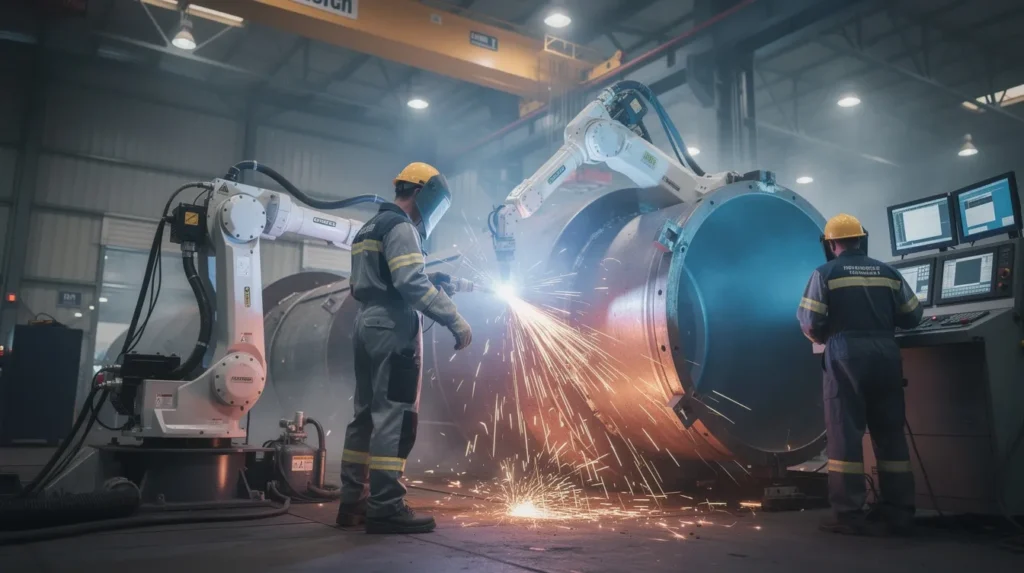
Nuclear welding is the joining of metal components in nuclear facilities, including reactor vessels, primary circuit piping, steam generators, containment penetrations, fuel pool systems, and support structures, all performed under nuclear-specific codes and QA systems. ASME BPVC Section III governs the construction of nuclear facility components, and welders must ensure compliance with environmental regulations alongside those codes.
What separates it from general industrial welding? Three things stand out: safety classification of components (Class 1, 2, 3), lifetime traceability of every weld, and constant regulatory oversight from bodies like the US NRC, UK ONR, or France’s ASN.
Common Welding Processes
Nuclear power plants use a range of welding processes depending on the application:
- GTAW (TIG): Gas Tungsten Arc Welding is used for high-integrity nuclear joints due to its precision control and cleanliness. Root passes, thin sections, and critical piping joints rely on it heavily.
- SMAW (Stick): Still widely used for maintenance and field repair work.
- SAW: Submerged Arc Welding provides high deposition rates for thick-walled Reactor Pressure Vessels and shell welding.
- Orbital GTAW: Automated Orbital Welding systems minimize human variability in critical piping welds.
- Narrow-gap welding: Reduces weld metal volume and physical distortion in massive components.
- Specialized repair methods: Weld overlays, buttering on dissimilar metal welds, and internal cladding.
Nuclear welding also appears in fuel cycle facilities, research reactors, fusion test facilities, and nuclear medicine production plants.
Typical Nuclear-Welded Components
- Reactor Pressure Vessel (RPV) shells, heads, and nozzle safe-ends
- Hot and cold leg piping (primary coolant)
- Steam generator tubing and feedwater nozzles
- Control rod drive mechanism penetrations
- Dissimilar metal welds (nickel alloy to stainless steel)
- Internal cladding and structural supports
The Role and Daily Work of a Nuclear Welder
What Does a Nuclear Welder Actually Do?
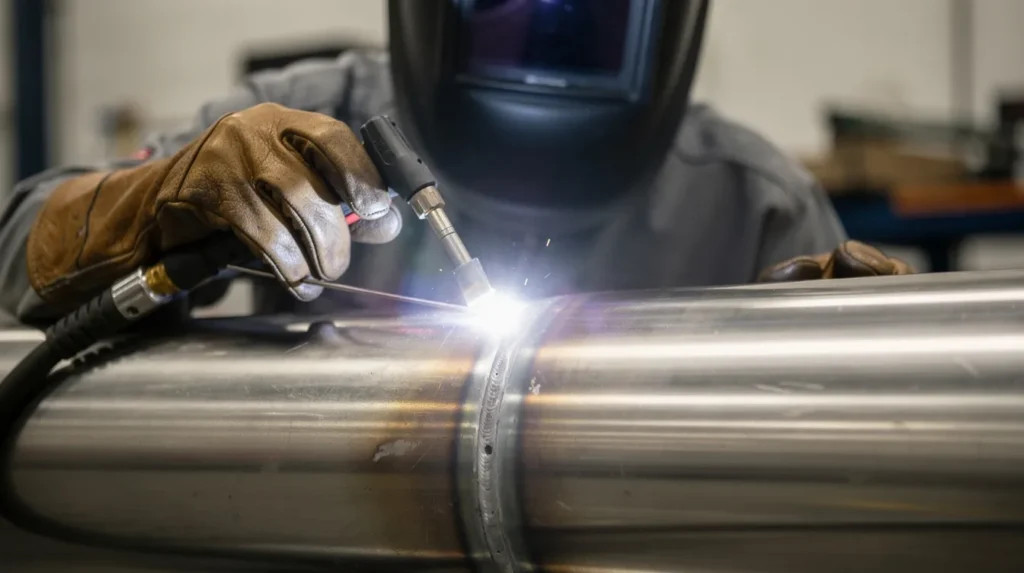
A nuclear welder spends the day preparing metal parts for welding (alignment, fit-up, surface cleaning), executing weld passes according to a Welding Procedure Specification (WPS), monitoring interpass temperature, and documenting every step. Nuclear welders must master both manual and automated welding techniques, because a single project might require hand-laid TIG root passes alongside mechanized orbital fill passes.
Each significant weld in nuclear construction is extensively documented for traceability and accountability. That means logging heat numbers, filler batch records, welder IDs, and inspection results for every joint.
Working Environments
The environments vary. You might work inside a containment building on reactor coolant system piping, in a turbine hall, in a fuel handling area, or in confined spaces requiring remote tools. Some tasks happen in high-dose radiation areas during outages, where time limits are strict and health physics teams monitor every minute. Shop welding for module fabrication or piping spools offers more controlled conditions, with better lighting, fewer interruptions, and no radiation exposure.
Nuclear welders ensure structural integrity of components that must perform under extreme conditions for decades. That responsibility shapes the culture: precision matters more than speed.
Connect & Level Up with TRX International
If you are interested in roles in nuclear space, reach out to the team at TRX International. We often have insights into upcoming outage needs and permanent staff positions before they hit the general job boards.
Soft Skills That Matter
Working 12-hour outage shifts with engineers, inspectors, and health physics staff means communication is non-negotiable. You need to adapt to changing schedules, maintain concentration under time pressure, and keep safety discipline even when fatigue sets in. Nobody wants a rework in a radiation area at 3 AM.
Typical Tasks of a Nuclear Welder
- Read and interpret WPS documents, isometric drawings, and materials specifications
- Perform multi-pass welds controlling heat input and interpass temperature
- Prepare surfaces, execute fit-up, and verify proper alignment
- Participate in inspection hold points, non destructive testing, and documentation
- Execute weld repairs or overlays during outages and life-extension programmes
- Coordinate with health physics teams for radiation-controlled work
Key Welding Applications in Nuclear Power Facilities
Primary Circuit Welding
Reactor Pressure Vessel nozzle safe-ends and hot/cold leg piping are among the most critical welds in any nuclear plant. These often involve dissimilar metal welds using nickel-based alloys (Alloy 182/82 historically, now replaced with Alloy 52/152 to resist stress corrosion cracking). Welds form pressure boundaries for radioactive materials and must endure thermal stress and high pressure over the full operating life. Nuclear welders prevent catastrophic failures in power plants by maintaining these boundaries.
Secondary Circuit Welding
Steam generators, feedwater nozzles, and heat exchangers demand high level weld quality on thick sections. SAW or narrow-gap GTAW is typically used, with mechanical properties verified to ASME Section III or equivalent codes.
Containment and Structural Welding
Containment shell liner welds, penetration seals, and structural brackets must maintain leak tightness under post-accident pressure loading. These are safety class welds with zero tolerance for porosity or incomplete fusion.
Life Extension, Uprates, and Decommissioning
Plants built in the 1970s-1990s need repair, modification, or weld overlays as part of life-extension programmes. Decommissioning generates thousands of jobs and requires cutting, capping, and sometimes welding waste containers.
Waste Packages and Fuel Cycle
Weld cladding enhances corrosion resistance in reactor components using specific alloy overlays. Spent fuel canister sealing, transport cask lid welds, and fuel rod end-plug fabrication all rely on precision welding to meet strict metallurgical and corrosion requirements.
Standards, Codes and Regulatory Framework for Nuclear Welding
Nuclear welding is regulated by ASME Section III standards, and the regulatory framework is layered. National regulators require operators to demonstrate that welding procedures and personnel meet applicable codes plus plant-specific technical specifications. Nuclear welding requires compliance with ASME Section III standards for any safety-related component.
Quality assurance frameworks like 10 CFR 50 Appendix B, NQA-1, and ISO 9001 dictate how documentation, audits, and material traceability are handled. Corrective action processes are part of the quality assurance requirements in nuclear welding, meaning any defect triggers a formal investigation and resolution chain.
A practical example: Class 1 pressure boundary welds on primary circuit piping in US PWRs must undergo full radiographic or ultrasonic examination. The NRC’s Code Case N-722-1 specifically addresses visual examination of Class 1 welds made with Alloy 600/82/182.
Main Nuclear Welding Standards by Region
| Standard | Region | Scope |
|---|---|---|
| ASME BPVC Section III | US / International | Nuclear facility component construction |
| ASME BPVC Section IX | US / International | Welding procedure and welder qualification |
| ASME BPVC Section XI | US / International | In-service inspection |
| RCC-M | France | Mechanical components for nuclear |
| EN / ISO Standards | Europe | Welder qualification (ISO 9606), design codes |
| NQA-1 | US (DOE, NRC) | Quality assurance in nuclear sector |
Welds in nuclear facilities must meet ASME Section III standards. National regulators (UK ONR, French ASN, Canadian CNSC) layer additional requirements on top.
Welding Procedure Qualification and Welder Certification
Nuclear welding is a highly specialized field essential to the safety and longevity of nuclear power plants. It demands precision, rigorous standards, and skilled professionals to ensure the integrity of critical reactor components.
How a Nuclear Welding Procedure Gets Qualified?
Welding Procedure Specifications (WPS) document the exact parameters required for safety-related welds. The qualification process follows a clear sequence.
- Step 1: A WPS is drafted, defining the joint geometry, base and filler materials, welding process, heat input limits, preheat temperature, interpass temperature, and post-weld heat treatment (PWHT) parameters.
- Step 2: Test welds are made under those exact conditions, generating a Procedure Qualification Record (PQR). These test coupons undergo destructive testing: tensile, bend, impact, and hardness tests. Non-destructive examination follows.
- Step 3: The qualified WPS is approved for production use, but only within the specific ranges tested. Change the material, thickness, or joint geometry beyond qualified limits, and you need a new PQR.
Welding Procedure Qualification is governed by ASME Section IX, which sets qualification rules for welding procedures and welders in the nuclear industry.
Nuclear applications add extra limits beyond what you’d see in conventional pressure vessel work: tighter heat input windows, specific filler compatibility requirements, and PWHT parameters matched to each material combination.
Welder Performance Qualification
Welders require certifications for nuclear environments. A welder typically qualifies under asme section ix by making test welds in specified positions (6G for pipe is common) across defined thickness ranges. Re-qualification happens periodically, or after any significant break in welding activity.
Common certifications include ASME IX qualifications, ISO 9606 (Europe), AWS certifications, plus utility-specific or site-specific approvals. Some positions also require security clearances and medical fitness clearance for work in radiological areas.
Quality Control and Inspection of Nuclear Welds
Quality assurance processes are critical in nuclear welding. The QC chain starts before the first arc strike and doesn’t end until an authorized inspector signs off.
Pre-weld: Fit-up inspection, joint geometry verification, preheat checks. In-process: Hold points after root passes or specified layers, dimensional checks, interpass temperature monitoring. Post-weld: Final dimensions, PWHT (if required), followed by NDT and acceptance.
Non-Destructive Testing Methods
Non-destructive testing is required for nuclear welds. Non-Destructive Examination (NDE) methods are the primary tool for ensuring integrity without destroying the component. Nuclear welding involves rigorous non-destructive testing (NDT), including:
- Visual (VT): First-line assessment of weld profile, undercut, surface defects
- Radiographic (RT): Internal defect detection in butt welds
- Ultrasonic (UT/PAUT/TOFD): Phased-array UT for dissimilar metal welds and thick sections; advanced UT widely used for safety-critical inspections
- Dye Penetrant (PT): Surface-breaking cracks and open discontinuities
- Magnetic Particle (MT): Near-surface defects in ferromagnetic materials
Advanced techniques like phased-array UT are standard for reactor coolant system nozzle welds. Automated inspection robots work in high-dose areas to reduce worker exposure. Every weld carries full traceability: heat numbers, filler batch records, welder IDs, calibration status of equipment, and weld history records preserved for the life of the plant.
Traditional vs Advanced Welding Technologies in Nuclear Reactor Repair
Welding in nuclear reactor construction is subject to extreme safety, regulatory, and material constraints. Traditional manual methods (GTAW, SMAW, SAW) remain the workhorses, but advanced technologies are gaining ground for repair, modification, and new construction.
Advanced Processes in Nuclear Welding
- Laser Beam Welding (LBW): Delivers high energy density with minimal heat input. Useful for narrow joints in RPV steels and sensitive alloys where distortion control is essential.
- Friction Stir Welding (FSW): A solid-state process that avoids large fusion zones, producing less residual stress. Promising for similar alloys and cladding applications.
- Hybrid Laser-Arc Welding: Combines laser precision with arc welding’s gap tolerance. Shows potential for nickel alloys and dissimilar metal joints.
- Automated Narrow-Gap GTAW/SAW: Mechanized systems that reduce weld volume, improve consistency, and cut filler metal consumption.
- Electron Beam Welding (EBW): Used in advanced manufacturing, though still under NRC qualification review for broader nuclear code acceptance.
Robotic welding techniques are increasingly important for consistency in nuclear construction projects, especially where repeatability matters more than adaptability.
The Challenge of Irradiated Materials
Neutron irradiation can lead to helium embrittlement in metals used in nuclear reactors. Existing welds may have heat-affected zones altered by decades of radiation exposure, with activated surfaces and locked-in residual stresses. Advanced processes like laser and FSW help minimize heat input and distortion during repair.
Example: Pressurizer Nozzle Repair
During a PWR refuelling outage, a dissimilar metal weld on a pressurizer hot leg nozzle shows a through-wall crack from Alloy 182 weld metal. The repair involves overlaying with Alloy 52/152 using automated narrow-gap GTAW, followed by phased-array UT to confirm crack removal. This approach cuts outage time compared to full nozzle replacement while improving long-term resistance to stress corrosion cracking.
Safety, Radiation Protection and Working Conditions for Nuclear Welders
Nuclear welding involves unique challenges due to the hazardous environment and strict safety requirements. Understanding these conditions is essential for welders working in nuclear facilities to ensure both personal safety and compliance with regulatory standards.
Radiological Hazards and Protection
Welders in nuclear plants face higher safety protocols due to radiation. Exposure comes from activated materials, coolant containing radionuclides, and residual radioactivity on surfaces. Radiation protection measures minimize exposure for workers during maintenance welding in operating nuclear plants.
The governing principle is ALARA: As Low As Reasonably Achievable. That means planning every weld task to minimize time in radiation fields, maximizing distance from sources, and using shielding wherever practical. Welders cooperate closely with health physics teams who monitor dose rates in real time.
Occupational dose limits sit at 50 mSv (5,000 mrem) per year in the US and similar levels in other jurisdictions. UK regulations designate workers as “classified persons” if they’re likely to exceed 6 mSv/year.
PPE and Working Conditions
Standard welding PPE (helmet, gloves, leathers) is supplemented with contamination suits, respiratory protection, and sometimes air-fed helmets or full SCBA for certain tasks. Dosimeters track whole-body and extremity exposure.
Outage work typically means 12-hour shifts, nights and weekends, in high temperatures or confined spaces on elevated platforms. Fatigue management is not optional. Medical surveillance tracks dose records over a welder’s entire career, and eligibility for certain work depends on current medical clearance.
Welders must follow strict safety protocols in nuclear facilities. There’s no shortcut culture here. The permit-to-work systems, the safety briefings, the toolbox talks: they exist because the consequences of cutting corners are measured in millisieverts and structural failures.
Career Pathways and Skills for Nuclear / Powerplant Welders
Entry Routes
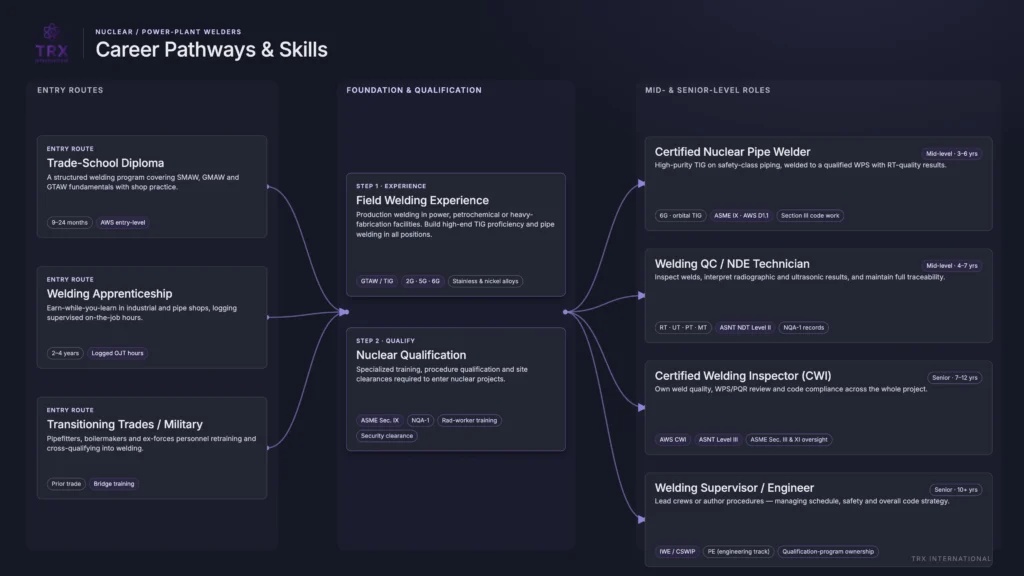
Most nuclear welders start with a trade school diploma or apprenticeship in general welding, gain practical experience in industrial or power facilities, then move into nuclear projects through specialized training and additional clearances. The required qualifications include high-end TIG proficiency, pipe welding in all positions (2G, 5G, 6G), familiarity with stainless and nickel alloys, and the ability to read complex isometric drawings.
Mid- and Senior-Level Roles
Career progression runs from nuclear welder to lead welder, welding supervisor, welding engineer, or QA/QC welding inspector. Field experience can also lead into planning, project management, or nuclear consulting roles. The highest paying nuclear jobs often go to those with both hands-on skills and code knowledge.
What Employers Want?
Core skills employers seek include specific certifications in ASME, EN, or RCC-M codes, MIG and TIG process competency, detail-oriented documentation habits, and strong knowledge of quality systems. Check out the top skills nuclear energy employers are looking for for a broader view.
Concrete Advice
- Obtain relevant codes training early. ASME IX qualification is the baseline for most positions.
- Keep certifications current. Lapsed qualifications mean lost opportunities.
- Log your weld hours carefully. Employers want to see documented experience.
- Gain outage experience if you’re targeting power plants. It’s a different animal from shop work.
- Train on both manual and automated techniques. The nuclear industry increasingly uses orbital and robotic systems.
UK nuclear welder salaries average around £31,726 annually, with ranges typically between £29,300 and £34,400. US nuclear technicians earn $100,000+, and reactor operators can exceed $120,000. Nuclear welders with coded qualifications and outage experience command premium rates.
Global Demand, Project Trends and Workforce Challenges
Global nuclear capacity stands at roughly 420 GW, with approximately 78 GW under construction in 15 countries. Half of that construction activity is in China. SMR deployment could reach 30 to 150 GW by 2050, depending on policy and investment trajectories.
These numbers translate directly into demand for qualified nuclear welders and powerplant welding specialists. The rise of Small Modular Reactors adds factory-fabricated module welding to the mix, alongside traditional site construction.
Workforce Challenges
The problems are real. Many experienced welders trained under older codes are nearing retirement. Training pipelines are slow because nuclear-grade competency requires years, not months. Meanwhile, shipbuilding, oil and gas, aerospace, and renewables all compete for the same skilled welders.
A 2025 US Department of Energy report found that 63% of manufacturing employers in nuclear power generation reported hiring was “very difficult.” The NEA’s 2026 report confirmed that tripling global nuclear capacity by 2050 will require massive workforce expansion.
Specific programmes driving demand right now: Hinkley Point C (UK EPR), Vogtle 3 & 4 (US AP1000), Barakah (UAE APR-1400), SMR demonstration projects in the UK, US, and Canada, and major decommissioning sites across Europe and North America.
How TRX International Supports Nuclear Welders and Employers?
TRX International is one of the best nuclear recruitment agencies and specialist nuclear headhunters for welding and fabrication roles across the global nuclear industry. Unlike generalist staffing firms, TRX focuses exclusively on nuclear, which means deeper knowledge of codes, clearances, and the technical requirements that matter for every position.
For Employers
TRX International sources cleared nuclear welders, powerplant welding supervisors, inspectors, and QA professionals for utilities, EPCs, OEMs, and decommissioning consortia. The company supports ramp-up before outages and major construction phases, building talent pipelines ahead of demand rather than scrambling when the clock starts ticking.
For Candidates
Candidate-focused services include career guidance for welders transitioning into nuclear from adjacent sectors, help with site approvals and security clearances, relocation support for international projects, and access to both contract and permanent roles. Whether you’re looking at reactor outage welding teams, SMR module fabrication shops, pressure vessel repair campaigns, or waste-package welding for decommissioning, TRX has the reach and the technical understanding to match you with the right project.
Get Ahead of the Curve
TRX International encourages both nuclear welders and hiring managers to engage early. Welders should register CVs and discuss career goals well before the next outage season. Employers should share forecast welding demand so TRX can build pipelines that deliver when they’re needed. Explore the full range of types of jobs in the nuclear industry to see where your skills fit.
Frequently Asked Questions (FAQs)
What certifications are required to become a nuclear welder?
Nuclear welders typically need certifications such as ASME BPVC Section IX qualification, ISO 9606, or RCC-M depending on the region. These certifications ensure welders meet the strict standards for welding procedures and performance required in nuclear facilities.
How does regulatory compliance affect nuclear reactor welding?
Regulatory compliance is critical in nuclear welding to ensure safety and structural integrity. Welds must adhere to codes like ASME Section III, and every weld is documented for traceability. Compliance also involves following environmental regulations and quality assurance processes.
What safety measures protect welders from radiation exposure?
Welders in nuclear plants follow strict radiation protection protocols, including using personal protective equipment (PPE), contamination suits, dosimeters, and working under ALARA principles. Health physics teams monitor radiation doses to minimize risk during maintenance welding in operating plants.
How do advanced welding technologies benefit nuclear reactor maintenance?
Advanced techniques such as automated orbital welding, laser beam welding, and friction stir welding reduce heat input, improve consistency, and minimize distortion. These technologies help maintain the integrity of reactor components while reducing outage times and risk.
Why is there a growing demand for nuclear welders globally?
The expansion of nuclear power capacity, new-build projects, SMR deployment, and decommissioning activities drive demand for skilled nuclear welders. Workforce challenges like retirements and competition from other industries make recruitment by specialist agencies like TRX International essential.
Next Steps for Aspiring and Experienced Nuclear Welders
Quick Checklist
- Strengthen core welding skills, especially TIG and pipe welding in all positions
- Pursue code qualifications (ASME IX, ISO 9606, or RCC-M as appropriate)
- Gain power plant or heavy industrial experience through installation and maintenance work
- Build outage experience if targeting operating nuclear plants
- Register with a specialist nuclear recruiter (not a generalist agency)
Experienced welders from shipbuilding, petrochemical, or offshore sectors should seriously consider transferring into nuclear welding. The project outlook spans decades. The emphasis on safety culture and precision, combined with premium pay, creates a career with real staying power. The tools and techniques transfer well, and the learning curve, while real, is manageable for anyone with solid fundamentals.
Nuclear reactor welding is both a critical engineering discipline and a rewarding career path. The technology keeps advancing, the global project pipeline keeps growing, and the demand for skilled welders shows no sign of slowing down. If you’re ready to explore roles in SMRs, large reactors, fusion, or decommissioning, contact TRX International to discuss your next move and find the right fit for your skills and ambitions.