
Advanced reactor fuel engineerSalary, qualifications, career path and hiring demand, 2026 edition
An advanced reactor fuel engineer designs, models, qualifies, and industrialises the nuclear fuel that makes a non-conventional nuclear plant viable. The work sits at the intersection of nuclear design, materials science, irradiation testing, manufacturing, and licensing: defining fuel limits, predicting behavior through burnup, converting test data into qualification evidence, and proving that HALEU, TRISO, metallic, or other novel nuclear fuel can be made repeatably. The role owns fuel behavior and nuclear compliance, not the whole reactor core.
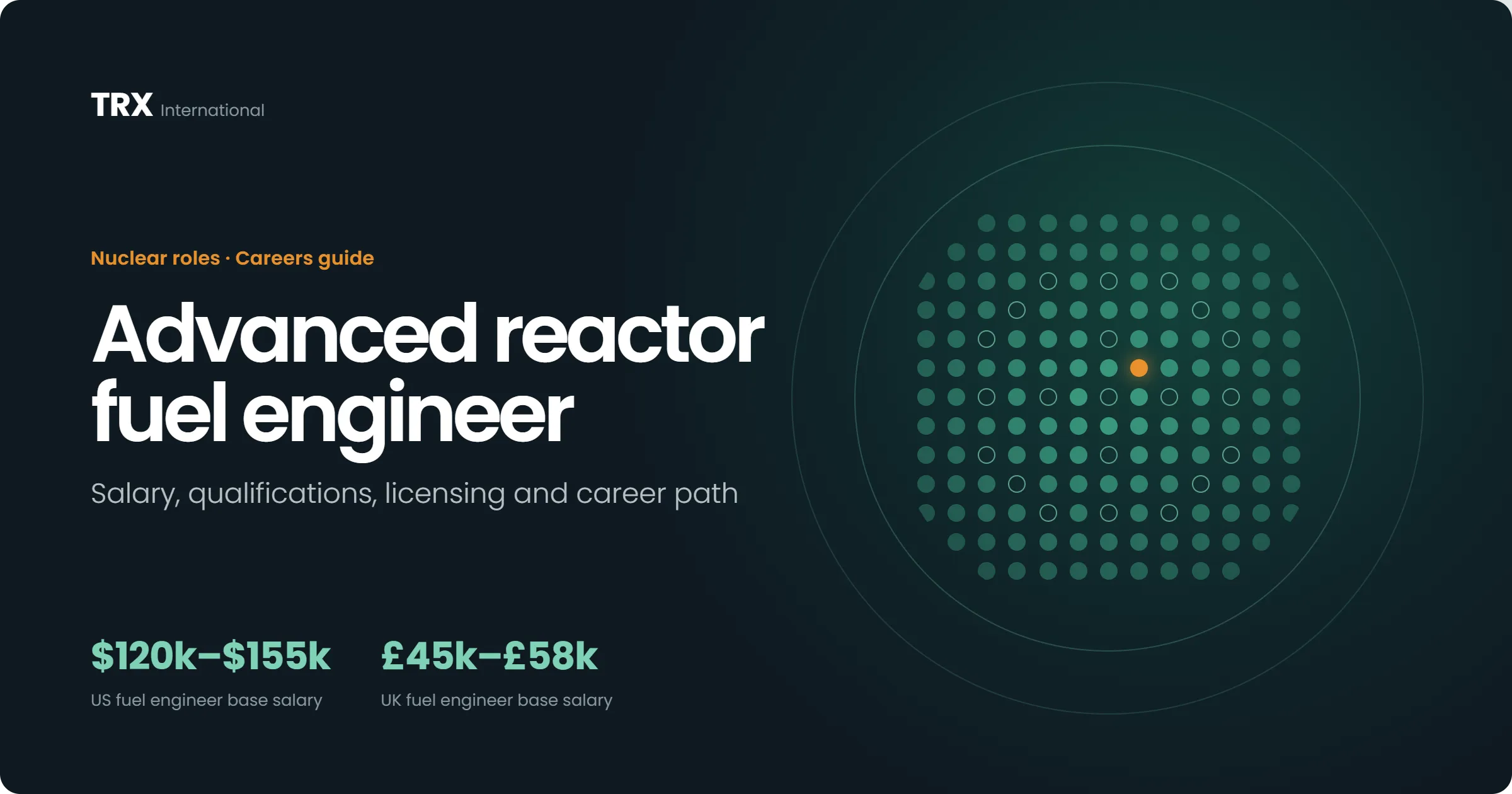
Advanced reactor fuel engineer jobs are a specialist market rather than a separately coded occupation. TRX models US base pay around $98,000–$225,000 depending on level, against the broader BLS nuclear-engineer median of $133,970. A live Framatome Advanced Fuel Neutronics Engineer posting is $100,000–$110,000; UK Rolls-Royce SMR fuel and core roles anchor the market from about £48,000 to £83,500.
There is no personal fuel-engineer licence. The real gates are demonstrable fuel-performance or fuel-design work, validated analysis methods, irradiation/qualification evidence, configuration-controlled calculations and enough nuclear-materials knowledge to defend assumptions. HALEU or Category II fuel-facility work can add security, export-control, radiation-worker and site-access requirements; CEng or PE helps at senior technical-authority level but is not the entry ticket.
The role at a glance
Everything an employer will ask about in the first fifteen minutes of a screening call.
- Also called
- advanced fuel engineer · nuclear fuel engineer · fuel performance engineer · TRISO fuel engineer · reactor fuel design engineer · core/fuel engineer
- Entry qualification
- BEng/BSc minimum in nuclear, materials, mechanical, chemical engineering or physics; MSc/PhD is common for fuel-performance, coatings and irradiation-heavy work.
- Typical entry pay
- $98,000–$125,000 (US TRX model) · £38,000–£50,000 (UK TRX model).
- Senior pay
- $175,000–$225,000 for principal/lead US roles · £63,000–£100,000 for UK principal through technical-authority roles.
- Contract day rates
- £550–£800/day for experienced fuel/performance work; £700–£950/day for qualification or technical-authority scopes; $90–$155/hr in the US specialist market.
- Professional gate
- No personal licence. Proven fuel design/performance calculations, V&V, irradiation evidence and nuclear-quality documentation are the real filters; CEng/PE becomes more useful with sign-off authority.
- Security
- UK BPSS common and SC possible on sensitive programmes. US export-control eligibility, badging and citizenship can apply to DOE/DoD or controlled fuel work; commercial roles vary.
- Where the work sits
- reactor developers, fuel vendors, national laboratories, test-reactor programmes and fuel-fabrication facilities, usually inside core design, fuels, materials or nuclear engineering employment.
- Travel
- Low to moderate in design roles; higher around fuel fabrication, irradiation campaigns, hot-cell/P.I.E. work, supplier qualification and regulator/test-facility reviews.
- TRX segments
- New technology development · SMR/AMR · Fuel cycle · Nuclear manufacturing · Research & demonstration · Operating fleet fuel innovation
Six versions of the same job title
"Advanced reactor fuel engineer" changes with the fuel form and the evidence gap. One employer needs particle-coating expertise; another needs metallic-fuel performance, qualification modelling or a manufacturing route that can survive licensing. Bar shows relative hiring volume across TRX's 2026 desk activity.
TRISO particle and compact fuel
Designing coated particles, compacts or pebbles; translating kernel/coating dimensions, defect fractions, fission-product retention and temperature limits into a qualified fuel specification for HTGRs, microreactors or FHRs.
HALEU metallic fast-reactor fuel
Fuel-pin and assembly engineering for sodium- or lead-cooled fast reactors, including metallic fuel behaviour, swelling, fission-gas release, cladding interaction, burnup limits and fabrication tolerances.
Fuel performance and qualification
Building and validating the analytical case that a fuel form remains within design limits through normal operation, transients and target burnup, then linking models to irradiation and post-irradiation examination data.
Advanced LWR / LEU+ fuel
Developing higher-enrichment, accident-tolerant or higher-burnup light-water-reactor fuel using new claddings, coatings, pellets or enrichments while preserving manufacturability and core compatibility.
Molten-salt and dissolved fuel
Working where fuel is also a chemical system: salt composition, redox control, actinide/fission-product behaviour, source terms, material compatibility and online or batch fuel-management assumptions.
Fuel manufacturing and industrialisation
Turning a laboratory fuel recipe into repeatable nuclear-grade production: process windows, criticality controls, equipment qualification, inspection, nonconformance disposition, material accountancy and production yield.
What the week actually looks like
A composite day for a mid-senior advanced reactor fuel engineer supporting a HALEU-fuelled demonstration programme, split between fuel-performance analysis, manufacturing evidence and qualification. Test-reactor windows and fabrication issues set the real priorities.
What advanced reactor fuel engineers are paid in 2026
There is no official wage series for "advanced reactor fuel engineer". The ladder below is a TRX market model anchored to BLS nuclear-engineer data and current specialist postings from Framatome, Rolls-Royce SMR and adjacent advanced-reactor employers. Base salary only; bonus/equity can be material at private developers.
How advanced reactor fuel engineering compares to adjacent roles
BLS rows are May 2025 official occupation data; the exact-role row is a TRX model and the Framatome row is a current live-posting midpoint, because advanced fuels are not separately coded.
| Occupation | Median | P10 | P90 | What moves the number |
|---|---|---|---|---|
| Advanced reactor fuel engineer | $148,000 | $98,000 | $225,000 | Fuel form, qualification ownership, HALEU/TRISO experience, irradiation evidence, technical authority |
| Nuclear engineers | $133,970 | $92,960 | $196,290 | Official BLS occupation anchor; reactor, analysis, licensing and operations roles combined |
| Materials engineers | $112,860 | $72,300 | $175,720 | Materials R&D and process depth; nuclear and high-temperature experience lift specialist pay |
| Advanced Fuel Neutronics Engineer (Framatome live range midpoint) | $105,000 | — | — | Current 2026 posting; early-career specialist fuel/neutronics scope |
Sources: US BLS OEWS May 2025 for Nuclear Engineers and Materials Engineers; 2026 Framatome live posting for the Advanced Fuel Neutronics Engineer anchor; TRX market model for the uncoded advanced-reactor fuel specialism. UK anchors include current Rolls-Royce SMR fuel-performance, fuel-assembly and core-design roles.
Qualified TRISO / novel fuel evidence
Engineers who can connect fabrication data, irradiation results, fuel-performance modelling and licensing acceptance are scarce because the chain takes years to build.
HALEU industrialisation
Fuel designers who understand enrichment, conversion/deconversion, criticality, transport, safeguards and manufacturability can prevent a reactor design from being stranded by its fuel supply.
Technical authority for qualification
Owning method V&V, design limits, nonconformance decisions and regulator-facing fuel evidence commands more than producing calculations inside somebody else's framework.
Three ways in, and only one of them starts with a fuel degree
Advanced fuel engineering is entered through nuclear engineering, materials science, reactor physics or fuel manufacturing. The common denominator is evidence: calculations linked to real material, real irradiation or real production data.
Graduate fuel-performance route
The most direct engineering path.
Materials / PhD route
Strong for TRISO, coatings, cladding and irradiation science.
Reactor physics or manufacturing transfer
A strong lateral route when the evidence is fuel-specific.
Are you actually ready to compete for an advanced reactor fuel engineer role?
A fuels shortlist is evidence-heavy. Your CV has to show the fuel form, analysis or test owned, and which limit or qualification decision changed because of your work. "Supported fuel design" without the code, irradiation/manufacturing evidence, material system or deliverable usually loses to a candidate who makes those specifics visible.
Free resume scoring on avua. Your score is yours; it is not shared with employers.The strongest CVs name the fuel form, enrichment, analysis method, irradiation/manufacturing evidence and exact technical decision owned. "Fuel experience" is too broad.
Illustrative TRX shortlisting pattern only. Your own score is generated by avua from your CV and the role you are targeting.
The credentials that actually gate the work
This role is gated less by certificates than by controlled nuclear-fuel evidence: validated methods, material/fabrication knowledge, qualification history and the access conditions attached to HALEU or test-facility work.
| Credential | Jurisdiction | Required for | Time | Notes |
|---|---|---|---|---|
| Engineering / science degree | All | Entry | 3–5 yrs | Nuclear, materials, mechanical, chemical engineering or physics are the common bases. |
| MSc / PhD | All | R&D-heavy fuel roles | 1–5 yrs extra | Common for coatings, irradiation science and fuel modelling; not mandatory for all design roles. |
| Fuel-performance / design competence | All | Independent technical work | 2–6 yrs | Demonstrated controlled calculations and design-limit ownership matter more than a generic nuclear title. |
| CEng / PE | UK / US | Senior sign-off / credibility | 4–7 yrs | Helpful for technical-authority roles; not a legal requirement for most fuel-engineer jobs. |
| SQEP / technical-authority designation | UK | Design approval / retained authority | Role-specific | Employer appointment based on competence and scope. |
| BPSS / SC / DV | UK | Site / sensitive programme access | 2–20 wk+ | BPSS is common; higher clearance depends on programme sensitivity. |
| Export-control / citizenship eligibility | US | DOE/DoD or controlled technology | Role-specific | Some advanced-reactor and fuel programmes restrict access; commercial roles vary. |
| Radiation worker / nuclear material facility training | US / UK | Fuel fabrication, hot cell, test reactor access | Days–weeks | Site-specific training can include contamination control, criticality and material-accountability requirements. |
A fuel engineer is not an NRC-licensed operator. Part 70 licences attach to US fuel-cycle facilities, not to the individual engineer; personal access, material-control and radiation-worker requirements depend on the facility and task.
What appears on a 2026 advanced reactor fuel engineer shortlist
The shortlist is looking for proof that you can connect fuel physics, material behaviour, test evidence and manufacturing reality without losing configuration or uncertainty control. Ordered by how often a hiring manager treats it as a hard filter rather than a nice-to-have.
Named on the specification
- Fuel-performance modelling — BISON, FRAPCON/FAST or equivalent thermo-mechanical fuel code; credible setup, convergence, sensitivities and interpretation rather than button-pushing
- Neutronics and depletion interface — SCALE/ORIGEN, MCNP, Serpent, OpenMC or vendor methods for isotopics, power histories, burnup and source terms
- Fuel design limits — Temperature, stress/strain, swelling, fission-gas release, coating failure, cladding interaction, dimensional stability and transient margins appropriate to the fuel form
- Irradiation and P.I.E. — Experiment definition, dosimetry/temperature history, specimen traceability, hot-cell data interpretation and model-to-test comparison
- Materials behaviour — TRISO coatings/SiC, ceramics, metallic fuels, cladding, corrosion, fission products, irradiation damage or salt/fuel chemistry as applicable
- Qualification and licensing evidence — V&V matrices, uncertainty, applicability ranges, design criteria, topical-report inputs, safety-case interfaces and auditable calculation records
- Manufacturing and nuclear quality — Specifications, process windows, inspection/acceptance, nonconformance disposition, NQA-1/quality arrangements and supplier interfaces
- HALEU / criticality awareness — Enrichment, material form, criticality controls, transport/storage interfaces and why fuel supply constraints can change the engineering design
- Configuration and data control — Requirements traceability, controlled models, versioned material properties, calculation checking and defensible assumptions
What decides between two shortlisted candidates
- Qualified TRISO experience — Particle/compact/pebble manufacturing plus irradiation and fission-product-retention evidence
- Metallic fast-reactor fuel — U-Zr or equivalent metallic-fuel behaviour, sodium compatibility, cladding interaction and high-burnup evidence
- HALEU fuel-facility delivery — Experience turning enriched feedstock into licensed, repeatable production rather than treating HALEU as a procurement line item
- Fuel-performance code V&V — Owning validation against irradiation/P.I.E. data and defending the applicability envelope
- First fuel manufacture — Hands-on support to process qualification, hold points, lot acceptance and disposition of real production deviations
- Regulator-facing fuel case — Topical-report, Part 70, reactor licensing or safety-case work where fuel assumptions were directly challenged
The 2026 demand map
Advanced fuel demand follows reactor deployment, but it also follows the slower infrastructure underneath it: HALEU enrichment, fuel fabrication, irradiation, post-irradiation examination and regulator acceptance. In 2026 those chains are scaling at the same time.
| Programme | Location | Phase in 2026 | Engineering demand |
|---|---|---|---|
| TRISO-X TX-1 / X-energy | Oak Ridge, Tennessee | Part 70 licence issued; facility under construction | Very high: TRISO scale-up, qualification, HALEU fabrication, process and quality engineering |
| Xe-100 / Dow demonstration | Seadrift, Texas + INL | Construction-permit review; TRISO irradiation ongoing | High: fuel performance, irradiation data, qualification and core/fuel interfaces |
| TerraPower Natrium | Kemmerer, Wyoming | Construction permit approved; final design / fuel development | Very high: HALEU metallic fuel, pin/assembly design, performance, fabrication and licensing |
| GNF-A Natrium fuel fabrication | North Carolina, US | Fuel-facility licensing / amendment development | High: HALEU fuel process, criticality, safeguards, qualification and production engineering |
| BWXT Specialty Fuels / Project Pele / Antares | Lynchburg, Virginia + INL | TRISO production; Antares criticality milestone achieved | Very high: TRISO manufacture, compacts, HALEU processing, QA and demonstration fuel |
| Kairos Power Hermes / Hermes 2 | Tennessee | Construction permitted / build programme; fuel methods V&V | High: TRISO pebble fuel, KP-BISON performance, salt environment and qualification evidence |
| Standard Nuclear TRISO network | Oak Ridge, Idaho, Richland | Production and new facilities scaling through 2026 | High: TRISO process engineering, commissioning, qualification, nuclear material controls |
| Urenco Advanced Fuels Facility | Capenhurst, UK | HALEU facility design; LEU+ trial production completed | High upstream demand: enrichment, chemistry, process, criticality and advanced-fuel interfaces |
| Rolls-Royce SMR core & fuel | Derby / Manchester / Warrington, UK | Detailed design, GDA and Wylfa deployment preparation | High: fuel performance, assemblies/control rods, core design and safety limits |
| Rolls-Royce / UKNNL / JAEA coated-particle fuel | UK / Japan | 2026 cooperation on AMR and CPF qualification/manufacture | Growing: coated-particle fuel R&D, qualification, manufacturing science and test evidence |
Programme phases move. The table reflects public 2026 programme and licensing positions; confirm current hiring and site status before making a relocation decision. Fuel demand can remain high even before reactor construction because qualification and manufacturing lead deployment by years.
The bottleneck has moved from reactor concept to qualified fuel supply
Hiring is strongest where a developer must prove fuel can be manufactured repeatably, survive its irradiation envelope and scale commercially. TRISO-X, BWXT, Standard Nuclear, Natrium and the UK HALEU build-out all show that fuel is programme infrastructure. Candidates spanning analysis, qualification and manufacturing have more options than single-tool analysts.
People who have closed the loop from model to irradiation to production
Many engineers can learn a fuel code; far fewer have designed an irradiation, interpreted P.I.E., dispositioned manufacturing deviations and updated a qualified method or limit. That loop takes years and access to rare facilities, which is why developers and fuel vendors compete for the same small pool.
Adjacent and onward roles
Advanced fuel engineering sits between core design, materials, manufacturing and licensing. These are the closest specialist and progression moves.
Questions we get asked every week
How much does an advanced reactor fuel engineer earn in 2026?
TRX models US base pay from about $98,000 at entry to $225,000 for principal/lead fuel engineers. The BLS nuclear-engineer median is $133,970 and a live 2026 Framatome Advanced Fuel Neutronics Engineer role is $100,000–$110,000.
The UK model runs roughly £38,000–£100,000, anchored by current Rolls-Royce SMR fuel roles.
Do you need a PhD to become an advanced reactor fuel engineer?
No. A strong BEng/MEng plus fuel-performance, core-design or manufacturing evidence is enough for many engineering roles.
A PhD becomes more common in TRISO coating science, irradiation materials, mechanistic fuel modelling and research-heavy qualification work, where the employer is committed to hiring depth in a narrow phenomenon rather than general design capability.
Do advanced reactor fuel engineers need a licence or security clearance?
There is no individual NRC fuel-engineer licence. Employers gate the role through competence, controlled calculations and facility access.
BPSS is common in UK nuclear programmes and SC can apply; US HALEU, DOE, DoD or export-controlled work may require citizenship or other eligibility, plus site-specific radiation-worker, criticality and material-control training.
What is the difference between a fuel engineer and a reactor physics engineer?
Reactor physics engineers calculate reactivity, power distribution, depletion and core behaviour.
Fuel engineers take those histories and determine whether the physical fuel remains within temperature, stress, swelling, fission-product, coating or cladding limits, then connect the model to irradiation and manufacturing evidence. The titles can overlap; the technical ownership is different.
Which advanced reactor fuel types are creating the most demand in 2026?
TRISO and HALEU-based fuels are the clearest hiring signal as X-energy/TRISO-X, BWXT, Standard Nuclear and Kairos move qualification or production. Natrium adds demand for HALEU metallic fast-reactor fuel.
UK demand centres on Rolls-Royce SMR fuel/core work, Capenhurst HALEU and emerging coated-particle AMR development.
What skill adds the most value to an advanced reactor fuel CV?
Closed-loop qualification evidence is the differentiator: show the fuel model, irradiation/P.I.E. data, manufacturing limit, V&V decision and resulting design change.
Code names help, but "BISON/MCNP experience" alone does not. Recruiters want the technical limit, specification or qualification decision you actually owned.
We only recruit in nuclear. That is the whole point.
TRX works across reactor design, advanced fuels, fuel-cycle infrastructure, manufacturing, new build and operating nuclear in 14+ countries. Send us your CV and we will tell you honestly whether your evidence fits fuel performance, TRISO/advanced-fuel development, core design, fuel manufacturing or the wider advanced-reactor market — and what that experience is worth.