
Nuclear apprentice trainerSalary, qualifications, career path and hiring demand, 2026 edition
A nuclear apprentice trainer transforms occupational standards into comprehensive training that ensures safe, practical learning for the next generation of nuclear equipment operators. The role involves teaching technical theory, demonstrating plant and workshop tasks, coaching apprentices through practical exercises, reviewing evidence, tracking progress, and helping each learner become ready for workplace assessment and end-point assessment. This position is responsible for developing capability and may carry out formative or employer-based assessment, while final occupational competence must be confirmed through the approved assessment and authorisation arrangements. Trainers maintain rigorous training records and comply with regulatory requirements to support employment readiness in the nuclear field.
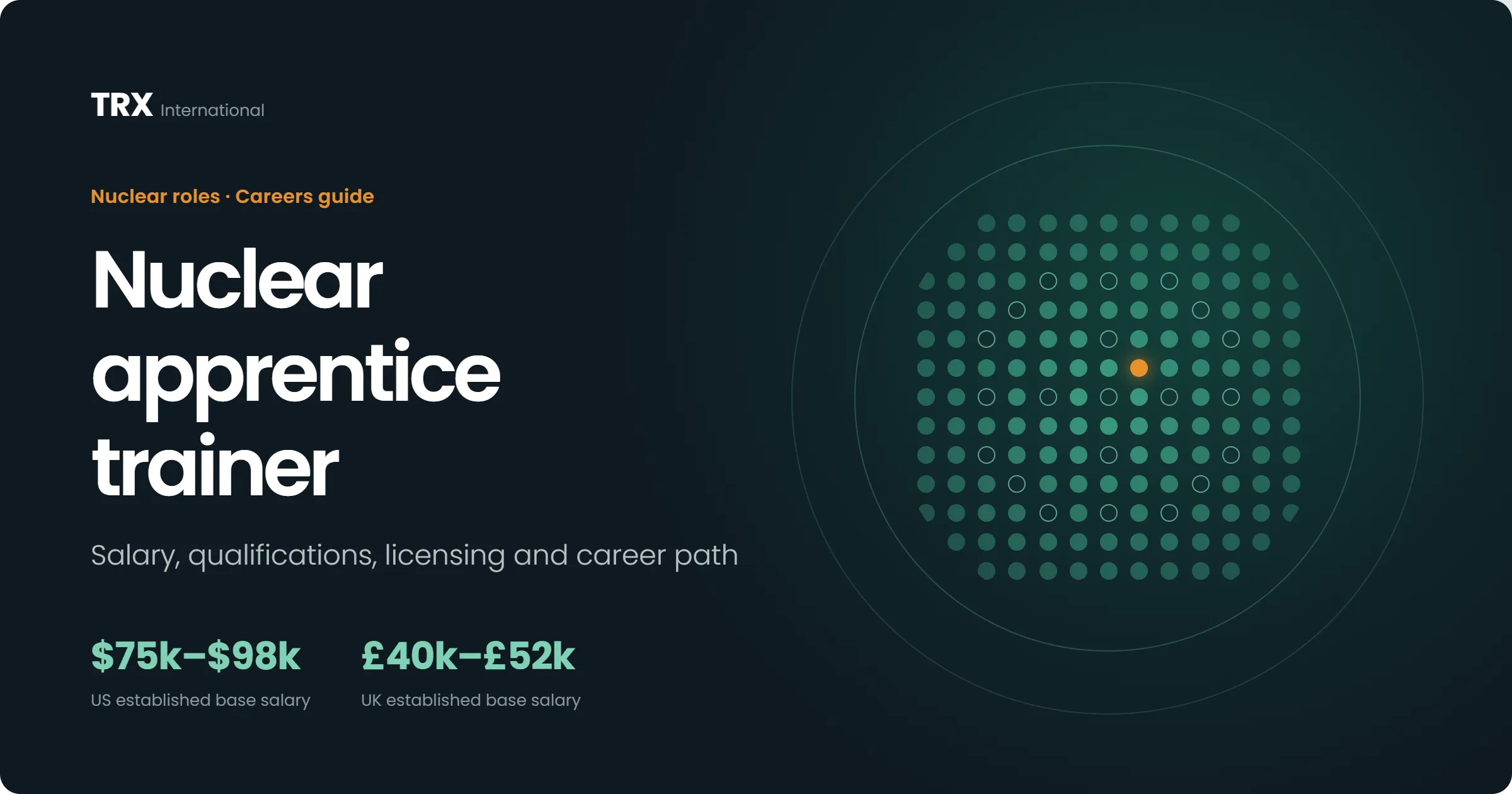
Established UK nuclear apprentice trainers are modelled around £40,000–£52,000 base, rising to £48,000–£62,000 for senior trainers and higher for programme leads. General UK Apprentice Trainer pay is materially lower, at about £29,700 average in 2026, but nuclear trainers are usually experienced technical practitioners and often hold teaching / assessor credentials. In the US, comparable nuclear craft and technical trainers are modelled around $75,000–$98,000, with current nuclear training-specialist benchmarks around $90,000.
The practical gate is occupational credibility plus teaching capability. Employers commonly want a recognised technical apprenticeship, engineering / operations experience, Level 3 teaching or assessor qualifications, and evidence of coaching apprentices safely in workshops or nuclear environments. For England apprenticeships, trainers must understand the current occupational standard, required off-the-job training, knowledge / skills / behaviours, portfolio evidence and gateway to independent end-point assessment.
The role at a glance
everything an employer will ask about in the first fifteen minutes of a screening call.
- Also called
- Apprentice trainer · technical trainer · trainer / assessor · engineering trainer · apprenticeship coach · vocational trainer · skills instructor
- Entry qualification
- Usually a completed engineering, operations, maintenance, health-physics, fabrication or other technical apprenticeship plus several years of occupational experience. Degree routes exist for higher-level apprentice programmes.
- Typical entry pay
- $62,000–$78,000 US comparable technical-trainer level · £34,000–£42,000 UK at junior trainer / assessor level.
- Senior pay
- $90,000–$115,000 US senior trainer and $105,000–$135,000 lead scope · £48,000–£62,000 UK senior trainer and £58,000–£72,000 apprenticeship lead.
- Contract day rates
- £300–£425/day experienced delivery; £425–£575/day specialist / senior programme work; $50–$95/hr US technical training support.
- Professional gate
- Recognised occupational competence plus an employer-approved trainer route; Level 3 Award in Education and Training, CAVA / assessor qualifications or equivalent frequently strengthen applications.
- Security
- BPSS / SC is common for UK nuclear apprenticeships; apprentices and trainers may also need medical, site-access and radiological clearances depending on practical work.
- Where the work sits
- Nuclear skills academies, site training centres, employer training teams, colleges, apprenticeship providers and operational / maintenance departments.
- Travel
- Moderate. Trainers often split time between classroom, workshop, plant, college and employer sites.
- TRX segments
- Operating fleet · Decommissioning · Fuel cycle · Large new build · Nuclear manufacturing · Defence nuclear · Radioactive waste management
six versions of the same job title
the trainer must be credible in the occupation being taught. A nuclear operator apprentice trainer and a welding-inspection trainer use similar learning methods but cannot substitute for one another without relevant technical competence.
Nuclear operator apprentice training
Develops apprentices for plant operation, decommissioning and process duties. Training covers safe systems of work, procedures, plant systems, human performance, radiation fundamentals, alarms, waste, communications and practical plant operation.
Engineering maintenance apprentice training
Teaches electrical, mechanical, instrumentation / control, machining or maintenance apprentices through workshop fundamentals and increasingly complex plant tasks. Practical demonstrations, fault-finding and safe work standards dominate.
Health physics / radiation protection apprentice training
Supports apprentices learning contamination control, radiation measurement, PPE, controlled-area behaviour and practical monitoring. Technical accuracy and nuclear safety culture are essential because poor habits can become embedded early.
Welding / fabrication / inspection apprentice training
Builds specialist fabrication, welding or inspection skills used across nuclear manufacturing and construction. Trainers may support workshop qualifications, NDT awareness, codes / standards and preparation for higher-level occupational assessment.
Nuclear technician / degree apprenticeship training
Works with Level 5 / 6 apprentices combining academic learning with technical placements. The trainer coordinates practical competence, professional behaviours, evidence and employer learning alongside university or college delivery.
Defence nuclear / specialist craft apprentice training
Develops apprentices for naval nuclear, weapons-establishment, dockyard and classified manufacturing environments. Security, local rules and employer-specific qualification pathways add to the national apprenticeship standard.
What the week actually looks like
a composite day for a Nuclear Apprentice Trainer delivering Level 2–4 engineering and nuclear-operational learning across a training centre and site environment.
What nuclear apprentice trainers are paid in 2026
“Nuclear apprentice trainer” is not separately coded in national salary statistics. These ladders are a TRX market model anchored to current engineering trainer / assessor hiring, broad apprentice-trainer data and nuclear training-specialist pay.
How Nuclear Apprentice Trainer compares to adjacent roles
Broad apprentice-trainer salary data understates specialist nuclear training because many nuclear trainers arrive after a skilled technical career. TRX therefore applies a nuclear / engineering premium while keeping the role below formal training-management levels.
| Occupation | Median | P10 | P90 | What moves the number |
|---|---|---|---|---|
| Nuclear apprentice trainer | £46,000 | — | — | Technical discipline, nuclear site experience, teaching / assessor scope |
| UK Apprentice Trainer, broad 2026 market | ~£29,700 average | ~£18,000 | ~£56,700 | Broad all-sector data, including lower-paid non-technical training |
| UK Engineering Assessor, 2026 vacancy | £40,000 | — | — | Levels 2–4 engineering apprenticeships and field-based delivery |
| Savannah River Nuclear Solutions Training Specialist | ~$90,000 average | — | — | Nuclear technical training and DOE-site context |
| Nuclear Competency Assessor | £52,000 TRX model median | — | — | Independent competence judgement rather than developmental training |
Broad apprentice-trainer salary data understates specialist nuclear training because many nuclear trainers arrive after a skilled technical career. TRX therefore applies a nuclear / engineering premium while keeping the role below formal training-management levels.
Current occupational credibility
trainers with recent plant, workshop or radiation-protection experience command more than generic vocational tutors because apprentices learn from authentic practice.
Trainer-plus-assessor capability
recognised teaching and workplace-assessor qualifications allow the employer to use one person across development, formative assessment and employer competence activity where independence permits.
Multi-standard / academy delivery
trainers who can support several technical pathways, coordinate employers and contribute to programme design sit at the top of the market.
Three ways in
Nuclear apprentice trainers are usually practitioners first and trainers second. Employers prefer people who have done the job safely before teaching it to others.
Skilled craft / technician to trainer
Nuclear operator / health physics route
College / apprenticeship-provider route
Are you actually ready to compete for a nuclear apprentice trainer role?
The CV must prove both technical credibility and learner outcomes. State the occupation you came from, apprentice standards delivered, class / cohort size, practical modules taught, assessor or teaching qualifications, completion / gateway outcomes and how you supported learners who were falling behind. Nuclear employers want evidence that you can teach safe work habits, not simply present slides.
Free resume scoring on avua. Your score is yours; it is not shared with employers.“Delivered engineering training” is generic. “Trained 36 Level 3 maintenance apprentices through practical modules, with 94% reaching gateway on schedule and zero safety-related workshop incidents” is shortlist evidence.
Illustrative TRX shortlisting pattern only.
The credentials that actually gate the work
Trainers need sufficient technical and educational competence for the programme they teach. Apprenticeship funding and EPA rules also create governance requirements beyond ordinary internal training.
| Credential | Jurisdiction | Required for | Time | Notes |
|---|---|---|---|---|
| Relevant technical apprenticeship / occupational qualification | UK / global | Practical technical training | 2–5 yrs | Employers expect trainers to understand the occupation from experience. |
| Level 3 Award in Education & Training or equivalent | UK | Common trainer credential | Months–1 yr | More advanced teaching qualifications can strengthen college / academy roles. |
| Level 3 CAVA / assessor qualification or equivalent | UK | Workplace assessment activity | Months–1 yr | Needed where the trainer formally assesses competence within scope. |
| Apprenticeship-standard / KSB knowledge | England | Apprenticeship delivery | 1–2 yrs practical depth | Trainers must map learning to current knowledge, skills and behaviours. |
| EPA / gateway rules knowledge | England | Completion readiness | 1–2 yrs | Independent EPA organisations conduct final EPA under the applicable standard. |
| Nuclear site / occupational competence | UK / US | Nuclear-specific practical delivery | 3–7 yrs | Operations, maintenance, HP, fabrication or another pathway-specific discipline. |
| BPSS / SC / medical / site access | UK | Nuclear site practical training | Weeks–months | Requirements depend on site, learner activity and access. |
A trainer can hold assessor credentials without being the independent end-point assessor. Good governance makes clear whether a person is teaching, carrying out employer assessment, verifying evidence or acting on behalf of an approved EPA organisation.
What appears on a 2026 nuclear apprentice trainer shortlist
Hiring managers screen for trainers who can turn technical expertise into structured learner development without weakening safety, evidence or apprenticeship standards.
Named on the specification
- Practical technical instruction — safe demonstrations, supervised practice, coaching, task breakdown and correction of unsafe habits
- Classroom / theory delivery — explaining nuclear fundamentals, procedures, drawings, systems and occupational knowledge clearly
- Apprenticeship standard mapping — linking learning activities to current knowledge, skills and behaviours
- Learner progress management — reviews, action plans, support, attendance, evidence and gateway readiness
- Portfolio and evidence coaching — helping apprentices produce authentic, relevant evidence without writing it for them
- Training records and compliance — LMS / e-portfolio, off-the-job learning, assessment records, safeguarding and audit-ready documentation
What decides between two shortlisted candidates
- Nuclear operative / health physics standard experience — direct delivery of nuclear-specific apprenticeship pathways
- Electrical / mechanical / I&C workshop authority — strong practical craft credibility in scarce disciplines
- Trainer and assessor qualifications — ability to support learning plus formal workplace assessment within approved scope
- Nuclear safety culture and human performance — embedding conservative decision-making and procedural adherence from day one
- Apprentice recovery / additional-learning support — evidence of improving outcomes for learners who initially fell behind
- Programme design / academy mobilisation — building new modules, workshop facilities or employer-provider delivery models
The 2026 demand map
Demand follows the scale of apprentice intake and the sector’s need to replace experienced workers while expanding new build, fuel-cycle, decommissioning and defence capability.
| Programme | Location | Phase in 2026 | Engineering demand |
|---|---|---|---|
| Sellafield apprenticeship programme | Cumbria, UK | 750+ apprentices across 24 pathways | Very high — sustained requirement for nuclear, engineering, science and project trainers |
| Sellafield Nuclear Operator pathway | Cumbria, UK | Active 2026 Level 2 intake | Very high — classroom, practical, workplace and portfolio development over 24 months |
| Westinghouse Springfields | Lancashire, UK | 2026 apprentice recruitment open; long-established academy | Very high — engineering, process, laboratory and degree apprenticeships |
| Sizewell C | Suffolk / UK | Construction mobilisation | Very high — project has pledged 1,500 apprenticeships during construction |
| Hinkley Point C | Somerset, UK | Construction / commissioning transition | High — large early-careers pipeline moves toward technical and commissioning competence |
| NDA group / NRS / NWS | UK estate | Long-term decommissioning and waste mission | Persistent — apprentice pipelines protect specialist capability over decades |
| UK defence nuclear enterprise | Barrow / Derby / Faslane / Aldermaston and wider UK | Major workforce expansion | Very high — craft, engineering and nuclear-skills apprenticeships are a core supply route |
| US DOE nuclear sites | South Carolina / Idaho / New Mexico and wider US | Operations, cleanup and mission expansion | High — craft / technical training supports workforce renewal |
| Advanced-reactor manufacturing | US / UK | FOAK build and supply-chain scale-up | Rising — new production skills require structured entry-level technical development |
Demand follows the scale of apprentice intake and the sector’s need to replace experienced workers while expanding new build, fuel-cycle, decommissioning and defence capability.
apprenticeships are now workforce infrastructure.
Sellafield supports more than 750 apprentices across 24 pathways and has trained thousands over decades; Westinghouse Springfields has trained almost 2,000 apprentices since 1950; Sizewell C has committed to 1,500 apprenticeships during construction. These are not small early-career schemes. They are long-term workforce supply systems, and trainer capacity directly limits how quickly new entrants become productive.
trainers who still understand the work.
Apprenticeship professionals can teach portfolio process, and senior nuclear workers can demonstrate technical tasks. The scarce profile combines both: current enough technically to command apprentice respect, but skilled enough educationally to explain, coach and assess beginners without assuming knowledge. That crossover is what nuclear training academies compete for.
Adjacent and onward roles
Apprentice training can progress toward competence assessment, technical training leadership, early careers or wider learning and capability roles.
Questions candidates genuinely search or ask recruiters
How much does a Nuclear Apprentice Trainer earn in 2026?
TRX models established UK nuclear apprentice trainers at roughly £40,000–£52,000 base, with senior trainers around £48,000–£62,000. That sits above broad UK Apprentice Trainer data, which averages about £29,700, because nuclear roles usually require significant occupational experience and technical qualifications related to nuclear power plant operations and plant equipment. Comparable US nuclear craft / technical trainers are modelled around $75,000–$98,000, with nuclear Training Specialist benchmarks around $90,000.
What is the difference between a Nuclear Apprentice Trainer and a Nuclear Competency Assessor?
The trainer develops the apprentice through teaching, demonstrations, coaching, practice and progress reviews focused on safety procedures and equipment handling. A competency assessor makes formal judgements against defined competence criteria to ensure compliance with safety regulations. One person may be qualified to perform both functions in parts of a programme, but the roles should remain clear. For English apprenticeships, final end-point assessment is delivered under the approved EPA arrangements rather than simply by the apprentice’s everyday trainer.
Do you need an assessor qualification to train nuclear apprentices?
Not always for pure teaching, but it is highly valuable and may be required where the job includes formal workplace assessment. UK employers often recognise CAVA or equivalent assessor credentials. A teaching qualification such as Level 3 Award in Education and Training can strengthen the delivery side. Neither replaces occupational competence in the engineering, operations or nuclear discipline being taught, including knowledge of local laws and federal regulations.
Which nuclear apprenticeships can a trainer work on?
Common pathways include Nuclear Operative, Nuclear Health Physics Monitor, engineering maintenance, welding / inspection, Nuclear Technician and Nuclear Scientist / Nuclear Engineer routes. Sellafield’s current programme spans 24 pathways, while Westinghouse Springfields recruits engineering, process, laboratory and degree apprentices. Trainers are normally authorised only for standards and technical content they are competent to deliver, including training on control room operations and other equipment.
Why is apprentice training important to the nuclear sector in 2026?
The sector is expanding while many experienced workers are approaching retirement. Sellafield has more than 750 apprentices in training, Sizewell C has pledged 1,500 apprenticeships during construction, and defence nuclear, SMRs and decommissioning programmes all need long-term skills pipelines. Apprenticeships allow employers to build nuclear safety culture, human performance, and technical competence from the start rather than competing only for the same experienced hires.
What experience most improves a Nuclear Apprentice Trainer CV?
Show both occupational credibility and learner outcomes. Name the technical discipline, apprenticeship standards delivered, trainer / assessor qualifications, cohort size, practical modules, completion or gateway results and examples of coaching struggling learners. Nuclear employers particularly value trainers with recent plant or workshop experience, strong safety culture, portfolio / EPA knowledge and evidence that apprentices became competent rather than merely completing courses. Highlight transferable skills and knowledge of federal and local laws regarding safety regulations, sexual orientation, gender identity, national origin, and protected veteran status to ensure compliance and inclusivity.
We only recruit in nuclear. That is the whole point.
TRX can distinguish apprentice training from competency assessment, technical instruction, early-careers management and wider learning and development. Send us your CV and we will assess whether your evidence fits nuclear apprentice training, trainer / assessor, qualification or skills-development roles.