
Nuclear knowledge management specialistSalary, qualifications, career path and hiring demand, 2026 edition
A nuclear knowledge management specialist protects the technical know-how an organisation cannot afford to lose. The role identifies critical nuclear knowledge, maps where it sits, assesses knowledge-loss risk, captures tacit expertise from specialists, structures knowledge organization systems, supports knowledge sharing networks and designs transfer plans for successors. In nuclear, the work matters because plants, designs, safety cases and decommissioning missions last far longer than individual careers. The distinction is crucial: document management controls printed and electronic information; knowledge management preserves the reasoning, context, judgement and experience people need to use those records correctly, facilitating sustainable education and implementing knowledge management across the nuclear life cycle.
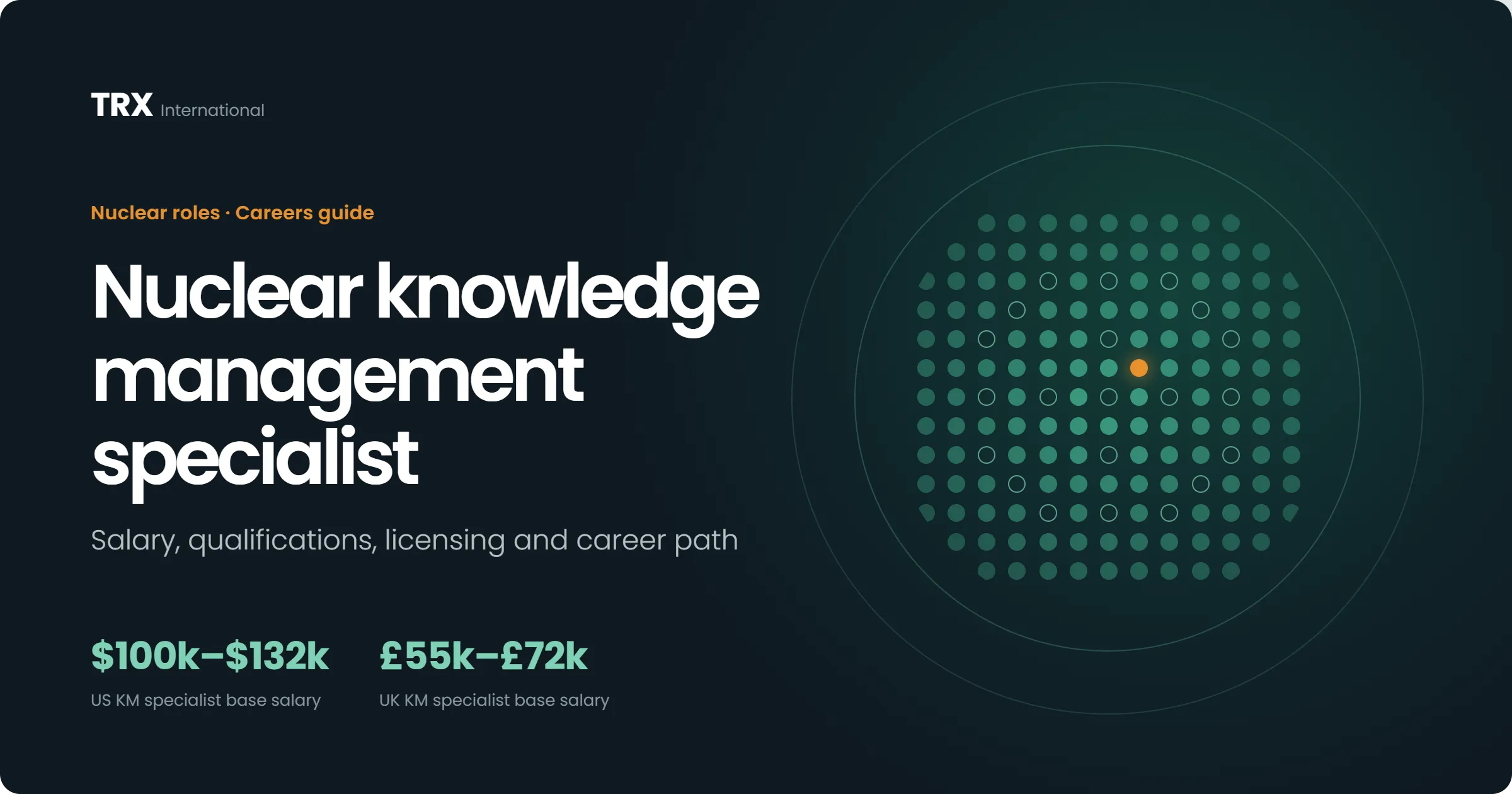
Nuclear knowledge management specialist pay sits above generic KM when the role requires significant nuclear engineering knowledge, critical-knowledge risk assessment or enterprise responsibility across long-lifecycle nuclear power planning programmes. TRX’s 2026 model places established US specialists around $100,000–$155,000, with lead and principal roles reaching roughly $175,000–$205,000; UK specialists commonly model around £55,000–£88,000, rising toward £105,000–£125,000 for lead or head-of-function scope. Exact nuclear knowledge management section title data is limited, so broader KM salary evidence is combined with nuclear-specific market premiums.
There is no nuclear KM licence. The real gate is the ability to manage nuclear knowledge by identifying critical knowledge, distinguishing tacit from explicit knowledge, assessing knowledge-loss risk, capturing expert judgement and designing transfer that changes successor capability. The IAEA treats knowledge management as part of maintaining organisational competence and safety, with methods including knowledge-risk assessment, elicitation interviews, concept mapping, communities of practice, succession planning and structured knowledge transfer. Nuclear employers also expect strong information-governance judgement because not all knowledge should be stored, shared or retained in the same way.
The role at a glance
Everything an employer will ask about in the first fifteen minutes of a screening call.
- Also called
- Knowledge management specialist · nuclear knowledge transfer specialist · knowledge retention specialist · knowledge capture specialist · organisational knowledge specialist · knowledge risk specialist
- Entry qualification
- Usually engineering, science, information/knowledge management, learning, organisational development or project background plus enough nuclear-sector experience to understand the knowledge being protected.
- Typical entry pay
- $82,000–$105,000 US · £45,000–£58,000 UK.
- Senior pay
- $120,000–$175,000 US for senior/lead specialists · £68,000–£105,000 UK; principal or head-of-KM roles can move higher.
- Contract day rates
- Roughly £425–£600/day for mainstream nuclear KM and £600–£800/day for major knowledge-risk, decommissioning or enterprise-KM assignments; US specialist contracts commonly model at $65–$125/hr.
- Professional gate
- No single credential. Strong facilitation, knowledge-risk methodology, information governance and nuclear technical credibility are the practical gates.
- Security
- UK BPSS is common, SC frequent on defence/sensitive programmes and DV role-specific. US federal/defence work can require citizenship or clearance.
- Where the work sits
- Decommissioning organisations, operating utilities, reactor vendors, defence nuclear, major projects, national laboratories, regulators, technical support organisations and central information/knowledge functions.
- Travel
- Low to moderate; higher where the specialist interviews experts across sites or facilitates cross-organisational communities.
- Shift pattern
- Mainly days. Retirement deadlines, major handovers, licence transitions and urgent expert-departure risk can create concentrated periods of activity.
- TRX segments
- Decommissioning & dismantling · Operating fleet · Large new build · Defence nuclear · New technology development · Radioactive waste management · Fuel cycle
Six versions of the same job title
"Knowledge management specialist" changes with what the organisation is at risk of losing: plant know-how, design rationale, decommissioning history, specialist science or organisational capability. Bar shows relative hiring relevance across TRX's 2026 market.
Decommissioning knowledge specialist
Identifies and preserves plant history, configuration knowledge, legacy decisions, waste-route reasoning and specialist experience needed decades after operations stop.
Operating-fleet knowledge transfer specialist
Targets retirement risk, succession, expert-to-successor transfer, operating experience, station communities and specialist knowledge needed to sustain safe operation and life extension.
Design / engineering knowledge specialist
Captures design intent, decision rationale, assumptions, interfaces and technical judgement that are often not visible in final drawings or specifications.
New-build / project knowledge specialist
Preserves construction, commissioning, supplier and project lessons so knowledge survives handover from project organisations into future operating teams.
Defence / specialist capability knowledge lead
Protects scarce propulsion, materials, systems, manufacturing or infrastructure expertise where security constraints and long career pipelines make replacement difficult.
Research / advanced-reactor knowledge specialist
Structures emerging knowledge around experiments, test programmes, design evolution, modelling and lessons so first-generation expertise can be reused by later teams and units.
What the week actually looks like
A composite day for a nuclear knowledge management specialist supporting a UK decommissioning organisation with ageing experts, long-lived records and several critical knowledge-transfer programmes.
What nuclear knowledge management specialists are paid in 2026
Bars show the 25th to 90th percentile of base salary. The vertical marker is the median. Switch currency to move between the US and UK markets — they behave differently, and the shapes tell you why.
How nuclear knowledge management compares to adjacent roles
US figures. BLS medians and deciles are May 2025 for coded occupations; the nuclear KM row is a TRX market model because the title is not separately coded.
| Occupation | Median | P10 | P90 | What moves the number |
|---|---|---|---|---|
| Nuclear knowledge management specialist | $122,000 | $82,000 | $182,000 | TRX model: technical depth, knowledge-risk scope, decommissioning, succession, enterprise responsibility |
| Knowledge management specialist — all industries | $89,492 | $72,835 | $110,497 | Current US September 2026 broader KM anchor |
| Nuclear knowledge-management jobs — broad market estimate | $115,106 | $104,600 | $127,900 | Current nuclear-specific job-market estimate |
| UK knowledge management specialist — all industries | £42,506 | £25,420 | £71,983 | Current UK general specialist baseline |
The nuclear row is a TRX model because the exact title is not separately coded. The comparison rows are broader current-market benchmarks; technical nuclear KM can pay above them where the specialist is protecting scarce engineering or operational knowledge.
Critical tacit-knowledge capture
Eliciting judgement from senior specialists before retirement is materially more valuable than managing documents already written down.
Knowledge-loss risk ownership
Specialists who can identify critical roles, quantify loss risk and connect it to succession and workforce planning operate at a more strategic level.
Lifecycle / decommissioning knowledge
Preserving plant history, design rationale and long-horizon knowledge across decades creates a premium because the information may be needed long after its original owners have left.
Three ways in, and one of them is open to everyone
Nuclear KM is often a second specialism. Strong practitioners usually come from technical nuclear work, information/records management or learning/organisational development and then broaden into knowledge-risk management.
Technical specialist to KM
The strongest route for critical technical knowledge capture.
Information / records management to KM
The information governance route.
Learning / organisational development route
The workforce and capability route.
Are you actually ready to compete for a nuclear knowledge management specialist role?
A strong CV has to show more than SharePoint, records or "lessons learned". Name the critical knowledge you identified, experts interviewed, knowledge-loss risks assessed, transfer plans built, communities facilitated, taxonomies improved and evidence that successors could actually apply what was captured. Nuclear employers want to know that you can preserve judgement and context, not just migrate content into another system.
Free resume scoring on avua, TRX's job search and application platform. Your score is yours — it is not shared with employers.The biggest gap is usually proof of knowledge-risk judgement and transfer effectiveness rather than tool administration. The gap is the part you can fix.
Illustrative figures based on TRX shortlisting patterns across site engineering vacancies. Your own score is generated by avua from your CV and the role you are targeting.
The credentials that actually let you work on site
Nuclear KM is gated by technical context, facilitation skill and information-governance judgement rather than a single statutory credential.
| Credential | Jurisdiction | Required for | Time | Notes |
|---|---|---|---|---|
| Degree / equivalent specialist experience | UK / US | Most professional KM roles | 3–4 yrs or equivalent | Engineering, science, information, learning, organisational development and project routes are all credible. |
| Nuclear knowledge-management methods | International | Knowledge-risk and transfer programmes | Months + practice | IAEA methods include knowledge-risk assessment, expert elicitation, concept mapping and structured transfer. |
| Information / records governance knowledge | UK / US | Safe storage, retention and access | Role-specific | KM must respect records, security, IP, export-control and information-classification requirements. |
| Facilitation / interviewing competence | UK / US | Tacit knowledge capture | Practice-based | Senior experts rarely transfer useful judgement through questionnaires alone. |
| Knowledge-loss risk methodology | UK / US | Critical-role / succession work | Role-specific | Used to prioritise which knowledge requires intervention before experts depart. |
| Communities of practice / collaboration methods | International | Ongoing knowledge sharing | Role-specific | Important for knowledge that evolves and cannot be frozen into one document. |
| BPSS / SC / DV | UK | Sensitive programme access | Weeks–months | Defence and some advanced programmes require higher clearance. |
| DOE / federal clearance or export-control eligibility | US | Federal, laboratory and defence work | Programme-specific | Knowledge access can be more constrained than the KM technology itself. |
KM professionals need to know when knowledge should be shared, when it must be restricted and when it belongs in a formal record system rather than an informal collaboration space.
What appears on a 2026 nuclear knowledge management shortlist
Employers are screening for whether the specialist can identify valuable knowledge, capture it without stripping away context and make it usable by the people who need it later.
Named on the specification
- Knowledge-loss risk assessment — Critical roles, experts, retirement/attrition risk, uniqueness, replacement difficulty and consequence of loss
- Tacit-knowledge capture — Elicitation interviews, storytelling, critical-decision method, concept maps, process modelling, observation and expert walkthroughs
- Knowledge transfer design — Mentoring, shadowing, paired work, communities, case-based learning, successor plans and practical application
- Taxonomy / information architecture — Knowledge domains, metadata, tagging, search, relationships and navigation that make technical material findable
- Information governance — Records boundaries, security classification, access, retention, version control, IP and export-control constraints
- Effectiveness and knowledge-risk tracking — Residual risk, successor readiness, transfer completion, repository use, retrieval quality and evidence that knowledge can be applied
What decides between two shortlisted candidates
- Decommissioning knowledge preservation — Plant history, legacy decisions, waste routes and knowledge required decades after shutdown
- Engineering decision-rationale capture — Preserving why a design choice was made, including assumptions and rejected alternatives
- Critical expert facilitation — Ability to work with senior, time-poor or sceptical SMEs and extract usable knowledge without oversimplifying it
- Communities of practice — Sustaining peer exchange so knowledge evolves through expert networks rather than static repositories alone
- Digital KM / semantic search / AI-enabled retrieval — Using modern discovery tools while maintaining provenance, security and technical authority
- Succession and organisational capability integration — Connecting knowledge risk to workforce planning, competence, training and critical-role resilience
The 2026 demand map
Demand follows long-lifecycle programmes, ageing expert populations, organisational transition and missions where knowledge created today may not be needed again for decades.
| Programme | Location | Phase in 2026 | Engineering demand |
|---|---|---|---|
| NDA group | UK-wide | 2026 strategy makes proactive knowledge capture, sharing and transfer a formal priority across a 100+ year mission | Very high; group-wide KM improvement and taskforce activity |
| Sellafield | Cumbria, UK | Active decommissioning, legacy retrievals and workforce renewal | Very high; plant history and specialist tacit knowledge are mission-critical |
| Nuclear Restoration Services | UK | AGR transfers and decommissioning across multiple sites | Very high; operation-to-decommissioning transition creates knowledge-loss risk |
| Nuclear Waste Services / GDF | UK | Long-horizon waste and geological disposal development | High; programme timescales exceed individual careers and require durable institutional knowledge |
| EDF UK operating fleet / AGR transition | UK | Operations, defuelling, life extension and transfer of sites | High; ageing plant and mission changes increase knowledge-transfer pressure |
| Hinkley Point C / Sizewell C | UK | Construction, commissioning preparation and replication between EPR projects | High; design, construction and commissioning knowledge must transfer into future operating organisations |
| WANO | International | Continuous operating-experience, peer-review and secondee knowledge exchange | High-value specialist ecosystem; knowledge transfer is built into the secondment model |
| DOE environmental cleanup complex | US | Multi-decade cleanup and decommissioning missions | Very high; legacy facility knowledge, technical history and succession are persistent risks |
| Advanced reactor developers | US / UK / Canada | Design, licensing, testing and early deployment | Rising; first-generation design and test knowledge must survive turnover and scale-up |
Programme phases move. The table reflects public status verified in September 2026; candidates should confirm current programme, package and site-access requirements before making a relocation decision.
The most valuable knowledge often becomes important after its author has left
Decommissioning makes the problem obvious because decisions made during operation can determine how safely and cheaply work is done decades later. New build has the same issue in reverse: construction and commissioning knowledge must cross into operations. The 2026 NDA strategy explicitly prioritises capture, management, sharing and reuse because knowledge is now treated as a mission asset rather than an informal by-product of experienced staff.
People who can bridge technical experts and usable systems
IT teams can build repositories and engineers can explain their own discipline, but fewer people can identify which knowledge is critical, draw tacit judgement out of experts, structure it for future users and prove it transferred. Nuclear adds security, provenance and lifecycle requirements that make generic enterprise KM methods insufficient on their own.
Adjacent and onward roles
Nuclear KM connects information governance, organisational capability, learning, succession and technical assurance, creating several senior routes.
Questions candidates genuinely ask recruiters about nuclear knowledge management
How much does a Nuclear Knowledge Management Specialist earn in 2026?
TRX’s 2026 model estimates that established US nuclear knowledge management specialists earn between $100,000 and $155,000, with lead and principal roles reaching roughly $175,000 to $205,000 annually. UK specialists typically earn £55,000 to £88,000, rising to £105,000 to £125,000 for lead or head-of-function positions. These salary bands are modeled based on current wider knowledge management and nuclear market data, including roles involving human resource development, sustainable knowledge management systems, and digital information resource management within the nuclear technology lifecycle.
This is an early to mid-career delivery role in nuclear projects, which is why the range sits toward the lower end of this series, though site and living-away allowances add meaningfully on major programmes. Candidates who spend time gaining nuclear-specific labor experience and demonstrate strong evaluation skills tend to be more competitive in this field. Additionally, professionals based in regions such as Glen Allen have access to growing opportunities in the nuclear energy sector.
What is the difference between knowledge management and document management in nuclear?
Document management focuses on controlling records through versions, approvals, retention, access, and retrieval within information systems, often guided by official IAEA languages and guidance documents. In contrast, knowledge management in scientific and technical environments like nuclear technology involves preserving tacit knowledge, context, judgement, and relationships essential for applying technical knowledge correctly. While the disciplines overlap, a compliant document repository alone does not guarantee efficient and effective handling or sustainable knowledge management development.
Internal inspection sign-off authority is granted once you have demonstrated competence in nuclear quality assurance, regulatory compliance, and site evaluation.
What is tacit knowledge in nuclear?
Tacit knowledge comprises expertise embedded in people's experience, judgement, intuition, and pattern recognition that is challenging to document directly. Examples include recognizing unusual plant behavior, understanding critical assumptions in calculations, or recalling why certain technical options were rejected. Capturing tacit knowledge involves expert elicitation interviews, case discussions, and guided knowledge transfer, which are key components of human resource development initiatives and knowledge management development in nuclear sectors.
The nuclear-specific part is the quality assurance and documentation regime, which is considerably heavier than general construction, and the safety culture around stopping work to maintain strict compliance with nuclear quality assurance standards and nuclear regulatory requirements.
Why is knowledge management especially important in decommissioning?
Decommissioning projects often span decades beyond routine operations, during which the experts familiar with plant details retire or leave. Future teams require access to design history, contamination knowledge, modification rationale, radiation waste management decisions, and practical experience that may not be fully documented. The NDA’s 2026 strategy emphasizes proactive knowledge capture, lifecycle management, and contingency plans to ensure knowledge preservation across its 100+ year mission, supporting interested member states through human resource development services.
The honest caveat: this role is entirely site-based, involves early starts and relocation, and salary at this level is generally below design engineering roles. Its true value lies in being the standard pathway toward nuclear construction management, a field facing a critical shortage of qualified site engineers and nuclear construction professionals. Those who show expertise in nuclear quality assurance, safety culture, and complex site evaluation are highly sought after in the competitive nuclear new build vacancy sector.
Is Nuclear Knowledge Management a strong career in 2026?
Yes, particularly in UK decommissioning, fleet transition, new build, defence sectors, US environmental cleanup, and advanced reactor programmes. Demand is driven by ageing specialists, long programme lifecycles, and project phase transitions. The role is critical where knowledge loss impacts safety, cost, schedule, or technical decision reproducibility. Nuclear knowledge management specialists often work within the United Nations common system, assisting developing countries and member states with knowledge management initiatives and providing human resources expertise based on demonstrated successful track records.
Put simply, one produces the design and the other realises it on the ground. Both are civil engineering, and engineers do move between them, but the site role is construction-based and delivery-focused while the civil engineer role is design-based and analysis-focused.
What evidence matters most on a Nuclear Knowledge Management Specialist CV?
Demonstrate your knowledge-risk assessment skills and tangible outcomes. Detail critical roles assessed, experts interviewed, tacit-knowledge capture methods used, transfer plans developed, communities facilitated, taxonomies improved, and information systems enhanced. The strongest CVs prove that critical knowledge became more accessible, safer to use, and less reliant on single individuals—not merely that documents were uploaded or workshops conducted. Highlight your expertise core competencies, experience with innovative knowledge management products, and your role in implementing training courses and knowledge management development across scientific and technical environments.
Setting out, drawing interpretation and quality inspection are the near-universal hard filters.
We only recruit in nuclear. That is the whole point.
TRX can distinguish a document-management profile from genuine knowledge-risk work, and a generic KM specialist from someone who can capture nuclear technical judgement before it disappears. Send us your CV and we will tell you which knowledge-management, information-governance, capability or organisational-learning route your evidence supports — and what the 2026 market is paying for it.