
Sample management coordinatorSalary, qualifications, career path and hiring demand, 2026 edition
A nuclear sample management coordinator controls what happens to a clinical trial sample from laboratory receipt until it is analysed, archived, returned or disposed. They verify identity and chain of custody, apply storage and radiological requirements, register work in LIMS, route samples to the right analytical capability, protect holding times and resolve discrepancies. The technical distinction is not performing the measurement; it is preserving sample identity, condition, traceability and priority so the measurement remains defensible, meeting quality standards and regulatory requirements.
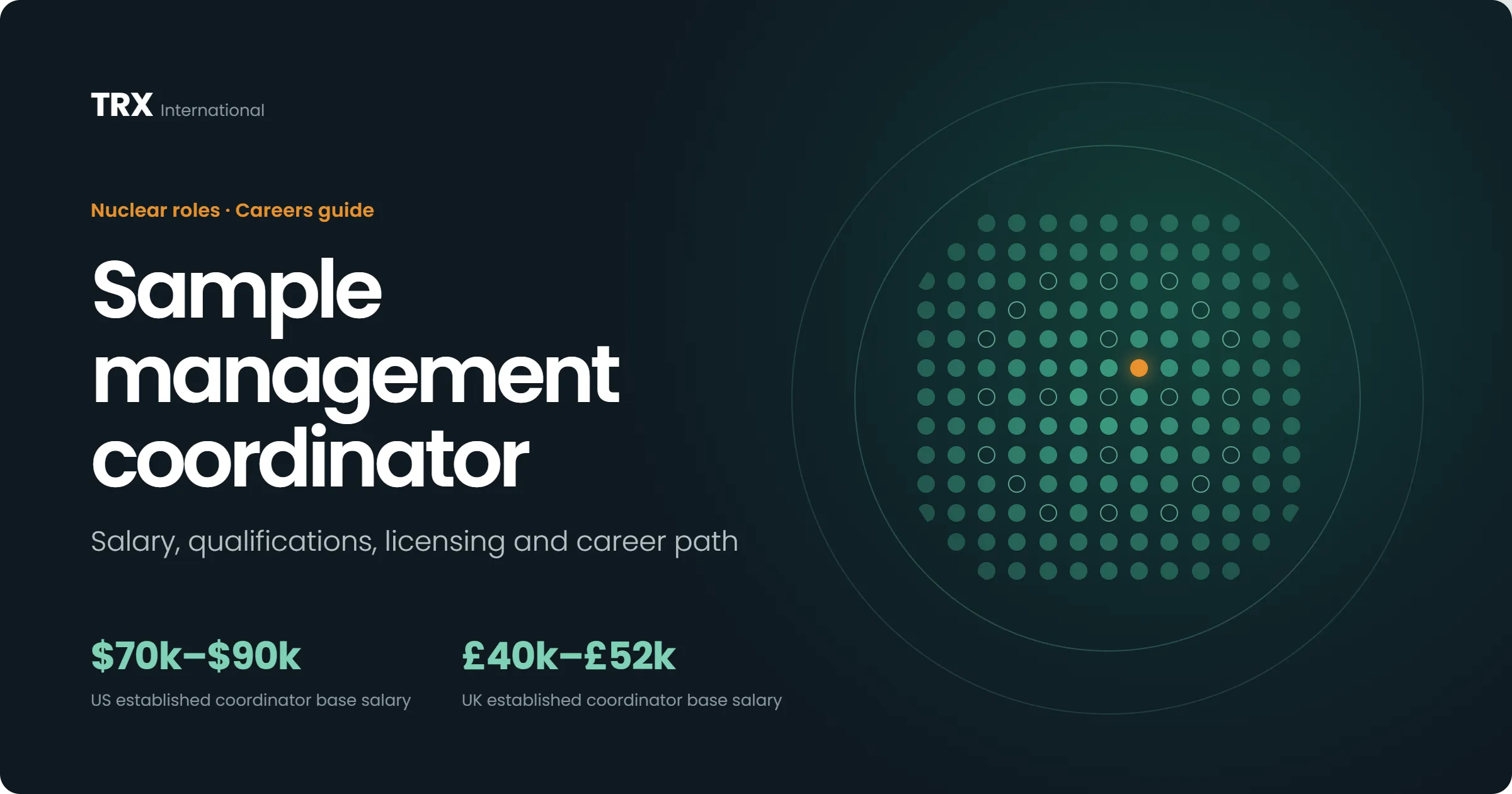
“Sample management coordinator” is not separately coded as a nuclear occupation, so TRX models the 2026 market from laboratory coordination, nuclear technician and regulated-sample roles. A practical US range is about $55,000–$112,000, with established nuclear coordinators around $76,000–$88,000. UK permanent salaries typically run from the low £30,000s into the £60,000s, with the strongest premiums on cleared, high-hazard and programme-critical work.
There is no universal professional licence. The real gate is whether the facility will authorise you to receive, identify, store and transfer its samples without breaking custody, radiological, security or quality controls. Employers look for competence in LIMS, controlled records, custody review, storage conditions and escalation of non-conforming receipts. Class 7 shipping, fissile-material handling or evidence continuity becomes an additional gate only where the sample stream requires it.
The role at a glance
Everything an employer will ask about in the first fifteen minutes of a screening call.
- Also called
- Sample coordinator · sample custodian · sample receipt coordinator · laboratory logistics coordinator · sample management specialist · laboratory sample controller
- Entry qualification
- HNC/HND, associate degree, laboratory apprenticeship or BSc in chemistry, environmental science, laboratory science or a related discipline. Strong regulated-lab experience can substitute for degree-level education.
- Typical entry pay
- $55,000–$70,000 (US TRX nuclear model) · £32,000–£40,000 (UK); non-nuclear US postings around $50,000–$70,000 are a useful floor anchor
- Senior pay
- $90,000–$112,000 (US senior/lead) · £52,000–£68,000 (UK senior/lead), with higher packages possible for clearance, actinide/fissile custody or team leadership
- Contract day rates
- £250–£350 routine laboratory sample coordination; £325–£450 for cleared radiological, decommissioning or high-throughput campaigns; about $32–$58/hr on comparable US contract support
- Professional gate
- No universal licence. The real gate is local authorisation to receive, log, store, transfer and disposition samples under the site quality and radiological management system.
- Security
- UK BPSS is common; SC or DV can apply to defence, plutonium and sensitive national programmes. US DOE/NNSA work may require a clearance and additional material-access controls.
- Where the work sits
- Analytical laboratories, sample receipt areas, environmental monitoring programmes, decommissioning projects, research facilities, hot laboratories and national-laboratory sample-management offices.
- Travel
- Usually low to moderate. Most work is site-based, but offsite laboratories, courier interfaces, campaign sampling, audits and inter-facility transfers can create periodic travel.
- TRX segments
- Operating fleet · Decommissioning & dismantling · Radioactive waste management · Fuel cycle · Nuclear research · National laboratories
Six versions of the same job title
“Sample management coordinator” changes with what is being controlled: environmental bottles, high-activity process material, forensic evidence, research specimens or thousands of decommissioning samples. The common responsibility is custody and traceability; the risk profile changes completely.
Radiological analytical laboratory
Controls receipt, dose/contamination information, identifiers, storage and routing for radioactive environmental, process and waste samples entering a nuclear laboratory.
Decommissioning and waste characterisation
Manages campaign-scale flows of soils, sludges, swabs, waters and waste samples where holding time, prioritisation, packaging and final disposition can become a production constraint.
National laboratory / actinide work
Handles highly controlled uranium, plutonium or other actinide samples, where material identity, secure storage, transfer approvals and radiological controls are more demanding than ordinary lab receipt.
Environmental monitoring
Receives scheduled and event-driven water, air, soil, sediment and biota samples, protects preservation/holding-time requirements and routes them to external or internal laboratories with complete custody records.
Research and user-facility samples
Coordinates user samples for reactors, neutron facilities and materials programmes, including special temperatures, activated material, return shipping and experiment-linked identifiers.
Forensics and evidential material
Maintains continuity of evidence for nuclear or other radioactive material, ensuring tamper controls, secure transfers, authorised storage and documented handovers can withstand external scrutiny.
What the week actually looks like
A composite day for an established sample management coordinator supporting a nuclear analytical laboratory receiving environmental, process and decommissioning material. The role sits between field teams, radiological protection, analysts, transport, customers and records.
What sample management coordinators are paid in 2026
There is no official wage series for “sample management coordinator” in nuclear. The ladders are a TRX 2026 market model anchored to current laboratory sample-coordination postings, broader nuclear/laboratory occupations and the extra value attached to radiological controls, clearance and accountable custody. They are base-pay estimates, not guaranteed employer bands.
How sample management coordinators compare to adjacent roles
Exact-title national statistics do not exist, so the coordinator values below are TRX models; broader laboratory and nuclear occupations are shown only as anchors.
| Occupation | Median | P10 | P90 | What moves the number |
|---|---|---|---|---|
| Sample management coordinator (nuclear) | $82,000 | $55,000 | $112,000 | Radiological custody, LIMS ownership, throughput, clearance, actinide/fissile material |
| Sample Management Coordinator (current generic live posting) | $60,000 | — | — | PerkinElmer 2026 range $50k–$70k; non-nuclear market anchor |
| Nuclear / laboratory technician (broader anchor) | — | — | — | Technical analytical responsibility can sit above coordination-only work |
| Laboratory operations / logistics lead | $103,000 | — | — | People leadership, programme throughput, quality and accountable material movement |
Sources/anchors: current 2026 US Sample Management Coordinator postings at about $50,000–$70,000; broader US laboratory/nuclear occupation data; Sellafield analytical-services scope; and TRX nuclear market modelling. Nuclear clearance, radiological handling and accountability are not captured by generic coordinator surveys.
Radiological / actinide custody
Employers pay more when sample receipt includes contamination controls, shielded storage, fissile or special nuclear material interfaces and strict material-access arrangements.
LIMS ownership and throughput control
Coordinators who can configure queues, reconcile inventory, protect holding times and recover a congested sample pipeline deliver measurable programme value.
Class 7, inter-facility and evidential transfers
Shipping interfaces, secure handovers and defensible chain of custody are scarce because one error can stop analysis or trigger a formal investigation.
Three ways in, and the strongest candidates have enough laboratory literacy to understand why a sample condition matters
The role is usually reached from laboratory support, sample receipt, environmental monitoring or regulated logistics. The strongest candidates have enough laboratory literacy to understand why a sample condition matters, but they are hired for control, traceability and judgement rather than for being the best analytical chemist in the room.
Laboratory technician to sample coordinator
Three to seven years.
Environmental sampling and monitoring
Three to eight years.
Regulated logistics / records transfer
Two to six years.
Are you actually ready to compete for a sample management coordinator role?
“Managed samples” is too weak for a nuclear shortlist. A credible CV shows scale and control: sample volumes, LIMS, custody and storage requirements, holding-time protection, discrepancy authority, and radioactive or security-sensitive transfers. Recruiters want evidence that you controlled the chain, not that you carried boxes between benches.
Free resume scoring on avua, TRX’s job search and application platform. Your score is yours; it is not shared with employers.Candidates often list sample receipt but omit custody exceptions, storage rules, throughput, LIMS reconciliation and transfer responsibility — the evidence that proves coordinator-level ownership.
Illustrative figures based on TRX shortlisting patterns across nuclear laboratory and operations-support vacancies. Your own score is generated by avua from your CV and the role you are targeting.
The credentials that actually gate the work
The role is gated by facility authorisation, radiological controls and custody competence rather than a single external credential. Additional transport, security or material-accountancy gates appear only on the sample streams that need them.
| Credential | Jurisdiction | Required for | Time | Notes |
|---|---|---|---|---|
| Laboratory / sample-receipt authorisation | All | Independent sample acceptance | Weeks–months | Local competence sign-off on receipt, storage, transfer, quarantine and disposition. |
| Radiological worker training | UK / US | Handling radioactive samples | Days–weeks | Level depends on facility, sample activity and contamination potential. |
| LIMS / controlled-record competence | All | Traceability and workflow | Days–months | Must preserve electronic audit trail and physical/electronic inventory agreement. |
| BPSS / SC / DV | UK | Site access / sensitive work | 2–20+ wk | SC/DV only where programme sensitivity requires it. |
| DOE/NNSA clearance | US | Sensitive national-lab work | Months | Role- and programme-specific; not every US laboratory sample role requires clearance. |
| Class 7 dangerous-goods awareness / shipper qualification | UK / US | Radioactive offsite transfers | Role-specific | Coordinator interfaces with qualified shipping staff; formal shipper status only when duties require it. |
| Nuclear material / fissile controls | Site-specific | Actinide or accountable material | Role-specific | Extra access, inventory, criticality or material-control requirements may apply. |
| Chain-of-custody / evidence procedures | All | Forensics or legally sensitive samples | Days–weeks | Formal continuity, tamper controls and documented handovers beyond routine sample tracking. |
Exact requirements vary sharply with sample type. A bottle of environmental water, an activated reactor coupon and a plutonium-bearing sample may enter the same organisation under completely different receipt, storage and transfer controls.
What appears on a 2026 sample management coordinator shortlist
Recruiters screen for coordinators who can preserve identity, condition and traceability while keeping a busy laboratory moving. The hard filters are process controls and systems discipline, not generic administration.
Named on the specification
- Chain of custody and sample acceptance — verify seals, identifiers, documentation, condition and requested work; know when to accept, quarantine or reject.
- LIMS / sample tracking — create and reconcile records, statuses, locations, analyses, due dates, aliquots, transfers, retention and final disposition.
- Storage and preservation control — temperature, segregation, shielding, contamination controls, hazardous properties, retention periods and authorised locations.
- Radiological sample handling — read activity/contamination information, work within local radiation-protection controls and escalate material outside the authorised envelope.
- Controlled transfers and dispatch — documented handover, receiving-lab readiness, packaging interface, courier/transport coordination and custody update.
- Quality records and exception management — deviations, non-conformances, missing information, audit trail, reconciliations and defensible close-out without undocumented workarounds.
What decides between two shortlisted candidates
- High-throughput decommissioning campaigns — proven control of hundreds or thousands of samples where laboratory capacity and holding times compete.
- Actinide / fissile or high-activity material — experience with stronger access, storage, radiological and material-control requirements than routine environmental samples.
- Class 7 and inter-site shipping interfaces — enough transport knowledge to build the correct handover and involve the qualified shipping function before movement becomes urgent.
- LIMS workflow improvement — designing queues, barcoding, dashboards, reconciliations or electronic custody steps that reduce sample loss and rework.
- Nuclear forensics / evidential continuity — tamper controls, secure custody and handovers where the sample may need to support an investigation or legal process.
- Customer and laboratory prioritisation — judgement to negotiate urgent work, scarce analytical capacity and disposition constraints without silently bypassing quality controls.
The 2026 demand map
Demand follows organisations with large, regulated analytical flows: decommissioning sites, national laboratories, environmental programmes, research facilities and operating fleets. The role becomes more valuable as sample volume, hazard and external reporting obligations increase.
| Programme | Location | Phase in 2026 | Engineering demand |
|---|---|---|---|
| Sellafield VLA analytical services | Cumbria, UK | New 8-year analytical-services contract from Aug 2026 | Very high; scope explicitly includes receipt, transport, storage, analysis, reporting and disposal |
| Sellafield / UK nuclear analytical estate | Cumbria, UK | Decommissioning and operations | High; sustained environmental, waste, process and characterisation sample flows |
| UKNNL laboratories | Sellafield / Preston, UK | Research, fuel-cycle and analytical programmes | High; radiological laboratories require controlled receipt, storage and routing |
| Los Alamos National Laboratory Sample Management Office | New Mexico, US | Environmental and national-security operations | High; dedicated office tracks custody, storage and shipment to analytical laboratories |
| Savannah River National Laboratory – Analytical Characterization & Sample Management | South Carolina, US | Actinide and materials analysis | High; active support to Pu sample-analysis programmes |
| Idaho National Laboratory Analytical Laboratory | Idaho, US | Fuel-cycle and nuclear-material analysis | High; formal analytical-lab sample management and transfer procedures |
| ORNL HFIR / SNS user facilities | Tennessee, US | Operating research facilities | Moderate–high; dedicated sample-management desks and radioactive sample shipping/return workflows |
| Operating nuclear fleets and environmental monitoring programmes | UK / US | Operations | Steady; routine and event-driven chemistry, effluent and environmental samples |
| Decommissioning / waste-characterisation programmes | UK / US | Execution | High; campaign volume creates strong receipt, prioritisation, storage and disposition demand |
| Nuclear forensics laboratories | International | Capability development / casework | Specialist; secure evidence custody, authorised storage and documented transfers |
Programme phases and vacancies move. The table shows active 2026 demand centres where formal sample receipt, tracking, storage or controlled transfer is part of the operating model; it is not a list of current vacancies.
Sample management is becoming a throughput role, not just a reception desk
Sellafield’s new VLA analytical service spans receipt and transportation through storage, analysis, reporting and waste disposal, while LANL operates a dedicated Sample Management Office and SRNL names sample management inside its analytical organisation. Candidates who can control the full queue, not merely log bottles into LIMS, map best to these programmes.
People who combine logistics discipline with nuclear judgement
Generic sample coordinators exist in pharma, biotech and commercial labs; far fewer know what to do when a radioactive sample arrives with incomplete custody, an activity outside the receiving envelope, a holding-time conflict or a transfer touching Class 7, security or material-control rules. That combination makes nuclear sample-management experience portable and valuable.
Adjacent and onward roles
Sample management sits between laboratory operations, analytical quality, environmental monitoring and nuclear logistics. These are the most natural sideways and onward moves.
Questions we get asked every week
How much does a nuclear sample management coordinator earn in 2026?
There is no exact government wage series. TRX models US permanent pay at roughly $55,000–$112,000, with established coordinators commonly around $70,000–$90,000; UK roles typically run about £32,000–£68,000. Generic 2026 US Sample Management Coordinator postings around $50,000–$70,000 provide a useful floor, while radiological controls, clearance, actinide material and leadership move nuclear roles higher. Actual compensation often reflects factors such as experience, security clearance, and responsibility level.
Do you need a science degree to become a sample management coordinator?
Not always. HNC/HND, associate-degree, apprenticeship and experienced laboratory-support routes are all credible because the job is primarily about controlled process execution and judgement. A bachelor's degree in chemistry, environmental science, or a related discipline helps when the coordinator must understand preservation, analytical methods, biological samples, and unusual matrices, but employers will often value proven regulated-lab custody experience more than an unrelated degree.
What is the difference between a sample management coordinator and an analytical laboratory technician?
The coordinator owns the sample’s identity, custody, location, condition, priority and transfer through the laboratory system. The laboratory technician prepares and measures the sample under analytical methods. In smaller laboratories one person may do both, but the recruitment distinction is useful: the coordinator is responsible for the chain and workflow; the technician is accountable for executing analytical tasks correctly.
Is chain of custody only important for nuclear forensics?
No. IAEA monitoring guidance treats chain of custody, record keeping, accurate documentation and data management as quality-assurance elements, and ordinary environmental or operational samples still need traceable collection, receipt, storage and transfer. Forensics raises the evidential standard, but routine nuclear analysis can also be challenged if identity or custody cannot be demonstrated.
Which systems matter most for the role?
A laboratory information management system (LIMS) is the core digital tool, but the shortlist is looking for what you did with it: registration, barcode or identifier control, location, analysis requests, due dates, aliquots, transfers, retention and disposition. Strong candidates also understand controlled document systems, inventory/reconciliation tools, sample shipments and the transport or material-control systems that interface with LIMS.
What is the most valuable skill in 2026?
Exception handling. Routine samples can be taught; the higher-value coordinator knows what to do when the sample, paperwork, seal, radiological classification, storage condition or due date does not line up. Employers want someone who stops the uncontrolled step, protects the sample, creates a complete record and gets the right authority involved without losing sight of programme urgency. Strong attention to detail and the ability to collaborate with clients and healthcare teams are essential.
We only recruit in nuclear. That is the whole point.
TRX works across operating plants, decommissioning, radioactive waste, fuel-cycle, national laboratories, research facilities and new technology. Send us your CV and we can assess whether your evidence fits sample management, laboratory operations, radiochemistry, environmental monitoring or radioactive-material logistics — and which parts of your custody and LIMS experience actually move the shortlist.