Salem Nuclear Generating Station: Operations, Environment and Careers
Salem nuclear plant's two reactors supply nearly 2,300 MWe to the Mid-Atlantic grid. See how it works, why its cooling is contested and the jobs it supports.
Salem Nuclear Generating Station is a dual-reactor nuclear power plant located in Lower Alloways Creek Township, New Jersey. With two units producing nearly 2,300 megawatts of electricity, it's one of the largest baseload generators in the Mid-Atlantic. The plant also sits at the center of longstanding environmental disputes over its cooling system, ongoing regulatory battles, and new clean hydrogen ambitions.
Quick facts about Salem Nuclear Generating Station
Salem Nuclear Generating Station is a two-unit pressurised water reactor (PWR) nuclear power plant in Lower Alloways Creek Township, Salem County, New Jersey, on the Delaware River estuary. Construction began in September 1968, with Unit 1 entering commercial operation in 1977 and Unit 2 following in 1981.
The Salem plant is majority owned and operated by PSEG Nuclear LLC, a subsidiary of Public Service Enterprise Group, which holds 57.41% ownership. Constellation Energy holds the remaining 42.59%. Each reactor core holds 193 nuclear fuel assemblies, using nuclear fission to produce heat that drives steam turbines.
| Metric | Salem Unit 1 | Salem Unit 2 |
|---|---|---|
| Net Electrical Capacity | ~1,174 MWe | ~1,130 MWe |
| Commercial Operation | 1977 | 1981 |
| License Expiration | August 2036 | April 2040 |
| Combined Output | ~2,300 MWe |
The Salem facility sits adjacent to the Hope Creek nuclear power plant, forming one of the largest nuclear complexes in the United States, sometimes called Artificial Island. Both are licensed by the U.S. Nuclear Regulatory Commission (NRC) and supply the PJM Interconnection market across New Jersey, Pennsylvania, and Delaware.
The facility employs over 1,600 workers, making it the largest employer in Salem County. From TRX International's perspective, Salem is a reference site for nuclear careers in the Mid-Atlantic.
Location, design and site layout
Salem sits about 18 miles south of Wilmington, Delaware, on the eastern shore of the Delaware estuary. The site occupies roughly 700 acres of reclaimed marshland and coastal plain, with controlled access roads and an exclusion area of approximately 0.80 miles.
Both Salem reactors are Westinghouse-designed four-loop PWRs. Light water serves as both moderator and coolant. Each unit has a licensed thermal power of 3,459 MWt. The plant design includes twin containment domes, turbine buildings, and 12-bay intake structures on the Delaware River. The prominent natural draft cooling tower visible on the peninsula belongs to Hope Creek, not Salem.
Here's the key distinction: Salem uses a once-through cooling system, drawing water directly from the river. Hope Creek uses a closed cycle cooling system with its tower. They share the same peninsula and high-voltage transmission infrastructure, but their cooling approaches are fundamentally different.
Philadelphia is approximately 40 miles to the north. Barge access on the Delaware River supports delivery of large components. The New Jersey Office of Emergency Management coordinates planning with Salem County authorities for the surrounding communities near Hancocks Bridge and other local areas.
Reactor units, performance and operational record
Salem's two reactors have collectively delivered decades of low-carbon electricity, with stretches of strong reliability punctuated by periods of extended maintenance.
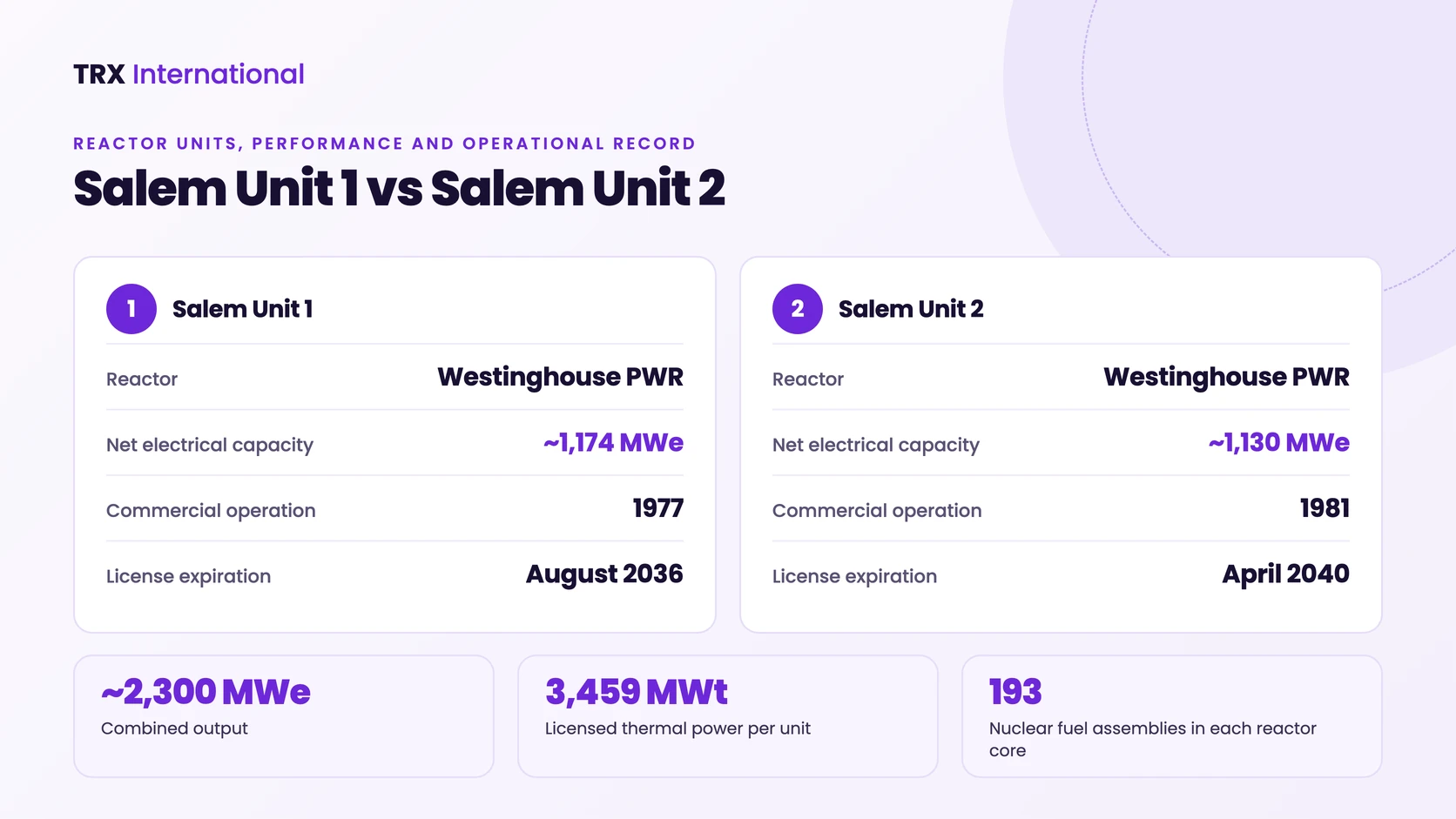
Salem Unit 1: A Westinghouse PWR with net capacity of approximately 1,174 MWe. First grid connection occurred in the mid-1970s. The original operating license would have expired in 2016; NRC renewal extended it through August 2036.
Salem Unit 2: Also a Westinghouse PWR, net capacity around 1,130 MWe, entering commercial service in 1981. Salem 2 has a lifetime capacity factor of 89.7%. The unit logged 5 breaker-to-breaker runs without trips, with the longest unbroken run reaching 531 days. Salem 2 has recorded 14 reactor scrams since 2011, and its license runs through April 2040.
The mid-1990s brought trouble. Both units were shut for extended maintenance due to leaking steam generators and unreliable instrumentation and control systems. Those shutdowns lasted years.
The August 2013 incident drew public attention: a slightly radioactive water leak led to a temporary shutdown. Salem plant resumed operations 48 hours after the shutdown, and the event reinforced the conservative safety culture that NRC oversight demands.
Modern reliability improvements, including digital controls and predictive maintenance, have pushed recent capacity factors above 91% for both units. The plant's long operational history creates ongoing demand for operators, engineers, and maintenance technicians.
Electricity generation and role in the regional grid
Salem provides firm, always-on power to the PJM Interconnection region. The two units produce roughly 2,300 MWe combined. Salem and Hope Creek together supply electricity to around three million homes across New Jersey, Pennsylvania, and Delaware.
Steam produced through nuclear fission in the reactor coolant system drives turbine-generators. About two-thirds of the thermal energy becomes waste heat rejected through the cooling system. Salem connects to the grid via 500 kV transmission lines linking multiple states.
Salem's operation helps avoid nearly 14 million metric tons of carbon dioxide emissions annually, a figure that underpins its role in New Jersey's clean energy portfolio. The plant complements planned offshore wind and solar deployments by providing baseload generation that doesn't depend on weather. Salem planned significant investments to enhance generating capacity and operational efficiency, including a ~200 MW uprate split between both owners.
Salem's nuclear output is proposed as a source for the Mid-Atlantic region's clean hydrogen ambitions. Cobalt-60 commercial-scale production was also planned at the Salem facility for 2026, adding medical isotope manufacturing to the site's contributions.
Cooling system, environmental impacts and Delaware River ecology
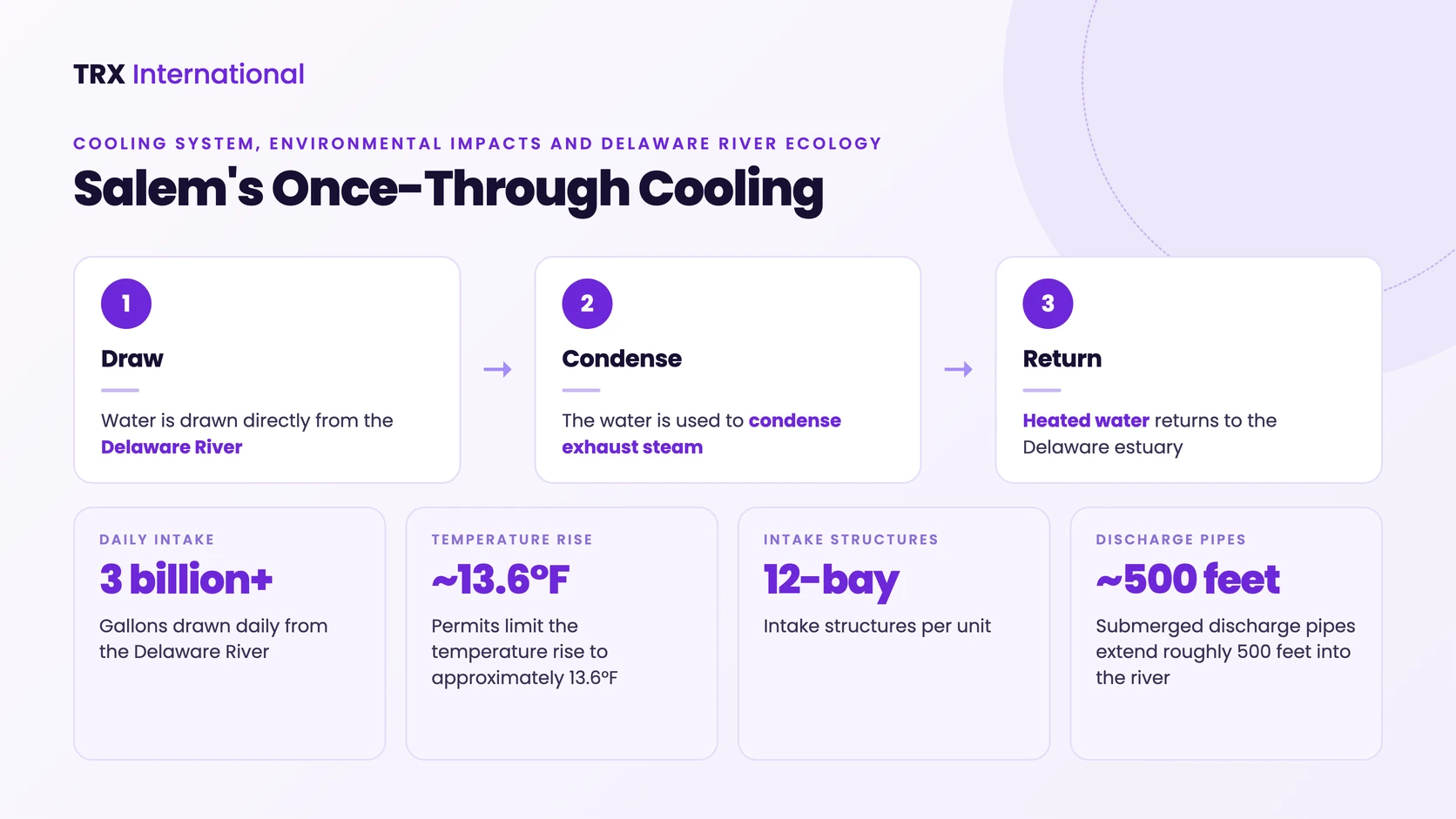
Salem's cooling system is classified as once-through cooling. The plant draws over 3 billion gallons daily from the Delaware River, uses that water to condense exhaust steam, then returns heated water to the Delaware estuary. Permits limit the temperature rise to approximately 13.6°F.
The scale of water withdrawal creates severe ecological consequences. The EPA estimates Salem entrains 14.7 billion fish, eggs, and larvae yearly. Salem Nuclear Plant kills approximately 3 billion fish annually through impingement on intake screens and entrainment through the cooling system. Salem's cooling system causes 48% mortality in striped bass annually. The bay anchovy population has declined due to the plant's operations.
Environmental groups, particularly the Delaware Riverkeeper Network led by Maya van Rossum, have called Salem the largest predator in the Delaware estuary. PSEG Nuclear disputes the highest mortality estimates, citing alternative studies and existing mitigation measures (screens, fish return systems, and wetland restoration) as representing best available technology under New Jersey Department of Environmental Protection rules.
The cooling system's physical features include 12-bay intake structures per unit, submerged discharge pipes extending roughly 500 feet into the river, and operational constraints requiring power reductions when heavy debris threatens to clog intakes.
Regulatory framework, permits and legal disputes
The NRC handles nuclear safety at Salem. The New Jersey Department of Environmental Protection (NJDEP), sometimes referenced as the Jersey Department of environmental protection, manages water permits under the federal Clean Water Act.
Clean Water Act Section 316(b) requires cooling water intake structures to use the best technology available to minimize environmental damage. Salem's water discharge permit was delayed since 2006, when PSEG applied for NJPDES renewal.
The timeline of legal action tells the story:
- October 2013: The Delaware Riverkeeper Network and Clean Water Action filed a lawsuit against NJDEP, challenging delays in renewing Salem's water discharge permit.
- November 2014: The lawsuit was settled. NJDEP agreed to issue a draft discharge permit by June 30, 2015.
- June 30, 2015: NJDEP issued the draft discharge permit on schedule.
- August 15, 2014: The EPA published new cooling regulations (new rules under 316(b)), though these left states considerable discretion.
- June 10, 2016: NJDEP issued a final permit allowing continued operations with once-through cooling.
- July 8, 2016: Delaware Riverkeeper Network filed a legal challenge against the final permit.
Ongoing administrative law proceedings and appeals continue in NJ. Environmental protection groups argue the permit allows continued harm without mandating closed cycle cooling towers. PSEG Nuclear maintains that its current intake configuration, plus mitigation, meets the best technology available standard under existing economics.
Once-through vs closed-cycle cooling and proposals for change
Technology choice for cooling is central to Salem's environmental debate.
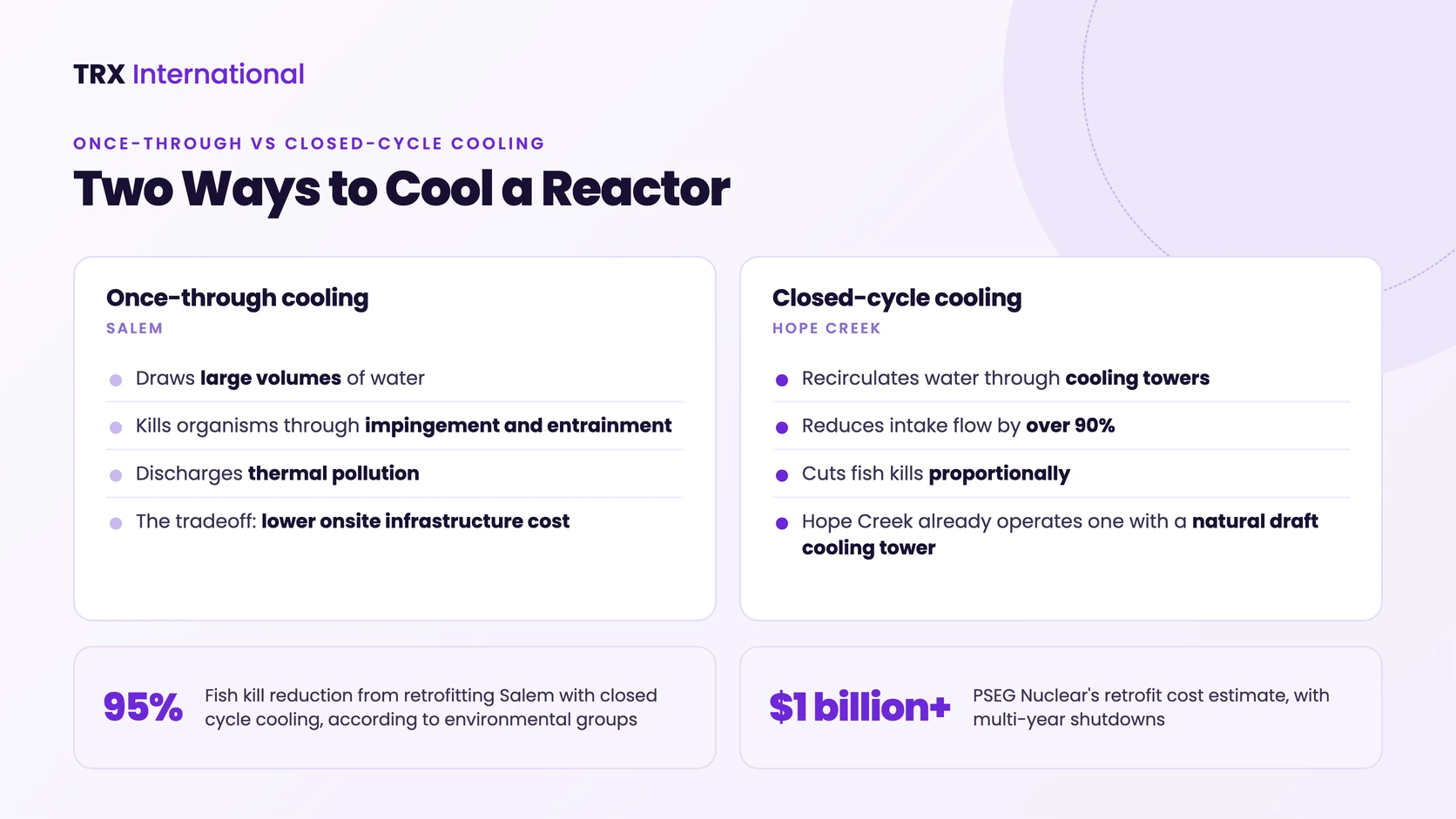
Once-through cooling draws large volumes, kills organisms through impingement and entrainment, and discharges thermal pollution. The tradeoff: lower onsite infrastructure cost. A closed cycle cooling system recirculates water through cooling towers, reducing intake flow by over 90% and cutting fish kills proportionally.
Retrofitting Salem with closed cycle cooling could reduce fish kills by 95%, according to environmental groups. The adjacent Hope Creek plant already operates a closed cycle cooling system with a natural draft cooling tower on the same peninsula. (If it works next door, the feasibility argument gets harder to dismiss.)
PSEG Nuclear's position: retrofitting Salem would cost on the order of $1 billion or more, require multi-year shutdowns, and could threaten the plant's economic viability in competitive power markets. The company and regulators argue that the existing system plus mitigation still qualifies as best technology available for existing facilities, as opposed to new construction projects where closed-cycle is typically expected.
Community, emergency planning and surrounding population
Salem operates under a 10-mile Emergency Planning Zone for immediate sheltering or evacuation in the event of an airborne release. A 50-mile ingestion pathway zone covers food and water contamination scenarios. The population within 50 miles is approximately 5.87 million, including parts of Wilmington and the Philadelphia metro area.
Emergency preparedness includes public communication systems tested regularly at Salem. PSEG Nuclear, county authorities, and the New Jersey Office of Emergency Management maintain siren systems, evacuation routes, and regular drills. Environmental monitoring of radiation is conducted around nuclear facilities like Salem on a continuous basis.
The area immediately surrounding the site is rural with low population density. The economic picture is different: Salem and Hope Creek together support over 1,600 full-time employees with an annual payroll exceeding $250 million. Property tax contributions provide revenue stability for the region.
Future outlook, MACH2 hydrogen hub and workforce opportunities
Salem's future depends on energy policy, environmental rulings, and workforce supply. The Mid-Atlantic Clean Hydrogen Hub (MACH2) received up to $750 million in federal cost-share to develop low-carbon hydrogen using clean electricity sources including Salem and Hope Creek.
Salem's approximately 2,300 MWe capacity could serve as a round-the-clock source for hydrogen production. Some environmental advocates oppose this plan, citing ongoing Delaware River impacts. Nuclear power plants like Salem must comply with stringent federal safety and environmental regulations regardless of which direction the facility takes.
Possible long-term scenarios range from continued operation with improved mitigation, to major cooling system upgrades, to integration into hydrogen and grid-balancing projects. Each path requires nuclear operators, project managers, environmental scientists, hydrogen systems engineers, and decommissioning specialists.
TRX International works as a specialist nuclear recruitment partner, supporting utilities like PSEG Nuclear and their contractors in sourcing experienced staff for operations, life-extension projects, environmental compliance, and hydrogen-related work. Salem Nuclear remains an anchor of New Jersey's power system and a focal point for the next generation of nuclear careers. If you're exploring roles in this space, we'd like to hear from you.
Frequently Asked Questions
Who owns and operates the Salem Nuclear Generating Station in New Jersey?
PSEG Nuclear LLC, a subsidiary of Public Service Enterprise Group, operates the plant and holds 57.41% ownership. Constellation Energy holds the remaining 42.59%.
When do the operating licenses for Salem Unit 1 and Unit 2 expire?
Unit 1's original license would have expired in 2016, but NRC renewal extended it through August 2036. Unit 2 entered commercial service in 1981, and its license runs through April 2040.
What is the difference between the Salem and Hope Creek nuclear plants?
They sit side by side on the same peninsula and share high-voltage transmission infrastructure. Salem uses once-through cooling, drawing water directly from the river, while Hope Creek uses a closed cycle cooling system with its natural draft cooling tower.
How does the Salem nuclear plant's cooling system affect the Delaware River?
The plant draws over 3 billion gallons daily and returns heated water to the estuary. The EPA estimates Salem entrains 14.7 billion fish, eggs and larvae yearly, though PSEG Nuclear disputes the highest mortality estimates.
How many people live within 50 miles of the Salem nuclear plant?
Approximately 5.87 million people live within 50 miles, including parts of Wilmington and the Philadelphia metro area. Salem operates under a 10-mile Emergency Planning Zone and a 50-mile ingestion pathway zone.
What kinds of jobs does the Salem nuclear plant create for workers?
The facility employs over 1,600 workers, making it the largest employer in Salem County. Its long operational history creates ongoing demand for operators, engineers and maintenance technicians, and future projects will need environmental scientists and hydrogen systems engineers.
Eleanor Whitfield writes for TRX International on careers in nuclear safety, regulation and quality assurance. Her articles break down specific roles, the qualifications and security clearances they require, and how professionals build expertise in one of the most tightly governed industries in the world.