Nuclear Reactor on the Moon: Powering a Permanent Lunar Base
NASA plans to launch a roughly 100-kilowatt nuclear reactor on the Moon by late 2029. See why lunar bases need fission power and the careers it's creating.
The idea of installing a nuclear reactor on the Moon sounds like science fiction. It's not. NASA plans to launch a lunar reactor by late 2029, and China with Russia aims to follow within five years after that. The race to build permanent infrastructure on the lunar surface is accelerating, and nuclear power sits at the center of it all.
This article covers what a lunar nuclear reactor actually is, why it's needed, and what it means for careers in nuclear energy and space engineering.
What is a Nuclear Reactor in a Lunar Context?
The Basics, Scaled Down
A nuclear reactor creates electricity through controlled nuclear chain reactions, specifically fission, where heavy atomic nuclei (like uranium-235) split apart and release heat. That heat gets converted into electricity. On Earth, this happens in massive power plants rated at 500 to 1,600 megawatts electric, with water-based cooling systems, large containment buildings, and hundreds of staff.
A reactor on the Moon is a completely different animal. Think kilowatt-scale, not gigawatt-scale. Compact. Autonomous. No water cooling. No atmosphere to help reject heat. The entire unit needs to fit on a spacecraft, survive a rocket launch, land in one-sixth gravity, and then run for years with minimal human intervention.
Nuclear power is considered a safe, clean, reliable energy option on Earth. Making it work 384,000 km away requires rethinking almost everything about reactor design.
NASA's Six Decades of Space Nuclear Work
The space agency NASA has been working on nuclear power for space longer than most people realize.
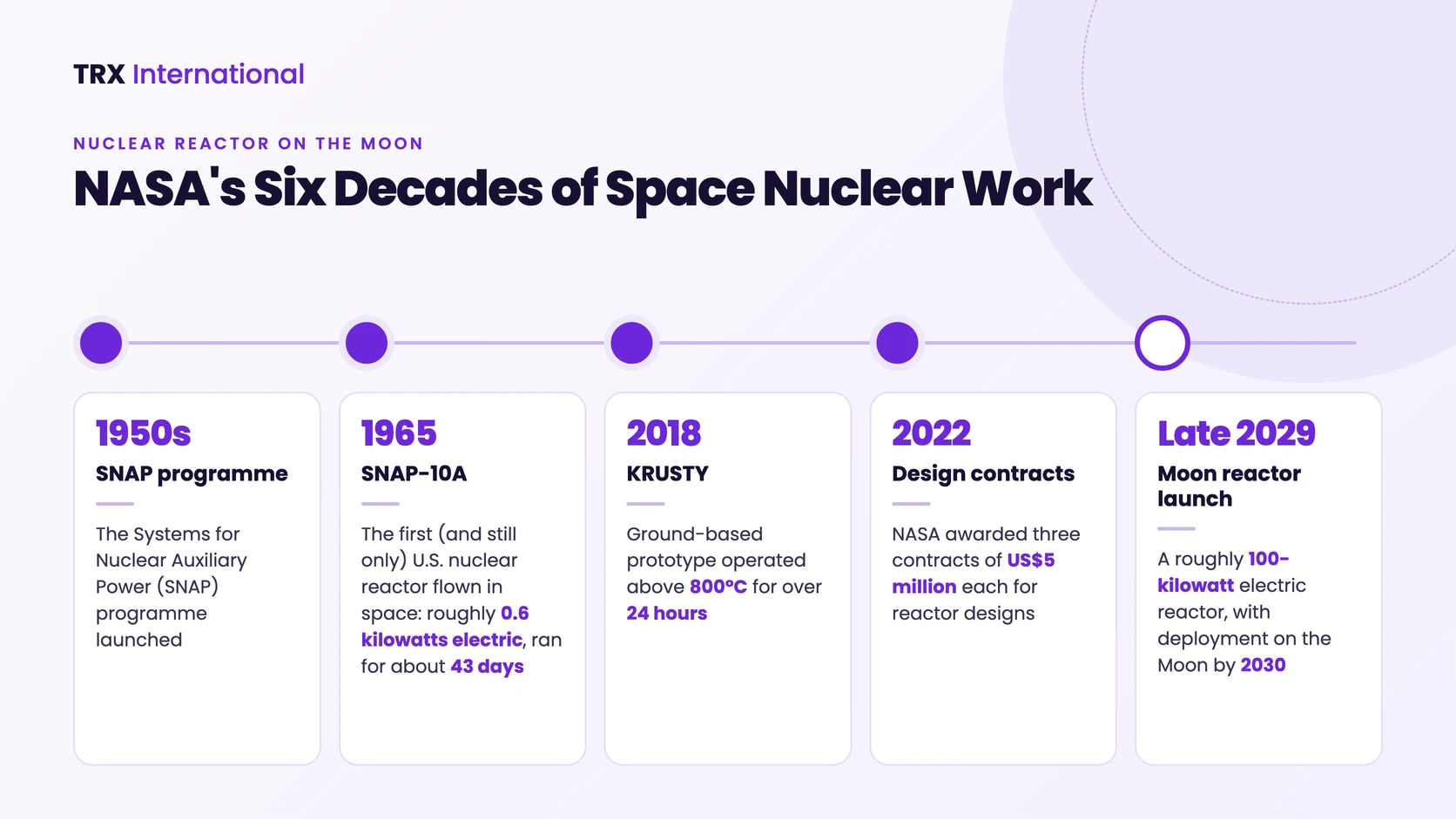
The Systems for Nuclear Auxiliary Power (SNAP) programme launched in the 1950s. SNAP-10A became the first (and still only) U.S. nuclear reactor flown in space when it launched in April 1965, producing roughly 0.6 kilowatts electric in orbit. It ran for about 43 days before an unrelated electrical failure shut it down. The SNAP-8 project explored reactor designs rated up to 600 kilowatts thermal, with higher outlet temperatures, though it never flew.
Fast forward to 2018. NASA and the Department of Energy tested KRUSTY (Kilopower Reactor Using Stirling Technology), a ground-based prototype of a compact fission reactor. KRUSTY operated above 800°C for over 24 hours, demonstrating that heat-pipe cooling and Stirling engine power conversion could work in a flight-like configuration. NASA has funded multiple nuclear reactor research projects since 2000, and KRUSTY was the most visible proof of progress.
Then came real money. NASA awarded three contracts of US$5 million each for reactor designs in 2022, pushing industry teams to develop concepts for a fission surface power system that could operate on the lunar surface.
From 40 kWe to 100 kWe: Ambitions Grew
Earlier NASA concepts for Moon missions targeted around 40 kilowatts electric, enough for a small outpost with basic life support and some science instruments. That was the initial target for the Fission Surface Power programme.
But ambitions grew. Plans expanded to include in-situ resource utilisation (ISRU), regolith processing, manufacturing, long-range rover operations, and continuous communications. The power budget kept climbing.
The proposed reactor could generate 100 kilowatts of power. The New York Times and other outlets reported on this goal: a roughly 100-kilowatt electric nuclear reactor design that NASA wants ready for launch by 2029, with deployment on the Moon by 2030. NASA's FY2027 budget documentation confirms the target, with mass constraints under approximately 15 metric tons. The reactor will generate 100 kilowatts of power, enough to run about 33 average American homes, or more relevantly, an entire small lunar base.
These compact reactors use highly enriched uranium fuel, designed for maximum energy density in minimal mass. Every kilogram matters when you're putting something on a rocket.
What Makes a Lunar Reactor Different
Here's where it gets interesting (and difficult). A standard terrestrial reactor and a reactor on the Moon share the same physics, but almost nothing else.
- No atmosphere. Zero convective cooling. All waste heat must be radiated away through large radiator panels. Thermal management is a key challenge for operating nuclear reactors in a vacuum.
- Extreme temperature swings. The Moon's environment poses extreme temperature fluctuations impacting reactor materials, from +120°C during daytime to -180°C at night. Everything expands and contracts, repeatedly, for years.
- Abrasive dust. Lunar dust is abrasive and can affect mechanical components and radiation shielding. The stuff is electrostatically charged, sticks to everything, and grinds down surfaces.
- Transport survival. The reactor must handle launch vibrations, microgravity during transit, then land in lunar gravity. Transportation of nuclear reactors from Earth introduces significant logistical challenges. Heavy lifting is needed for launching nuclear materials, which adds to costs and risks.
- Radiation shielding. Radiation shielding is essential for lunar nuclear reactors to protect astronauts. Studies estimate components near the core would see neutron fluences of 10¹⁵ to 10¹⁶ n/cm² per year, with gamma doses reaching 500 Mrad/year.
- Autonomous operation. No on-site technician is going to walk over and flip a switch if something goes wrong. These designs must be inherently safe, with passive shutdown features that work without active cooling or human input.
Safety by Design
"Nuclear power" and "nuclear energy" in off-Earth applications mean something specific: fission reactors engineered to be safe, compact, and capable of shutting down without active cooling. Many proposed designs use solid fuels, heat pipes (no high-pressure coolant loops), and thermal inertia mechanisms that make meltdown scenarios physically unlikely. The reactor doesn't start until it's on the lunar surface, well away from Earth's biosphere.
New Roles, New Specializations
This emerging field is already creating specialist roles that didn't exist a decade ago. Nuclear engineers who understand compact fast-neutron reactors. Materials experts who know how metals and ceramics behave under simultaneous vacuum, high temperature, and radiation exposure. Space systems engineers qualified to NASA standards. Remote operations architects. Radiation protection advisors for off-Earth environments. At TRX International, we're seeing these requirements appear in job specifications more frequently every quarter.
Why Put a Nuclear Reactor on the Lunar Surface?
The Direct Answer
A nuclear reactor on the Moon provides continuous, reliable power where solar alone cannot deliver. Nuclear reactors offer continuous power independent of sunlight on the Moon, and that single fact makes fission the strongest candidate for powering a permanent lunar base. Getting to a moon by 2030 presence, as multiple agencies aim to do, requires guaranteed electricity around the clock.
The Solar Problem
A lunar day lasts four weeks, with two weeks of darkness. Solar panels work well during the sunlit half. During the two-week lunar night? They produce nothing.
Nuclear fission provides uninterrupted power during the lunar night lasting 14 Earth days. To cover that gap with solar alone, you'd need enormous battery arrays, heavy enough to consume most of your launch mass budget, and subject to degradation in extreme cold. The math doesn't favor solar panels for a permanent base. Fission reactors can operate in permanently shadowed regions of the Moon, the very craters at the south pole where water ice is most abundant. That's where you want your base. And that's exactly where solar doesn't work.
The practical move for agencies is to switch from solar-only architectures to nuclear-primary power for sustained operations.
What 40 to 100 kWe Actually Powers
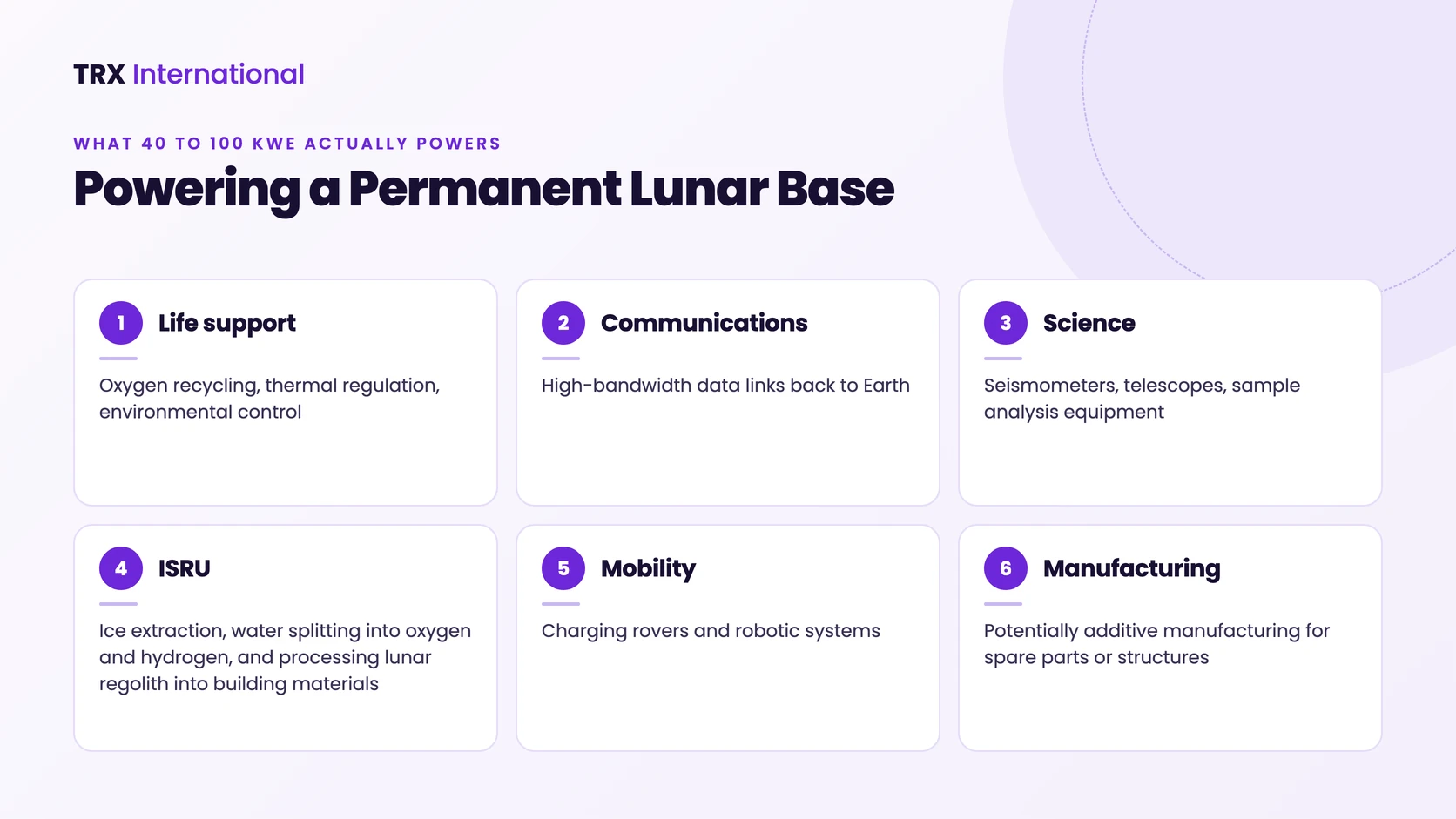
Nuclear reactors can provide necessary power for extensive lunar settlement and industry. A fission surface power system in the 40 to 100 kWe range supports:
- Life support: oxygen recycling, thermal regulation, environmental control
- Communications: high-bandwidth data links back to Earth
- Science: seismometers, telescopes, sample analysis equipment
- ISRU: nuclear power facilitates in-situ resource utilisation by providing energy for ice extraction, water splitting into oxygen and hydrogen, and processing lunar regolith into building materials
- Mobility: charging rovers and robotic systems
- Manufacturing: potentially additive manufacturing for spare parts or structures
Using nuclear reactors can support sustained human habitats and industrial activities on the Moon. That's not a theoretical claim. It's the engineering rationale behind every serious lunar base proposal since 2019.
The Artemis Timeline
NASA's Artemis program aims for a lunar presence by 2026, with crewed flights and infrastructure buildup extending through the 2030s. The programme targets the south polar region, where water ice concentrations are highest.
Space Policy Directive 1, signed by President Donald Trump in December 2017, redirected NASA back toward the Moon after years focused on asteroid missions. That directive set the trajectory that became Artemis. Since then, the programme has picked up bipartisan support (and attracted more comments from both sides of the aisle than almost any other NASA effort).
NASA plans to launch a Moon reactor by late 2029. Nuclear power supports sustained human presence on the Moon, and the reactor deployment fits into early Artemis base-build phases. Nuclear energy could serve as a stepping stone for future missions to Mars, where solar power becomes even less practical due to distance from the Sun.
As Politico and other outlets have noted, the space race framing has returned. The first country to operate a working fission power station on the lunar surface will hold a significant strategic advantage, one that goes beyond scientific prestige into questions of space dominance and resource access.
China and Russia's Parallel Track
This isn't a solo American effort. China and Russia announced joint plans in the early 2020s for the International Lunar Research Station (ILRS), an ambitious programme targeting a basic configuration by about 2035. China and Russia aim to establish lunar reactors by mid-2030s, with Rosatom, the Kurchatov Institute, and Chinese space authorities all involved in power system planning.
China's Chang'e-8 mission (targeting 2028) will lay groundwork for power infrastructure. No finalized reactor design or public contract exists yet for the ILRS nuclear power module, but the intent is clear from conference presentations and policy documents. Neither country is idle.
That matters geopolitically. 49 nations signed the Artemis Accords for lunar cooperation, establishing safety zones around installations and principles for resource use. China is not a signatory. Russia's status has shifted over recent years. International cooperation will be necessary for establishing nuclear energy frameworks on the Moon, and right now, two separate frameworks are forming. How competing nuclear reactors and bases will coexist on the same celestial body remains an open question. NASA videos and public briefings have drawn attention to this coordination challenge, and experts have offered more comments on the topic throughout November 2025 and into 2026.
Lunar Resources Worth Fighting Over
The Moon contains water, helium, and rare earth metals. That's the resource equation driving proposals from every major space agency.
- Polar water ice: usable for drinking, oxygen production, and rocket fuel (hydrogen/oxygen). Critical for a country trying to build a refueling depot.
- Helium-3: abundant in lunar regolith, deposited by solar wind over billions of years. Speculated as fuel for future fusion reactors. The technology to use it doesn't exist yet, but the resource is there.
- Rare earth elements and metals: titanium, aluminum, and other materials in lunar basalt could eventually support in-space manufacturing or supplement Earth supply chains.
Extracting any of these requires substantial, continuous energy. Nuclear fission could improve energy reliability for long-term lunar operations. Without it, ISRU stays theoretical.
Workforce Implications
The push to operate a nuclear reactor on the Moon will boost demand for specialists across several fields:
- Radiation shielding engineers (neutronics and gamma protection)
- Remote operations and robotics engineers for autonomous systems
- Cybersecurity professionals securing off-Earth control systems
- Structural analysts for low-gravity environments and regolith foundations
- International regulatory experts who understand both nuclear law and space treaties
- Materials scientists specializing in high-temperature, radiation-resistant alloys
Nuclear reactors could become a foundation for a permanent human presence on the Moon. Building that foundation requires people. A lot of them.
Careers, Skills, and TRX International's Role in Lunar Nuclear Projects
Why We're Watching This Closely
TRX International is a specialist recruitment partner in nuclear energy and clean energy. We work with utilities, EPCs, research bodies, and medical nuclear organizations worldwide. When an entirely new application of nuclear fission starts generating real contracts (not just concept papers), we pay attention. And the lunar reactor programmes have crossed that threshold.
The set of skills required for space nuclear work overlaps heavily with terrestrial nuclear expertise, but adds layers of complexity that create new specializations.
Core Technical Roles
The types of jobs emerging around lunar nuclear power systems include:
| Role | Focus Area |
|---|---|
| Nuclear design engineer | Compact fission systems, fast-neutron cores |
| Reactor physicist | Criticality calculations, fuel burnup modelling |
| Safety case author | Accident analysis, passive shutdown verification |
| Radiation protection advisor | Neutron/gamma shielding, dose limits for crew |
| Thermal engineer | Heat pipe design, radiator sizing, vacuum thermal management |
| Materials scientist | High-temp alloys, radiation damage, thermal cycling |
| Power systems integration engineer | Stirling, Brayton, or thermoelectric conversion |
These roles already exist in terrestrial nuclear. The lunar context adds constraints (vacuum, dust, remote operation, mass limits) that make them distinct enough to justify specialist hiring.
Bridging Nuclear and Space
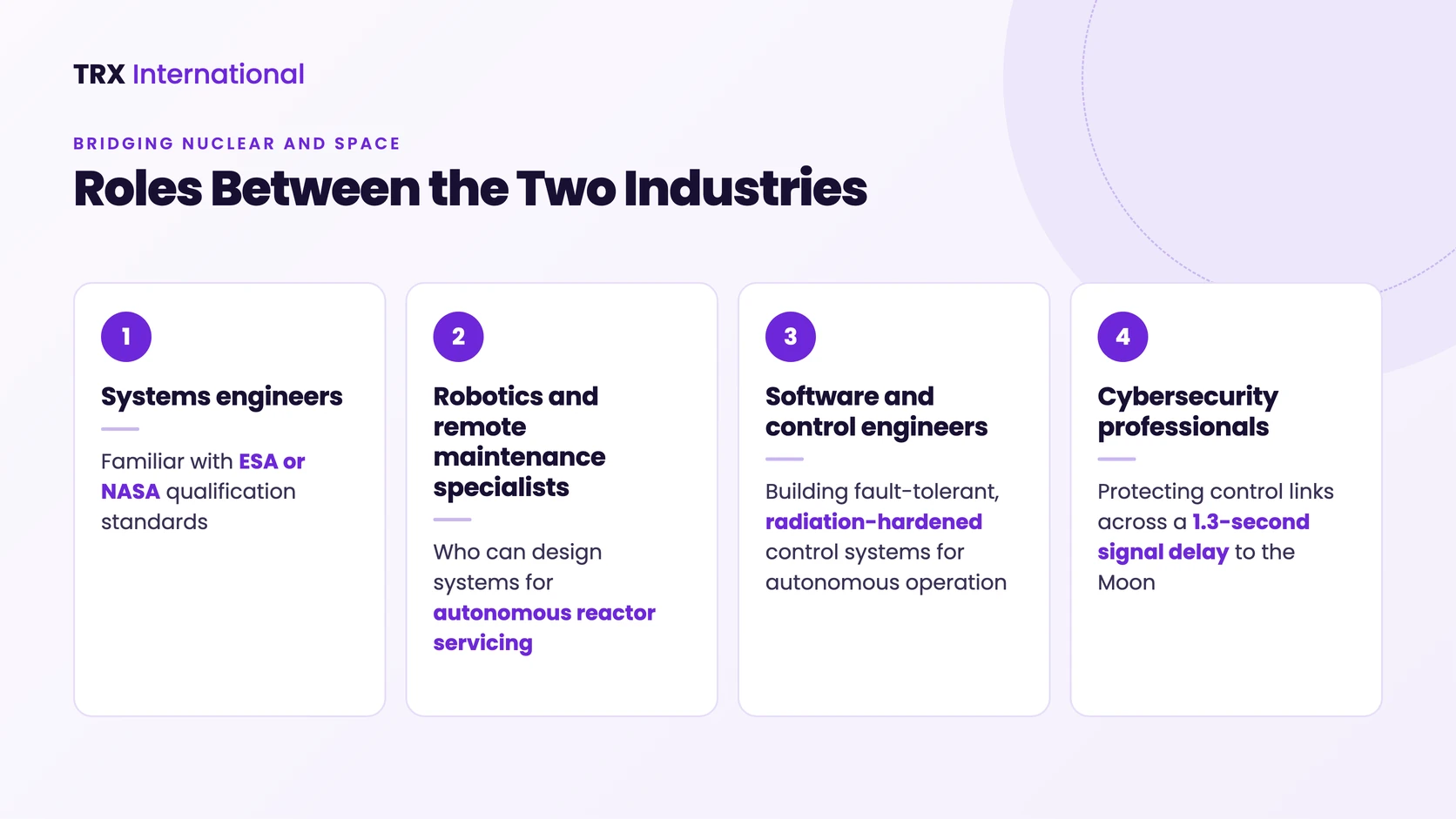
Some roles sit squarely between the two industries:
- Systems engineers familiar with ESA or NASA qualification standards
- Robotics and remote maintenance specialists who can design systems for autonomous reactor servicing
- Software and control engineers building fault-tolerant, radiation-hardened control systems for autonomous operation
- Cybersecurity professionals protecting control links across a 1.3-second signal delay to the Moon
These crossover positions will draw from both the nuclear workforce and the aerospace sector, and the future of careers in nuclear energy increasingly includes space applications.
Regulatory and Governance Careers
Here's one that people overlook. Someone has to license a nuclear reactor for launch, transit, landing, and operation on another world. That means experts in:
- Export controls for nuclear materials and technology
- Space law and treaty compliance
- Nuclear regulatory frameworks (think NRC in the U.S., ONR in the UK, plus IAEA guidance)
- Overlapping regimes between national nuclear regulators and international space agreements
Missions launching in the late 2020s and early 2030s need these people now. Not later.
SMR Skills Transfer Directly
The rise of small modular reactors on Earth is producing thousands of professionals with directly transferable skills. Project managers, QA/QC specialists, construction supervisors, and advanced reactor engineers working on SMR projects today are building exactly the expertise that lunar fission programmes will need within the decade. Professionals from fusion research and nuclear medicine imaging also bring relevant experience in radiation and shielding that maps onto space applications.
How TRX International Supports This Transition
We work both sides: helping nuclear professionals identify and transition into emerging space-nuclear roles, and helping organisations build project teams for fission surface power concepts. That includes:
- Career guidance for engineers looking at space nuclear opportunities
- Advice on security clearances and relocation for classified or international programmes
- Building specialist teams for contractors, research bodies, and agencies working on lunar reactor projects
- Connecting talent from adjacent sectors (SMR, decommissioning, fusion) with space nuclear employers
The nuclear reactor that powers a lunar base in the early 2030s will be designed, built, tested, and monitored by people working in the nuclear industry right now. The expertise you're developing today in terrestrial nuclear power may be directly applicable to operating a reactor on the Moon within the next decade.
If that interests you (and it should), explore the career opportunities in nuclear energy that TRX International tracks across the globe. Get in touch with our team for guidance on how your skills fit into the next generation of nuclear work, whether that's on Earth, in orbit, or on the lunar surface.
Frequently Asked Questions
When will NASA put a nuclear reactor on the Moon?
NASA plans to launch a lunar reactor by late 2029, with deployment on the Moon by 2030. China and Russia aim to establish lunar reactors by the mid-2030s through the International Lunar Research Station.
Why can't solar panels alone power a permanent base on the Moon?
A lunar day lasts four weeks, with two weeks of darkness, and solar panels produce nothing during the lunar night. Covering that gap needs enormous battery arrays, and solar doesn't work in permanently shadowed craters.
How much power will NASA's lunar nuclear reactor actually generate?
NASA's target is a roughly 100-kilowatt electric reactor, up from earlier concepts of around 40 kilowatts electric. Its FY2027 budget documentation confirms the target, with mass constraints under approximately 15 metric tons.
How is a nuclear reactor on the Moon designed to stay safe?
Many proposed designs use solid fuels, heat pipes with no high-pressure coolant loops, and thermal inertia mechanisms that make meltdown scenarios physically unlikely. The reactor doesn't start until it's on the lunar surface.
What careers will lunar nuclear reactor projects create for nuclear professionals?
Core roles include nuclear design engineers, reactor physicists, safety case authors, radiation protection advisors, thermal engineers, materials scientists and power systems integration engineers, plus crossover roles in robotics, software, cybersecurity and regulation.
Can skills from small modular reactor projects transfer to space nuclear work?
Yes. Project managers, QA/QC specialists, construction supervisors and advanced reactor engineers working on SMR projects today are building exactly the expertise that lunar fission programmes will need within the decade.
Elina Koskinen writes for TRX International on nuclear careers and professional development. Her guides help candidates at every stage, from graduates entering the industry to experienced engineers planning their next move, with practical advice on CVs, interviews, salaries and career progression.