Will Nuclear Fusion Create New Career Opportunities?
Yes: fusion jobs could reach 1 million by 2050. See which engineering, physics, trades and software roles are hiring now and how to get started.
Nuclear fusion is no longer a physics experiment stuck in a lab. It's becoming an industry. And industries need people. This article breaks down exactly where fusion jobs exist today, how many there could be by 2050, what skills you'll need, and how to position yourself (or your hiring strategy) for what's coming.
Answering the Big Question Up Front: Will Fusion Create New Jobs?
Yes. The short answer is backed by money, momentum, and math.
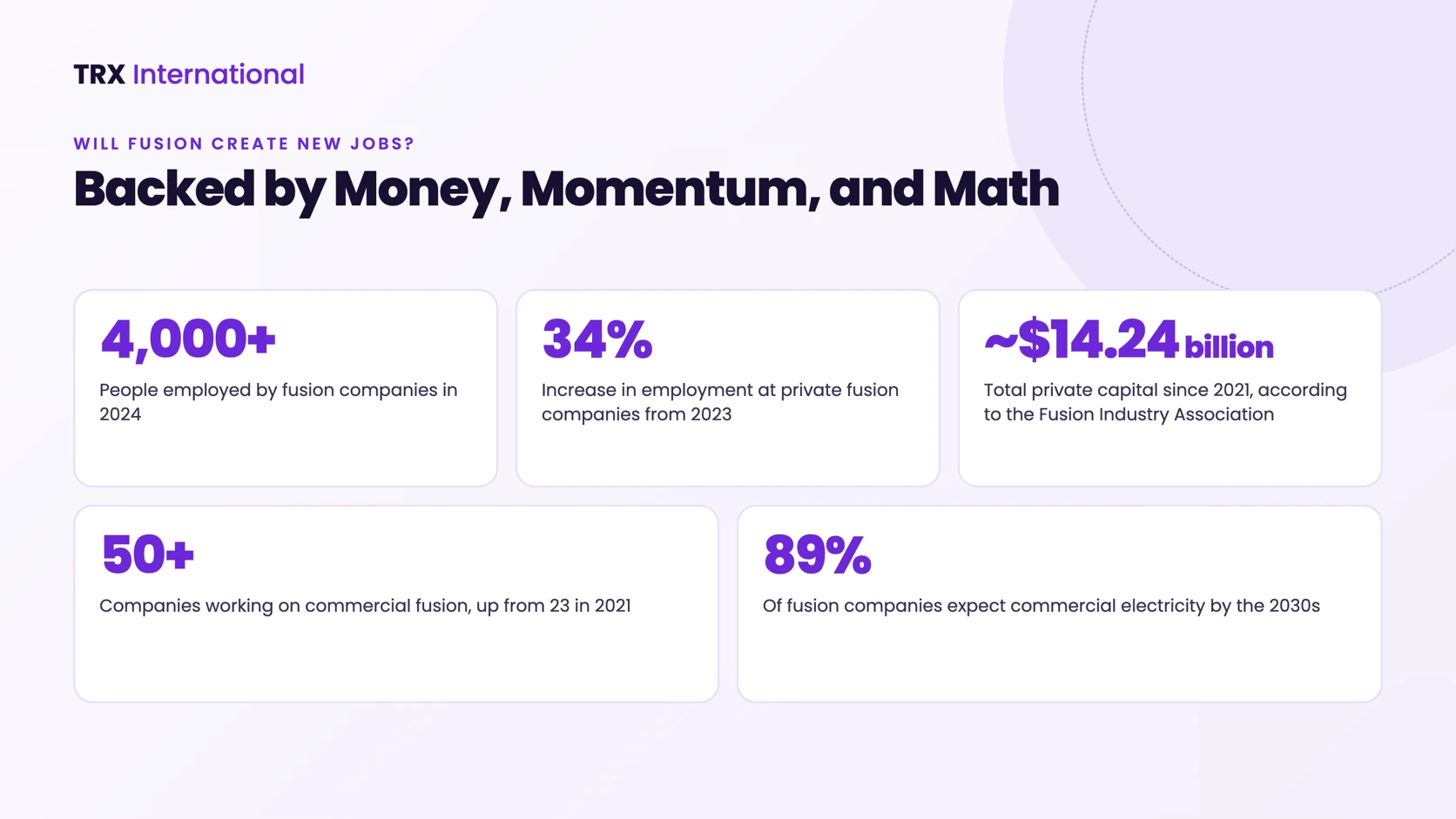
Fusion companies employed over 4,000 people in 2024, and private fusion companies saw a 34% increase in employment from 2023. That's not a blip. The fusion energy industry has received over $7.1 billion in investments, with total private capital since 2021 reaching roughly $14.24 billion according to the Fusion Industry Association. The number of companies working on commercial fusion has grown to over 50, up from 23 in 2021.
Nuclear fusion is shifting from physics research to commercial engineering. That shift is what creates jobs. Not just inside fusion companies and labs, but across the wider supply chain, construction, regulation, and grid infrastructure. The transition toward commercial power plants opens diverse career opportunities that didn't exist five years ago.
Here's a plain-language distinction: nuclear fission splits heavy atoms (uranium, plutonium) to release energy. Nuclear fusion does the opposite, forcing hydrogen atoms together under intense pressure and very high temperatures to release more energy per unit of fuel. It's the same process that powers the sun. Governments and investors across the US, UK, EU, China, Japan, and Korea are pouring billions into fusion projects because fusion fuel (deuterium from seawater, tritium bred in reactors) is nearly limitless and produces no long-lived radioactive waste.
And 89% of fusion companies expect commercial electricity by the 2030s. That timeline makes fusion recruitment a live issue right now.
The fusion workforce will encompass roles from scientific researchers to skilled tradespeople. Here's what we see at TRX International:
- Engineering roles (mechanical, electrical, systems, manufacturing) make up the largest share of current openings
- Physics and diagnostics positions are growing, especially in plasma physics and materials
- Digital roles (software, controls, data science) are appearing rapidly
- HSE, safety, and regulatory specialists are in early but rising demand
- Project delivery and leadership roles are emerging as companies move from R&D to construction
From Experimental Fusion to an Industry: Why Careers Are Emerging Now
Fusion research stretches back to the 1950s. For decades, it lived inside government labs and university departments, with the running joke that commercial fusion was always "30 years away." That joke is getting less funny, because the timeline has compressed.
The key milestones that changed the story:
- December 2022: The National Ignition Facility at Lawrence Livermore National Laboratory achieved fusion ignition, producing more energy from a fusion reaction than the laser energy input delivered to the target. This was the first time that had ever happened. The National Ignition Facility achieved fusion ignition in December 2022, and subsequent shots in 2023 and 2024 pushed output further.
- 2024: Helion Energy's Polaris achieved plasma temperatures of 150 million degrees Celsius, far exceeding the roughly 50 million degrees Celsius that fusion requires for deuterium-tritium reactions.
- ITER: The international ITER project aims to begin operations in 2034 and demonstrate net energy gain, targeting first plasma in the early 2030s. The ITER project aims to demonstrate net energy gain by 2034.
- Wendelstein 7-X in Germany set a world record for stellarator plasma confinement and demonstrated continuous operation capabilities.
- KSTAR in Korea achieved long-pulse, high-performance hydrogen plasma operations.
- Commonwealth Fusion Systems is building SPARC, a high-temperature superconducting magnet tokamak, with grid-scale demonstration (ARC) targeted for the late 2020s into the 2030s.
The shift from government labs (Princeton Plasma Physics Laboratory, UKAEA, LLNL, the ITER organization) to over 50 private fusion companies is what's driving job creation. Pure R&D employs scientists. Building prototype plants, pilot facilities, and grid-connected demonstrators employs everyone else: construction crews, operations staff, project managers, supply chain specialists, and regulatory professionals.
How Many Fusion Jobs Could There Be by 2050?
Let's put some numbers on this.
The existing nuclear industry (all fission reactors, fuel cycle, plant operations) employs roughly 1.2 million people globally. That's the benchmark. Fusion job growth is expected to reach 1 million by 2050, and fusion energy could create over 1.3 million jobs by 2050 under optimistic deployment scenarios.
Here's how the math works. Fusion plants will require about 1,500 machines to reach the target of providing roughly 20% of global power generation by 2050. Fusion energy could reach approximately 20% of global power generation by 2050 if deployment stays on pace. Fusion plant construction could create up to 8,500 jobs per project, counting direct construction, supply chain, and local support.
Commercial fusion may require approximately 60,000 specialized personnel by 2035, just to staff R&D centers, prototype plants, and early commercial facilities. That number climbs steeply through the 2040s.
Some comparative economics that matter for hiring: fusion plants are expected to cost about 20% less than nuclear fission plants of equivalent output. Fusion plant operating costs should be 50% lower than nuclear fission over the plant lifetime, largely because fusion plants will require about 20% fewer workers than nuclear fission equivalents (simpler fuel handling, less waste management, higher automation). Even with fewer workers per plant, the sheer number of plants creates enormous aggregate demand.
The global fusion market could be valued at over $40 trillion when you include electricity generation, supply chain, and technology licensing. Commercial fusion will create a massive shift in the global economy.
Current workforce breakdown in the fusion industry:
- 48% of fusion industry employees are engineers
- 25% of fusion industry employees are scientists
- The remaining ~27% cover operations, trades, business support, regulatory, and safety
What Kinds of Jobs Exist in Fusion Energy Today?
The demand for advanced manufacturing specialists will grow as fusion technology scales up. But the current job market already has real, open positions you can apply for.
Here's a snapshot grouped by role type:
Engineering (largest category):
- Senior Systems Engineer, Fusion Engine, at companies like Inertia (Livermore, CA)
- Power Electronics Engineer at Commonwealth Fusion Systems (Devens, MA)
- Manufacturing Engineering Manager at Thea Energy (Kearny, NJ)
- Mechanical engineers designing tooling and equipment for fusion reactor components
Physics and Science:
- Computational Plasma Physicist at Fuse Energy Technologies (San Leandro, CA)
- Senior Experimental Physicist at Borealis Fusion
- Laser-matter interaction experimentalists at LLNL
- Ion beam and neutron diagnostics researchers at Marathon Fusion
Software and Data:
- Realtime Controls Software Engineer at CFS
- DevOps Engineer at General Atomics
- Computational Automation and Data Science roles at LLNL
Plant-Adjacent Roles:
- Welders (multiple shifts) at Commonwealth Fusion Systems
- R&D Technicians at CFS and Helion Energy
- Maintenance technicians, electronics technicians, custodians at facilities like PPPL
Corporate and Project:
- Facility directors, VPs of engineering, recruiting coordinators, HR specialists
TRX International increasingly supports clients on both nuclear fission and early fusion recruitment campaigns, especially where cross-over skill sets make candidates valuable across both sectors.
Engineering Careers in Fusion: From Mechanical to Electrical
Mechanical engineering and electrical engineering form the backbone of fusion reactor and plant design, construction, and maintenance. Fusion requires specialized training in engineering and physics, but the day-to-day work often looks surprisingly similar to heavy industrial engineering, just with higher precision and more exotic materials.
Mechanical engineering roles:
- Manufacturing Equipment Engineer at CFS: designing and qualifying tooling for superconducting magnets, vacuum vessels, and cryostats
- Manufacturing Engineering Manager at Thea Energy (Kearny, NJ): overseeing production of stellarator components
- Spring 2027 mechanical engineering internships at Marathon Fusion (San Francisco)
- Engineers are critical for designing reactor cooling loops and thermal systems that remove heat from reactor walls
Electrical and power electronics roles:
- Power Electronics Engineer at CFS: designing high-current converters that feed superconducting magnets with precise, stable current
- Electrical engineers at Interlune (Houston) working on power systems
- Controls engineers designing fast protection systems that can shut down a fusion reactor in milliseconds if plasma instabilities develop
Where do fusion engineers come from? Traditional sectors like oil and gas, aerospace, automotive, and grid-scale renewables provide transferable skills. If you've designed pressure vessels, worked on turbine systems engineering, or managed electrical engineering for high-voltage equipment, fusion companies want to hear from you. TRX International helps candidates reposition their experience for fusion power projects.
Physics and Fusion Technology Roles: Plasma, Lasers, Ion Beams
Fusion technology depends heavily on advanced physics. If you studied plasma physics, laser physics, nuclear engineering, or materials science, your academic background maps directly onto specific fusion projects.
- Plasma science: Plasma physicists model high-temperature plasma behavior in fusion applications. Roles like Computational Plasma Physicist at Fuse Energy Technologies involve simulating how hydrogen plasma behaves inside a fusion reactor under magnetic confinement. Plasma simulation requires high-performance computing and advanced modeling techniques, often running on supercomputers.
- Magnetic confinement fusion uses strong magnetic fields to contain plasma at temperatures of 50 million degrees or higher. Tokamak Energy and CFS both hire physicists who design and optimize magnetic fields to keep plasma stable.
- Inertial confinement fusion compresses fusion fuel pellets using lasers. The National Ignition Facility, LMJ in France, and the Z Machine at Sandia all use variations of this approach. Xcimer Energy is developing a high power laser system for commercial laser fusion, and offers experimental laser internships (Denver, Summer 2027).
- Ion beams and particle beams: Marathon Fusion hires interns in ion beams and neutron diagnostics. These roles involve designing and operating diagnostic instruments that measure what's happening inside plasma at very close range.
- Magneto inertial fusion and other alternative concepts create additional demand for physicists who understand pulsed power, induced current systems, and fast-cycling magnetic fields.
- Materials science: Skills in materials science will be vital for developing radiation-resistant components for fusion reactors. Reactor walls and first-wall materials face extreme neutron bombardment, and someone has to design them to last.
This section matters for students and early-career physicists: your thesis on laser energetics or plasma science could be your entry ticket into a growing fusion industry.
Skilled Trades and Technicians: Building and Operating Fusion Plants
Fusion projects don't run on PhDs alone. They need welders, fabricators, R&D technicians, maintenance personnel, and electronics technicians. Specialized welders and machinists are needed for building fusion power plants, full stop.
Real jobs, right now:
- Welders at Commonwealth Fusion Systems (Devens, MA): multiple shifts, working on vacuum vessels, cryostats, and superconducting coils. These require nuclear-grade welding techniques and certifications.
- R&D Technician, Second Shift at CFS: hands-on assembly and testing of fusion components
- Second Shift Senior Maintenance Technician at Helion Energy (Everett, WA): maintaining the pulsed-power systems that drive Helion's fusion devices
- Technician Electronics at General Atomics (San Diego): supporting diagnostics and high-voltage systems
- Custodian at Princeton Plasma Physics Laboratory: essential site-support work that keeps a national lab running
Typical duties include precision welding of vacuum vessels, assembling superconducting magnets, installing diagnostics on fusion devices, maintaining high-voltage and vacuum systems, and supporting safe operations in environments with high-voltage or radiation considerations.
Training pathways: Apprenticeships, technical college programs, and cross-training from oil and gas or heavy industry all work. On-site certifications and safety training complete the picture. Transitioning workers from fossil fuel industries (like natural gas plant operations) to fusion jobs could leverage existing skills effectively. TRX International can advise candidates on the specific certifications that fusion and nuclear employers value most.
Software, Controls, and Data Science in Fusion Energy
Fusion reactors are data-rich, software-driven facilities. A tokamak or stellarator generates terabytes of diagnostic data per experiment, and its control systems must respond in microseconds.
AI-driven control systems will be essential for stabilizing plasma in fusion reactors. Data science plays a critical role in analyzing complex data from fusion reactors. Here's where the software jobs are:
- Realtime Controls Software Engineer and Senior Realtime Controls Software Engineer at CFS: building the control systems that keep plasma stable and protect superconducting magnets from damage
- DevOps Engineer at General Atomics: managing the infrastructure behind large-scale physics codebases
- Computational Automation and Data Science Scientist at LLNL: developing automated analysis pipelines for inertial confinement experiments
- IT Operations Specialist roles at UKAEA
Key technologies: real-time operating systems, FPGA-based control hardware, machine learning for plasma control and anomaly detection, data pipelines for diagnostics processing, and DevOps practices for managing simulation codebases.
New career paths are opening at the intersection of AI and fusion: predictive maintenance for high tech components, automated experiment design, and machine-learning models that predict plasma disruptions before they happen. If you're a software engineering professional in another industry, fusion offers a genuinely different (and consequential) application for your skills.
Project Management, Leadership, and Corporate Functions
Fusion is moving from lab to grid. That transition demands project managers, facility directors, and corporate leaders who can deliver multi-billion-dollar fusion projects on schedule.
- DIII-D Facility Director at General Atomics: running one of the world's largest operating tokamaks
- VP, Plant Design Engineering at Thea Energy: overseeing the design of a stellarator power plant
- Director of Heating and Fueling at Thea Energy: leading the systems that heat plasma and manage fusion fuel
- Technical Project Manager, Implosion at Xcimer Energy: managing the development of a laser-driven fusion implosion system
- Vice President, Science at Daedal Systems
- Chief of Staff, Corporate Affairs at Focused Energy
Non-technical corporate careers also exist: HR and pay and reward roles at UKAEA, senior technical recruiter at Xcimer Energy, recruiting coordinators at fusion start-ups, and office coordinators at Zap Energy.
Large nuclear builds have historically needed specialized project management, project controls, commercial managers, and PMO staff. The same applies to fusion industry build-out. TRX International supports employers assembling these multidisciplinary leadership teams.
Where Will Fusion Jobs Be? Global Hotspots and Clusters
The fusion job market isn't evenly distributed. Here's where the work is concentrated:
United States:
- Boston/Devens, MA: Commonwealth Fusion Systems (largest private fusion employer)
- Bay Area, CA: Marathon Fusion, Fuse Energy, multiple start-ups
- San Diego, CA: General Atomics, TAE Technologies
- Everett, WA: Helion Energy
- Livermore, CA: LLNL, Inertia
- Denver/Tucson: Xcimer Energy
- Princeton, NJ: Princeton Plasma Physics Laboratory
- Massachusetts Institute of Technology: academic fusion research hub
United Kingdom:
- Oxfordshire/Culham: UKAEA (2,600+ employees), STEP prototype site preparation
Continental Europe:
- Germany: Wendelstein 7-X (Greifswald), Max Planck IPP (Garching)
- France: LMJ (Bordeaux region), ITER (Cadarache)
Asia:
- Korea: KSTAR
- Japan: LHD, FAST
- China: EAST, private players emerging
Emerging clusters: Type One Energy's stellarator project in Tennessee, Canadian and Australian spin-offs, and regions with existing nuclear supply chains that are positioning to host fusion power plants.
Most engineering and operations roles are on-site. Some software engineering and corporate functions at CFS and others offer hybrid arrangements, but don't expect to build a spherical tokamak from your living room.
Fusion Technology Pathways and Their Job Impacts
Different fusion technology families create different workforce profiles. Here's how they break down:
- Magnetic confinement (tokamaks and stellarators): ITER, K-DEMO, SPARC/ARC, Type One Energy. These drive large plant-style jobs: civil construction, site preparation, plant engineering, operations, grid integration. Superconducting magnets are central, requiring cryogenic engineers, magnet winding technicians, and power electronics specialists.
- Inertial confinement (laser fusion): The National Ignition Facility, LMJ, Xcimer Energy, Pacific Fusion. These create more optics, high power laser, and high-precision manufacturing roles. Example: "Production Manager, Wound Film Capacitors" in Tucson supporting laser systems.
- Magneto inertial fusion and pulsed power: Helion Energy, General Fusion. Specific needs in pulsed power, liquid metal systems, fast-cycling plant operations, and durability engineering under repetitive thermal and mechanical stress.
- Stellarators: Wendelstein 7-X, Type One Energy, Thea Energy, Proxima Fusion. Complex 3D geometry demands advanced manufacturing, precision assembly, and computational modeling at scale.
- Hybrid and alternative concepts: TAE Technologies (field-reversed configuration using particle beams), One Energy, Tokamak Energy (compact spherical tokamak), Zap Energy (sheared-flow Z-pinch using the Z Machine concept). Each has distinct engineering requirements.
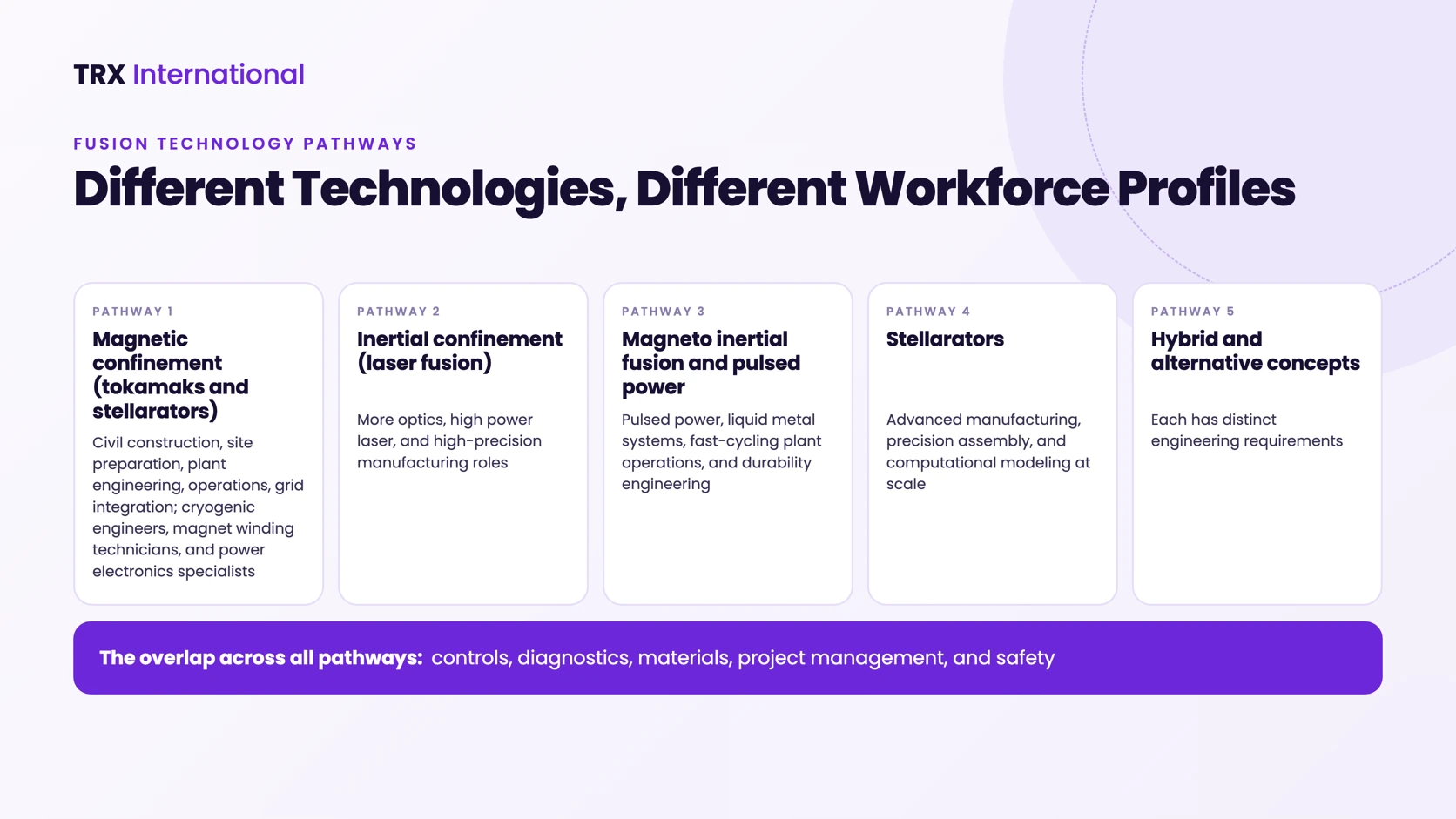
The overlap across all pathways: controls, diagnostics, materials, project management, and safety. Those skills transfer regardless of which fusion technology wins.
Understanding Fusion Fuel, Safety, and Regulatory Careers
Fusion fuel is simple in theory: deuterium and tritium. Deuterium occurs naturally in seawater at 30 grams per cubic meter, making it essentially inexhaustible. Tritium is rarer and must be bred inside the fusion reactor using lithium blankets. This fuel cycle creates specific career needs.
- Tritium handling: Engineers and technicians who manage tritium extraction, storage, and accountability. The nuclear fusion industry will require strict regulatory compliance and safety oversight around tritium systems.
- Neutronics engineers study the behavior of neutrons in nuclear fusion, modeling how neutrons interact with breeding blankets, shielding, and structural materials.
- Nuclear Quality Manager at SHINE Technologies, safety and health operations managers at UKAEA, and regulatory/quality specialists across fusion start-ups.
- Regulatory and safety roles in fusion will differ significantly from traditional nuclear practices. Fusion reactors don't produce the same long-lived waste as fission, and they can't melt down in the same way. Regulators in the US, UK, and EU are developing dedicated fusion licensing frameworks. The first US stellarator plant license was issued in Tennessee in 2026, and the Nuclear Regulatory Commission is clarifying its approach to fusion vs. fission oversight.
- High-temperature superconducting magnets are essential for magnetic confinement in fusion devices, and their safe operation requires specialized quality assurance and regulatory approvals protocols.
TRX International expects significant cross-over demand from current fission regulatory experts into fusion compliance roles, especially in the 2030s as commercial plants seek permits for electricity generation.
How Fusion Will Reshape the Wider Nuclear Job Market
Fusion doesn't replace fission jobs. It adds to them, and the two sectors will compete for the same talent.
Skills that transfer between fission and fusion:
- Radiation protection and dosimetry
- High-integrity manufacturing and nuclear-grade quality assurance
- Regulatory frameworks and licensing experience
- Plant operations, outage planning, and maintenance
- Structural and materials engineering
The rise of small modular reactors alongside fusion means candidates with nuclear backgrounds will be in high demand across both sectors. That creates competition for talent but also career flexibility. Some specialists (radiation safety officers, structural engineers, nuclear power plants operators) will be able to move between fusion and fission projects as employers diversify.
TRX International anticipates advising both employers and professionals on dual-experience career paths spanning SMRs, decommissioning, and fusion projects through the 2030s and 2040s.
Education Pathways: What to Study for a Fusion Career
Fusion projects may lead to new educational programs and workforce training initiatives in related fields. But you don't have to wait for a dedicated "fusion degree." Core routes include:
Degree programs:
- Mechanical engineering or electrical engineering (the most common backgrounds in fusion)
- Nuclear engineering (directly applicable, especially for reactor design and safety)
- Plasma physics or applied physics
- Materials science (essential for radiation-resistant component development)
- Computer science or data science (for controls, simulation, and AI roles)
Vocational routes:
- Welding certifications (especially nuclear-grade)
- Electrical technician qualifications
- Cryogenic systems training
Early-career opportunities to target:
- Spring 2027 internships at Marathon Fusion (San Francisco): mechanical engineering, plasma modelling, ion beams, neutron diagnostics
- Summer 2027 internships at Xcimer Energy (Denver): undergraduate and graduate laser fusion roles
- Graduate programs at LLNL and UKAEA
- Academic positions at Princeton Plasma Physics Laboratory and the Massachusetts Institute of Technology
Seek out university modules in fusion technology, plasma physics, cryogenics, power systems, high-voltage engineering, or control systems where available. Even a final-year project connected to fusion science strengthens your profile considerably. TRX International's blog on career pathways in the nuclear sector offers more comments and detailed guidance on aligning academic choices with industry needs.
Mid-Career Transitions into Fusion from Other Industries
Many current fusion hires come from aerospace, oil and gas, semiconductor, defence, and traditional power sectors. You don't need to start over.
Transferable roles:
- Turbine and thermal engineers into balance-of-plant design and cooling systems
- Offshore welders and pipefitters into vacuum and cryogenic systems
- Semiconductor cleanroom technicians into precision assembly and vacuum equipment maintenance
- Defence electronics engineers into power electronics and pulsed-power systems
- Grid operators from conventional power plants into fusion plant grid integration
Realistic transition steps:
- Short courses on fusion fundamentals (several universities and online platforms now offer these)
- Radiation safety certificates
- Hands-on experience via contract roles at national labs or fusion start-ups
- Work with recruiters like TRX International who understand cross-sector mapping and can help translate your CV into fusion-relevant language
The practical barrier is lower than most people think. If you've worked in high-reliability engineering or complex project environments, fusion companies already consider you a strong candidate.
Fusion Internships, Graduate Schemes, and Early Talent Pipelines
Major fusion employers are building structured early-talent pipelines right now. Here are concrete programs:
- Marathon Fusion (San Francisco): 2027 intern cohort covering mechanical engineering, plasma modelling, ion beams, and neutron diagnostics
- Inertia (Livermore, CA): Summer 2027 internships for engineering and physics students
- Xcimer Energy (Denver and Tucson): Undergraduate and graduate internships in experimental laser systems, Summer 2027
- UKAEA (Culham, UK): Graduate roles and research placements
- LLNL (Livermore, CA): Academic graduate appointments in fusion science, laser energetics, and computational physics
- CFS (Devens, MA): Engineering internships and co-ops
Typical selection criteria:
- Strong STEM fundamentals (GPA matters less than project and research experience)
- Coding skills for modelling and data analysis roles
- Demonstrable interest in fusion energy (publications, conference attendance, relevant coursework)
Start engaging early. Summer placements, research assistantships, and industry events like the FIA annual summit build connections that lead to first plasma (of your career, anyway).
Salary Levels and Career Progression in Fusion
Fusion salaries are competitive. Very competitive.
Across about 355 open fusion roles tracked in late 2026, the median published salary sits around $165,000 (US). The middle 50% of published roles fall between $148,000 and $188,000. A Senior Experimental Physicist at Borealis Fusion, for example, carries an indicative range of $160,000 to $200,000.
For context, nuclear engineers and reactor operators in fission earn median salaries in the low-to-mid $120,000 range. Fusion premiums of 25-30% above average power sector roles are common for in-demand skills. Check our guide to the highest paying nuclear jobs for broader salary benchmarks.
Typical progression routes:
- Technician → Senior Technician → Team Lead
- Engineer → Senior Engineer → Principal Engineer/Manager → Director/VP
- Scientist → Staff Scientist → Group Leader → Chief Scientist/CTO
Equity and stock options are increasingly part of compensation in VC-backed fusion start-ups, adding long-term financial upside. If a company you join gets to first plasma and commercial operation, early equity could be worth multiples of your base salary.
Skills Shortages: Where Demand Will Outstrip Supply
The nuclear sector already faces a skills gap: an ageing workforce, limited university throughput, and tens of thousands of new workers needed by the late 2020s just for fission. Fusion compounds that pressure.
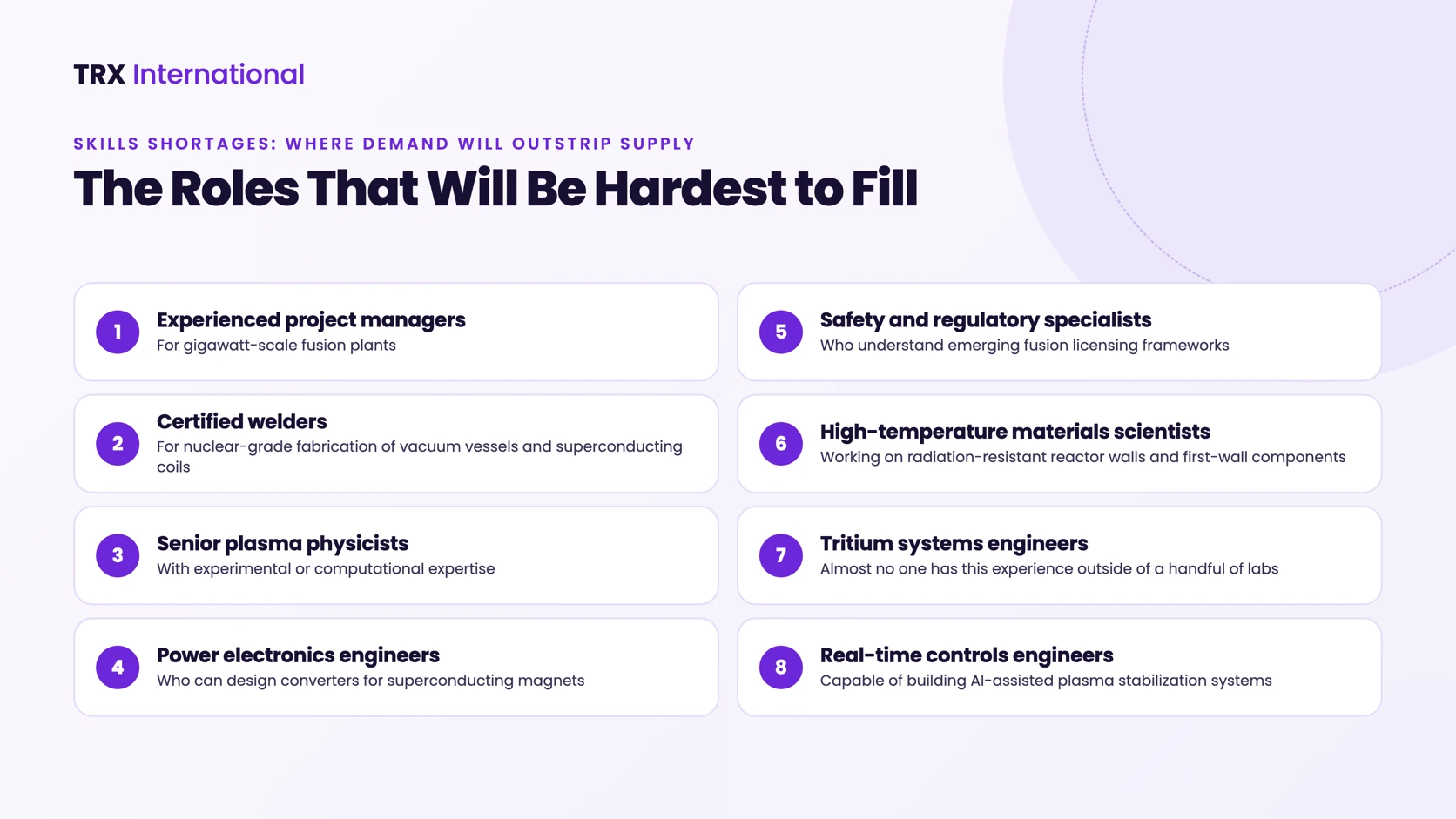
High-shortage categories (the roles that will be hardest to fill):
- Experienced project managers for gigawatt-scale fusion plants (very few people have managed projects of this complexity and novelty)
- Certified welders for nuclear-grade fabrication of vacuum vessels and superconducting coils
- Senior plasma physicists with experimental or computational expertise
- Power electronics engineers who can design converters for superconducting magnets
- Safety and regulatory specialists who understand emerging fusion licensing frameworks
- High-temperature materials scientists working on radiation-resistant reactor walls and first-wall components
- Tritium systems engineers (almost no one has this experience outside of a handful of labs)
- Real-time controls engineers capable of building AI-assisted plasma stabilization systems
TRX International is already mapping these future shortages and helping clients develop long-term talent strategies, including international mobility and training partnerships.
How Fusion Will Influence Non-Energy Sectors
The economic impact of fusion technology could reach far beyond energy production. Fusion technology could lead to job creation across various industries including healthcare and finance.
- Medical imaging: Stronger superconducting magnets developed for fusion reactors will improve MRI systems
- Cancer therapy: Better particle accelerators and neutron sources could advance radiotherapy and isotope production for nuclear medicine
- Space propulsion: Compact fusion reactor designs are being explored for deep-space missions
- Advanced manufacturing: Precision fabrication techniques for fusion devices transfer to aerospace, semiconductor, and other high-tech manufacturing sectors
- Financial services: The global fusion market could be valued at over $40 trillion, creating demand for energy traders, insurers, and investment analysts with fusion sector knowledge
- Materials testing: Fusion-based neutron sources could replace aging fission research reactors for materials testing
This cross-pollination creates indirect fusion-related careers outside traditional power plants. Many fall into TRX International's broader nuclear and medical nuclear recruitment remit.
Regional Policies and Investment: What They Mean for Jobs
The fusion research and investment wave has been dramatic. Fusion research has received over $7.1 billion in investments recently, with the US leading at roughly 53% of private funding and China at about 34%.
Key policy and program signals:
- UK's STEP programme: Aiming for over 100 MW net electricity from a prototype fusion plant by around 2040. Site preparation is underway in West Burton. This gives employers confidence to hire for long-term, permanent roles.
- Korea's K-DEMO: Scheduled into the late 2030s, creating demand for fusion engineers and plant operators in Asia.
- US DOE Milestone-Based Fusion Development Program: Launched in 2022, providing phased public funding to private fusion companies that hit technical milestones.
- EU fusion roadmap: Supporting ITER completion and domestic fusion industry development through Horizon Europe funding.
- Regulatory clarity: Differentiated rules for fusion vs. fission are being established in several jurisdictions. First-of-a-kind fusion plant licenses in the US will trigger jobs in plant siting, permitting, community engagement, and compliance.
National budgets committing hundreds of millions to fusion industrialization signal that these aren't speculative bets. They're policy commitments that underwrite long-term hiring.
How TRX International Supports Fusion Employers and Candidates
TRX International is a specialist recruitment partner across the nuclear and emerging fusion industry. We serve utilities, EPCs, research bodies, and fast-growing private fusion companies.
For employers:
- Permanent and contract recruitment across engineering, physics, trades, software, and leadership roles
- Global talent search with security clearance support and relocation assistance
- Tailored recruitment campaigns for fusion projects, from R&D labs to full-scale fusion reactor build-outs
- Supply chain workforce support for companies scaling from prototype to production
For candidates:
- CV advice tailored to fusion and nuclear roles
- Help translating adjacent-industry skills (aerospace, oil and gas, semiconductor) into fusion-relevant language
- Interview preparation and career transition guidance
- Access to roles across SMRs, decommissioning, fusion technology, plant engineering, and research
Learn more about how TRX International connects talent with nuclear energy leaders.
Preparing Your Career for a Fusion-Powered Future
Fusion energy is moving from theory to deployment. Commercial demonstration is expected in the 2030s, with large-scale buildout through the 2040s and 2050s. The job market is live today, not waiting for a breakthrough that's perpetually decades away.
Main opportunity areas:
- Engineering: mechanical engineering, electrical engineering, systems engineering, manufacturing
- Physics and fusion technology: plasma physics, laser fusion, materials science
- Trades and technicians: welding, fabrication, maintenance, electronics
- Software and data: real-time controls, software engineering, data science, AI
- Safety and regulatory: licensing, compliance, nuclear quality, radiation protection
- Leadership and corporate: project management, executive roles, HR, finance
Your next steps:
- Follow major fusion projects and companies (CFS, Helion Energy, Xcimer Energy, TAE Technologies, Tokamak Energy, One Energy)
- Build core technical skills in your discipline, with fusion-relevant specializations where possible
- Gain experience in adjacent nuclear or high-reliability sectors
- Connect with specialist recruiters like TRX International who can match your profile to the right opportunities
The fusion industry is hiring now, and it's going to hire a lot more. Whether you're an experienced nuclear engineer, a recent physics graduate, a welder looking for something different, or an employer assembling a team for your first fusion project, the window to get involved is open. Don't wait for fusion to arrive. It's already here.
Frequently Asked Questions
How many new jobs could nuclear fusion create by 2050?
Fusion job growth is expected to reach 1 million by 2050, and optimistic deployment scenarios put it at over 1.3 million. Commercial fusion may need approximately 60,000 specialized personnel by 2035 alone.
What qualifications do you need to get a job in fusion energy?
Mechanical or electrical engineering are the most common backgrounds, alongside nuclear engineering, plasma physics, materials science and computer science. Vocational routes include nuclear-grade welding certifications, electrical technician qualifications and cryogenic systems training.
Can nuclear fission workers transfer their skills into fusion energy jobs?
Yes. Radiation protection, nuclear-grade quality assurance, licensing experience, plant operations and materials engineering all transfer between fission and fusion. Some specialists will be able to move between fusion and fission projects as employers diversify.
How much do jobs in the nuclear fusion industry pay?
Across about 355 open fusion roles tracked in late 2026, the median published salary was around $165,000 in the US, with the middle 50% between $148,000 and $188,000. Equity is increasingly part of start-up compensation.
Which fusion industry jobs will be hardest to fill in the future?
The biggest shortages are expected among experienced project managers for gigawatt-scale plants, certified welders, senior plasma physicists, power electronics engineers, safety and regulatory specialists, materials scientists, tritium systems engineers and real-time controls engineers.
Where are most nuclear fusion jobs located in the world right now?
In the US, key hubs include Boston/Devens, the Bay Area, San Diego, Everett, Livermore and Princeton. Other clusters include Culham in the UK, Germany, France, Korea, Japan and China, with emerging clusters such as Tennessee.
Elina Koskinen writes for TRX International on nuclear careers and professional development. Her guides help candidates at every stage, from graduates entering the industry to experienced engineers planning their next move, with practical advice on CVs, interviews, salaries and career progression.