Are Nuclear Energy Jobs Safe from AI Automation?
Most nuclear energy jobs are protected from full AI automation for 10 to 20 years. See which roles are most exposed and how to future-proof your career.
Artificial intelligence is reshaping entire industries. If you work in nuclear energy (or you're thinking about it), the question is fair: will AI come for your job? Here's what the evidence actually shows.
Quick Answer: Will AI Replace Nuclear Energy Jobs?
Short version: no. Most nuclear power plant roles and nuclear engineer positions are structurally protected from full AI automation for at least the next 10 to 20 years. Nuclear engineers face a 10% automation risk, and AI currently absorbs less than 0.1% of their core work. Only 21% of industry observers predict a chance of full automation even 20 years out.
That doesn't mean AI isn't showing up. It is. But it's showing up as a tool, not a replacement. Artificial intelligence will mainly augment monitoring, calculations, and compliance documentation rather than replace licensed staff. The nuclear energy sector is heavily regulated and characterized by strict safety protocols. NRC regulations in the U.S., ONR rules in the UK, ASN in France, and IAEA guidance globally all require human accountability for key nuclear reactor decisions. No regulator has approved fully autonomous reactor operation. None.
The real career risk for nuclear professionals? Plant closure policy and project timing. Not AI tools. Nuclear employment in the U.S. increased by approximately 4% in 2025, and TRX International sees strong demand for experienced nuclear engineers, operators, and safety specialists through the 2030s.
Key assurances for jobseekers:
- Regulatory frameworks mandate human operators with real accountability for safety functions
- AI augments non-core tasks (report drafting, trend analysis) while reactor trips and emergency response stay human
- Workforce demand is growing, especially in SMR programs, new construction, and plant life extensions
- Roles requiring professional judgement, licensing, and on-site presence are the least exposed to automation
How AI Is Already Used in Nuclear Power Plants Today
AI in nuclear energy isn't science fiction. It's already deployed, just not where most people assume.
Predictive maintenance is the most visible use case. One documented deployment placed IoT sensor arrays and machine learning models on a nuclear plant's circulating water pump. The system performs anomaly detection on vibration and temperature data, predicts remaining useful life, and suggests maintenance scheduling. The result: fewer unplanned shutdowns, better planning for plant equipment upkeep.
AI-assisted monitoring is expanding too. Digital twin frameworks combine physics-based models with ML to create virtual sensors for reactor coolant pump components. These systems detect issues that physical instrumentation might miss, classify fault types, and increase observability in areas lacking sensors. A systematic review covering 99 studies found deep-learning models being applied to performance prediction and degradation tracking across existing plants and research reactors.
AI can assist with regulatory compliance by managing documentation and tracking requirements. Tools like "Atomic Canyon," developed with EPRI and NEI, help operators search operating records and technical knowledge bases faster. Early use of large language models for drafting procedures, safety reports, and regulatory correspondence is real, but qualified nuclear engineers still review and sign off on everything.
Here's what matters most: in all current deployments, human operators retain control-room authority and final decision making. Reactor trips, power changes, safety-related operations, those stay human.
Typical AI-supported tasks today:
- Vibration/temperature anomaly detection on pumps, valves, and turbines
- Trend prediction for reactor core instrumentation and cooling systems
- Radiation mapping and path planning for inspection robotics
- Drafting and summarizing compliance documentation
- Work order scheduling and prioritization
Why Full AI Automation Is Unlikely in Nuclear Operations
Automating a warehouse means rerouting a package. Automating a nuclear reactor means managing a system where a wrong call could affect public safety for decades. The constraints are categorically different.
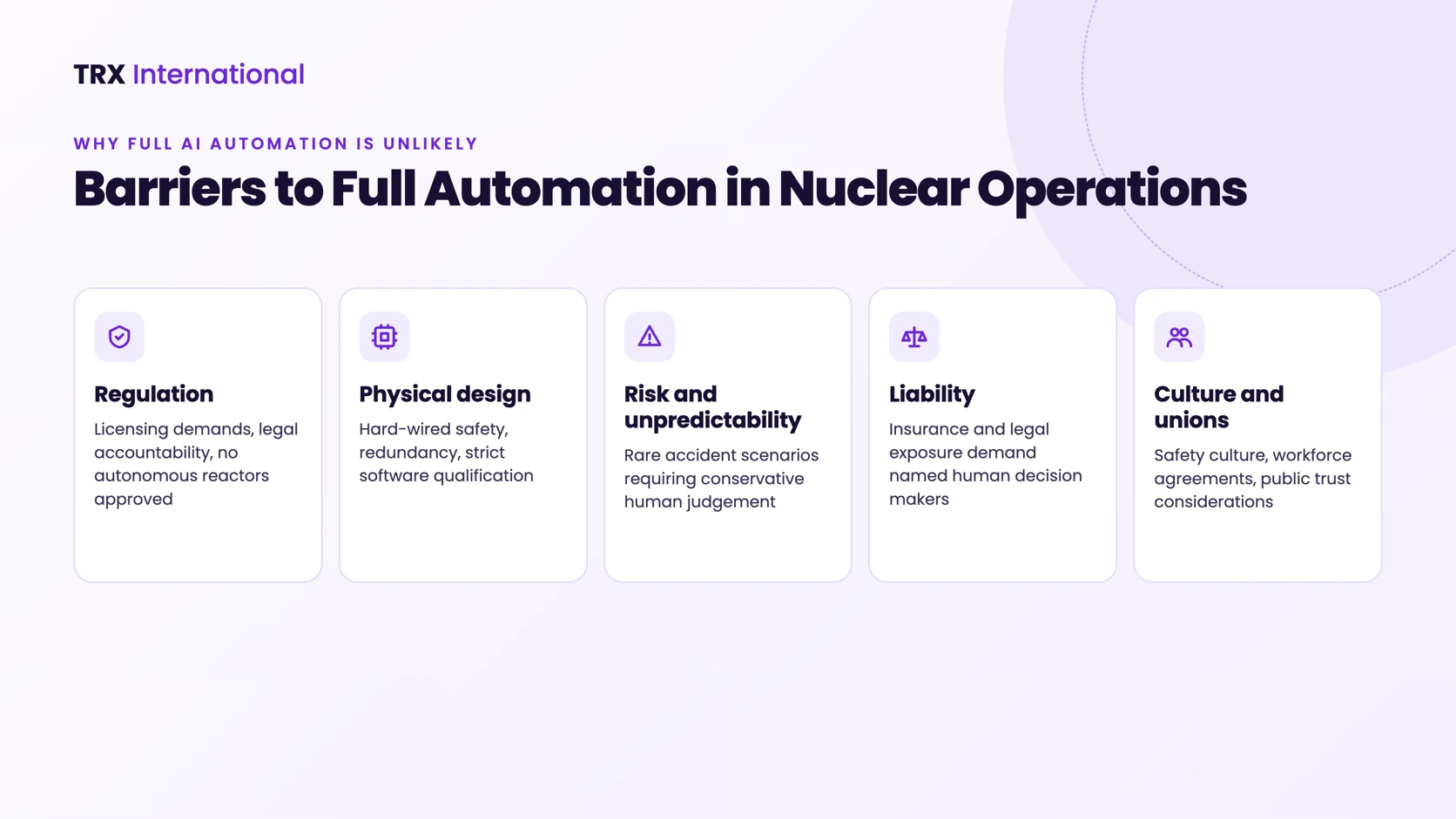
U.S. NRC rules (10 CFR Part 55) require licensed human operators present in the control room 24/7. NRC regulations prevent autonomous AI operation of nuclear reactors. Even proposed rules for microreactors and low-risk units still retain licensed staff for key safety functions. The UK's ONR and EU regulators follow similar logic. There is no regulatory pathway for fully autonomous nuclear reactors in the 2020s. Period.
Physical and cyber-security constraints add another layer. Critical safety systems in nuclear power plants are often hard-wired with redundant, diverse hardware and air-gapped backups. Software qualification processes (verification, validation, environmental qualification for radiation and temperature) are rigorous. AI and ML models, especially deep learning, struggle to meet these standards for high-assurance operation.
Plant owners and governments are not prepared to transfer legal responsibility for nuclear power plant safety to opaque AI systems. Insurance markets demand human oversight. Accountability has to sit with a person, not an algorithm.
Workforce culture and unions in many countries insist on human nuclear reactor operators and maintenance crews for safety-critical tasks. Nuclear engineers' work requires human judgment and regulatory accountability. That's not changing soon.
Barriers to full automation (summary):
- Regulation: licensing demands, legal accountability, no autonomous reactors approved
- Physical design: hard-wired safety, redundancy, strict software qualification
- Risk and unpredictability: rare accident scenarios requiring conservative human judgement
- Liability: insurance and legal exposure demand named human decision makers
- Culture and unions: safety culture, workforce agreements, public trust considerations
Nuclear Engineers and AI: Who Does What?
A nuclear engineer's core work spans reactor design, core physics, fuel cycle analysis, safety assessment, licensing, SMR development, fusion research, and nuclear medicine systems. Nuclear engineers require a BS or PhD in nuclear engineering, and many also require PE licensure and security clearance. As of 2024, there are 14,740 nuclear engineers employed in the U.S., with a median annual wage of $133,970.
AI can speed up 51% of nuclear engineers' tasks. It can also automate 25% of routine tasks. That sounds dramatic until you look at what those tasks actually are. Parameter sweeps, code runs, data aggregation, literature searches. The problem solving that defines engineering (interpreting ambiguous results, setting conservative safety margins, making regulatory submissions) stays firmly human. Credentialed accountability is essential for nuclear engineers' roles.
Nuclear engineers operate under codes and standards (ASME, IAEA, national nuclear code requirements) that demand traceability, conservatism, and professional judgement. AI tools can't sign off on a safety case. A senior nuclear engineer can.
AI-friendly tasks vs. judgement-critical tasks:
| AI-friendly tasks | Judgement-critical tasks |
|---|---|
| Parameter sweeps and simulation subroutines | Reactor design safety margins |
| Trend and data analysis | Licensing strategy and regulatory submissions |
| Drafting non-core documentation | Interpreting ambiguous or conflicting sensor data |
| Literature search and summarization | Emergency response planning |
| Fuel loading pattern optimization | Core physics decisions under novel conditions |
Nuclear engineer demand is rising due to regulatory expansion and climate concerns, with high paying jobs stable across the U.S., UK, EU, and Gulf new-build markets.
Which Nuclear Energy Roles Are Most and Least Exposed to AI?
AI risk is task-based, not job-title-based. Some aspects of a role are highly automatable. Others are structurally human. Nuclear reactor operators are protected by strong regulatory barriers requiring them to be physically present. Job openings for nuclear engineers are expected to rise 0.4% by 2035, mostly from retirements and transfers.
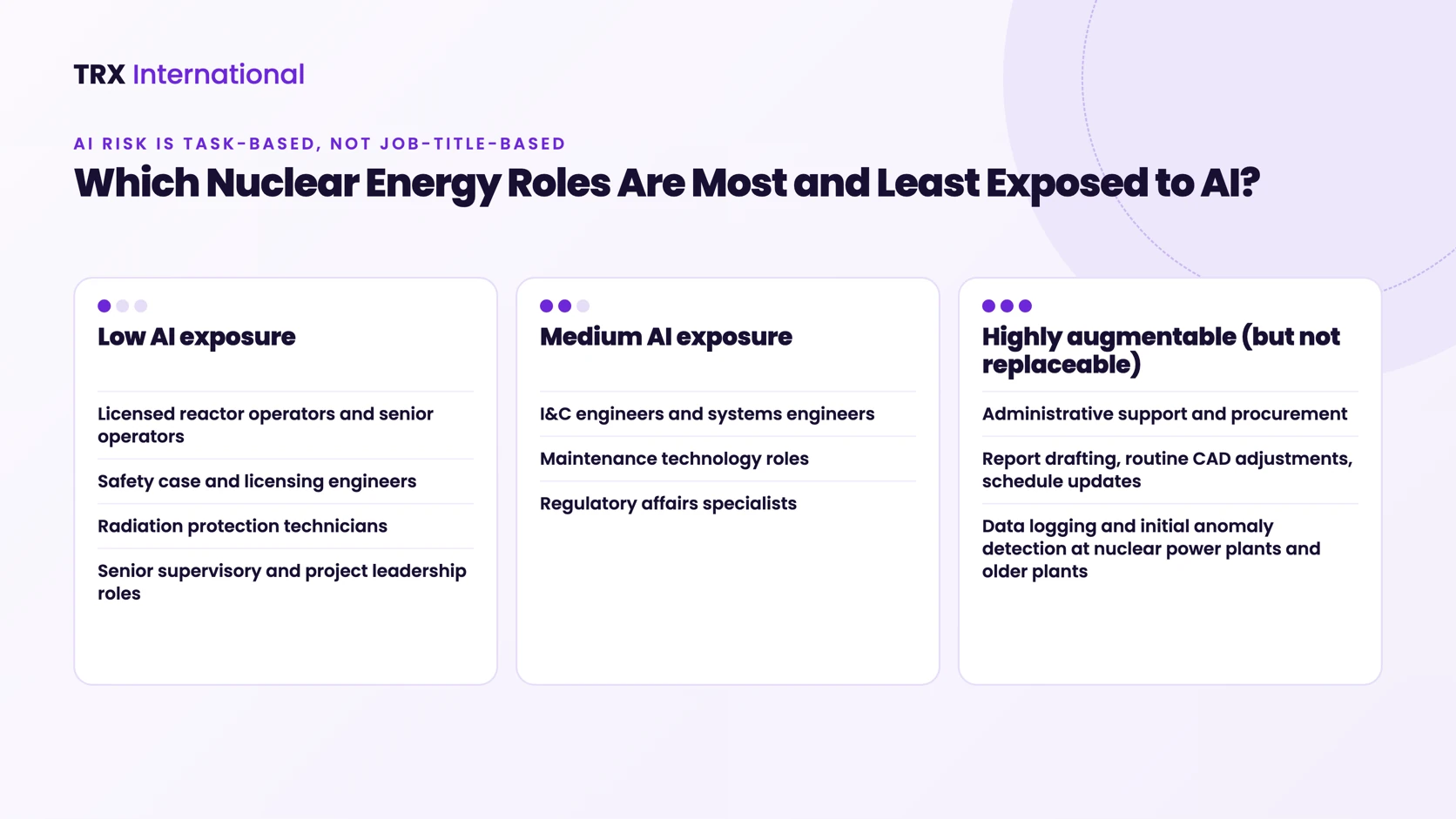
Low AI exposure:
- Licensed reactor operators and senior operators (Part 55 licensing, on-site decision making, consistent regulatory oversight)
- Safety case and licensing engineers (regulatory accountability, professional sign-off)
- Radiation protection technicians (hands-on, on-site presence required)
- Senior supervisory and project leadership roles
Medium AI exposure:
- I&C engineers and systems engineers (some design tasks augmentable, but technical judgement and code compliance remain human)
- Maintenance technology roles (predictive maintenance tools assist, don't replace, the wrench-turners)
- Regulatory affairs specialists (AI helps with documentation, but strategic navigation is human)
Highly augmentable (but not replaceable):
- Administrative support and procurement
- Report drafting, routine CAD adjustments, schedule updates
- Data logging and initial anomaly detection at nuclear power plants and older plants
Nuclear plants face challenges in recruiting skilled workers due to talent shortages, and demographic gaps in the nuclear workforce due to aging are a real concern for the industry. The skills gap is a bigger threat to staffing than AI.
AI, New Nuclear Build, and SMRs: More Jobs, Not Fewer
Global decarbonization goals and surging data-centre energy demand are driving interest in nuclear power and small modular reactors through the 2030s. This growth outweighs any efficiency gains from AI adoption.
Concrete projects are moving forward: UK's Sizewell C and Hinkley Point C, U.S. advanced reactor demonstration projects, Canada's SMR roadmap, and growing interest in Poland, the Czech Republic, and Gulf states. SMR developers use artificial intelligence for design optimization and digital twins, but they still need large teams of engineers, licensing experts, and construction managers.
AI adoption in the nuclear sector is creating demand for specialized roles such as AI integration engineers. AI-enabled productivity makes projects more bankable (better cost estimates, faster design iterations), which expands total demand for skilled professionals. U.S. nuclear workforce projections show growth from roughly 52,900 direct employees to around 66,000 by the early 2030s.
How AI supports job growth across the nuclear lifecycle:
- Design: virtual modelling, digital prototyping, design space exploration
- Construction: project tracking, schedule optimization, supply chain management
- Operation: predictive maintenance, diagnostics, condition monitoring
- Decommissioning: robotics, inspection AI, radiation mapping
The net outlook is positive. The tools change. The need for people doesn't.
Human Decision Making in Nuclear Safety: What AI Can't Replace
Three Mile Island in 1979. Fukushima Daiichi in 2011. Zaporizhzhia under conflict conditions in the 2020s. Each of these events demanded something no AI system can provide: human situational awareness under genuine uncertainty, cross-disciplinary coordination, and ethical trade-offs made in real time.
The types of decisions where human operators and engineers are irreplaceable include interpreting conflicting sensor data, weighing conservative shutdown decisions against operational and safety trade-offs, managing severe accident procedures, and coordinating with national authorities. AI models trained on historical data cannot always prepare for novel combinations of failure modes.
Deep learning models are opaque. Certifying their behavior across all accident scenarios is extremely difficult. Legal frameworks do not allow AI systems to assume liability for safety and licensing decisions. Nuclear licence conditions globally enshrine human authority for key safety decisions in nuclear reactors and spent fuel management. That makes it structurally difficult for AI to become the final decision maker, regardless of how capable the technology becomes.
How Nuclear Professionals Can Use AI Tools to Future-Proof Their Careers
If you're a nuclear engineer, operator, or project professional, here's what to do right now. Nuclear engineers must adapt to AI as an analytical amplifier, not fear it as a replacement.
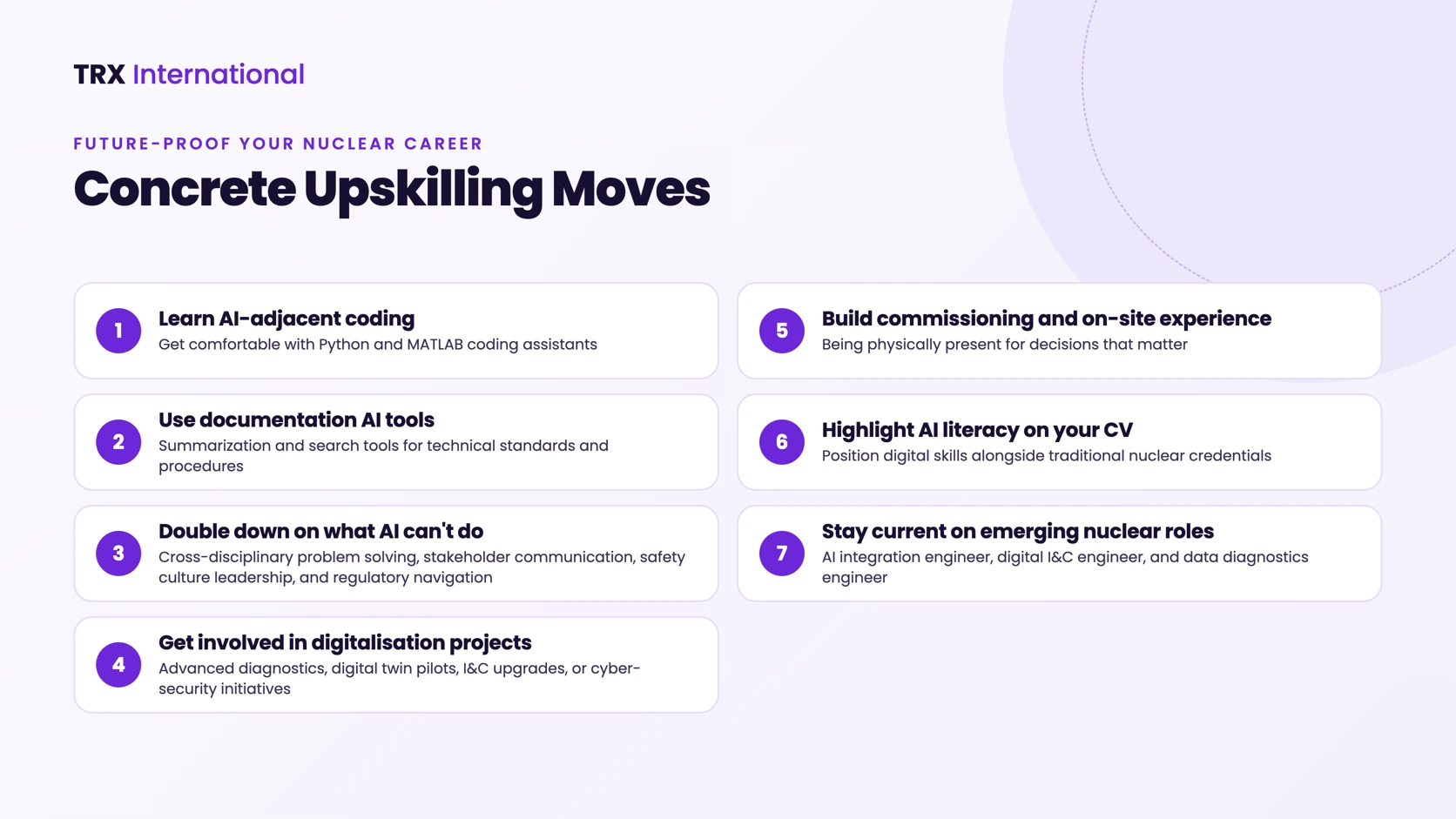
Concrete upskilling moves:
- Learn AI-adjacent coding. Get comfortable with Python and MATLAB coding assistants. You don't need to become a data scientist, but you should be able to run, modify, and interpret AI-assisted analysis of plant performance data.
- Use documentation AI tools. Practice with summarization and search tools for technical standards and procedures. Speed matters, and knowing how to query large document sets efficiently is a marketable skill.
- Double down on what AI can't do. Cross-disciplinary problem solving, stakeholder communication, safety culture leadership, and regulatory navigation are where your value grows, not shrinks.
- Get involved in digitalisation projects. Volunteer for advanced diagnostics, digital twin pilots, I&C upgrades, or cyber-security initiatives at your nuclear plant. Hands-on experience with these systems is career gold.
- Build commissioning and on-site experience. The more your career involves being physically present for decisions that matter, the more insulated you are from automation.
- Highlight AI literacy on your CV. TRX International can help candidates position digital skills alongside traditional nuclear credentials for employers investing in advanced control and analytics.
- Stay current on emerging nuclear roles. Positions like AI integration engineer, digital I&C engineer, and data diagnostics engineer didn't exist five years ago. They're hiring now.
TRX International's View on Nuclear Careers in an AI-Enabled World
Nuclear energy careers remain highly attractive and relatively insulated from full AI automation through the 2030s and beyond. The conversation about AI in the nuclear industry is important, but the expected outcome is consistent: tools evolve, roles adapt, and demand for experienced people grows.
TRX International sees hiring demand across nuclear power plants, SMR programmes, fusion research, nuclear medicine, and decommissioning projects worldwide. The roles we most frequently recruit for that intersect with AI and digitalisation include nuclear engineer (design and safety), I&C engineer, data and diagnostics engineer, digital project manager, and cyber-security specialist for nuclear power. The occupation of nuclear engineer isn't shrinking. It's gaining new tools.
Whether you're early-career or a senior nuclear engineer with decades of experience, AI is more likely to change your tools than eliminate your role. Those who act on AI literacy will often see their value and earning power increase. The future belongs to people who can explain a reactor's behavior to a regulator and use AI to reduce costs and improve efficiency at the same time.
How TRX International supports you:
- Tailored career advice for nuclear professionals at every stage
- CV feedback that highlights both traditional expertise and digital skills
- Access to roles across SMR design, new nuclear construction, operations, and advanced reactor programs globally
- Guidance on security clearance, relocation, and community fit
Ready to explore nuclear power and clean energy roles that are stable in the age of artificial intelligence? Get in touch with TRX International and let's plan your next move. If you have follow up questions about the nuclear energy industry, AI's role in it, or where the best opportunities are, we're here for that conversation.
Frequently Asked Questions
Will AI replace nuclear power plant operators in the next 20 years?
No. U.S. NRC rules under 10 CFR Part 55 require licensed human operators in the control room 24/7, and no regulator has approved fully autonomous reactor operation. AI supports operators with monitoring and analysis rather than replacing them.
Which nuclear energy jobs are most at risk from AI automation?
No nuclear role is fully replaceable, but administrative support, procurement, report drafting, routine CAD adjustments, schedule updates and data logging are the most augmentable. Licensed reactor operators, safety case engineers and radiation protection technicians have low AI exposure.
How is artificial intelligence currently being used in nuclear power plants?
Mainly for predictive maintenance, anomaly detection on pumps, valves and turbines, digital twins, radiation mapping for inspection robotics, and drafting compliance documentation. In all current deployments, human operators keep control-room authority and final decision making.
What skills should nuclear engineers learn to stay relevant as AI grows?
Learn AI-adjacent coding with Python and MATLAB coding assistants, use documentation AI tools, and get involved in digitalisation projects such as digital twin pilots and I&C upgrades. Cross-disciplinary problem solving and regulatory navigation are where your value grows.
Is AI creating new types of jobs in the nuclear energy industry?
Yes. AI adoption is creating demand for specialized roles such as AI integration engineers, digital I&C engineers and data diagnostics engineers. AI-enabled productivity also makes projects more bankable, which expands total demand for skilled professionals.
Why can't AI systems make safety decisions at a nuclear power plant?
Deep learning models are opaque, and certifying their behavior across all accident scenarios is extremely difficult. Legal frameworks don't allow AI systems to assume liability, and nuclear licence conditions enshrine human authority for key safety decisions.
Elina Koskinen writes for TRX International on nuclear careers and professional development. Her guides help candidates at every stage, from graduates entering the industry to experienced engineers planning their next move, with practical advice on CVs, interviews, salaries and career progression.