How Safe Is It to Work at a Nuclear Power Plant?
Working at a modern nuclear power plant is extremely safe: U.S. reactor workers average about 1.4 mSv a year, far below the 50 mSv limit. See the real risks.
If you're considering a career in nuclear energy, safety is probably near the top of your question list. Fair enough. The word "nuclear" carries decades of cultural baggage, most of it disconnected from what actually happens inside a modern nuclear power plant. This article breaks down the real risks, the real data, and what daily life looks like for the people who keep the lights on.
Is It Safe to Work at a Nuclear Power Plant? (Quick Answer)
The short answer: working at a modern nuclear power plant is extremely safe. Statistically, it's one of the safest jobs in heavy industry. Nuclear power plants maintain low injury rates, making them among the safest industrial work environments in countries with mature regulatory oversight.
Here's what the numbers actually say:
- Nuclear workers at U.S. commercial reactors in 2022 received an average measurable radiation dose of roughly 1.4 mSv per year. The legal limit is 50 mSv in a single year, and the international guidance from the ICRP caps it at 100 mSv over five years. So the average worker gets about 3% of the legal ceiling.
- The biggest day-to-day risks aren't radiation. They're the same things you'd find at any industrial site: lifting injuries, slips, electrical hazards, and fatigue from shift work.
- Large epidemiological studies tracking over 400,000 nuclear workers across multiple countries do find very small increases in certain cancer risks tied to cumulative low dose radiation exposure. But "very small" means roughly one excess death per 10,000 workers over 35 years.
No industrial job carries zero risk. Nuclear is no exception. But the data consistently shows that radiation exposure for the vast majority of workers stays far below the levels where measurable health effects begin.
TRX International is a specialist nuclear recruitment partner that tracks safety standards across global nuclear facilities. We help candidates identify roles at plants with strong safety records, transparent radiation protection, and well-regulated environments.
How Nuclear Power Plants Work (and Where People Actually Work)
Most people picture a nuclear power plant and imagine everyone standing next to a glowing reactor core. The reality is far less cinematic. The majority of staff spend their working hours in control rooms, offices, maintenance workshops, turbine halls, and training centres, not inside the nuclear reactor.
Here's the basics. A nuclear reactor uses the fission of uranium fuel rods to generate heat. That heat turns water into steam, and the steam spins a turbine to generate electricity. The entire process happens behind multiple physical barriers: fuel cladding around the fuel, the reactor pressure vessel, the primary coolant system, and a thick reinforced concrete containment building.
Staff work across clearly defined zones:
- Control room: heavily shielded, remote from the reactor core
- Turbine hall: houses the steam generator, turbine, and generator; low radiation levels
- Maintenance shops and offices: standard industrial or office settings
- Radiological controlled areas: near the reactor pressure vessel, spent fuel pools; tightly restricted access
- Security posts and training centres: no radiation exposure
Take a pressurised water reactor commissioned at a European nuclear plant in the 1990s. The "nuclear island" houses the reactor core, steam generators, pressuriser, and safety systems. The "conventional island" holds the turbine and condenser. During refuelling outages (every 18 to 24 months), some maintenance requires entry into higher-dose zones. Outside those outages, most work happens in low-dose areas.
Nuclear reactors cannot explode like nuclear bombs. The fuel enrichment levels used in commercial reactors are far too low for that. Advanced reactors and SMRs keep the same functional separation between nuclear and conventional zones, which shapes both safety procedures and staffing patterns.
Radiation Exposure at Work: How Much Dose Do Workers Actually Receive?
Radiation is the thing people worry about most. So let's compare perception with measured data from regulators like the Nuclear Regulatory Commission.
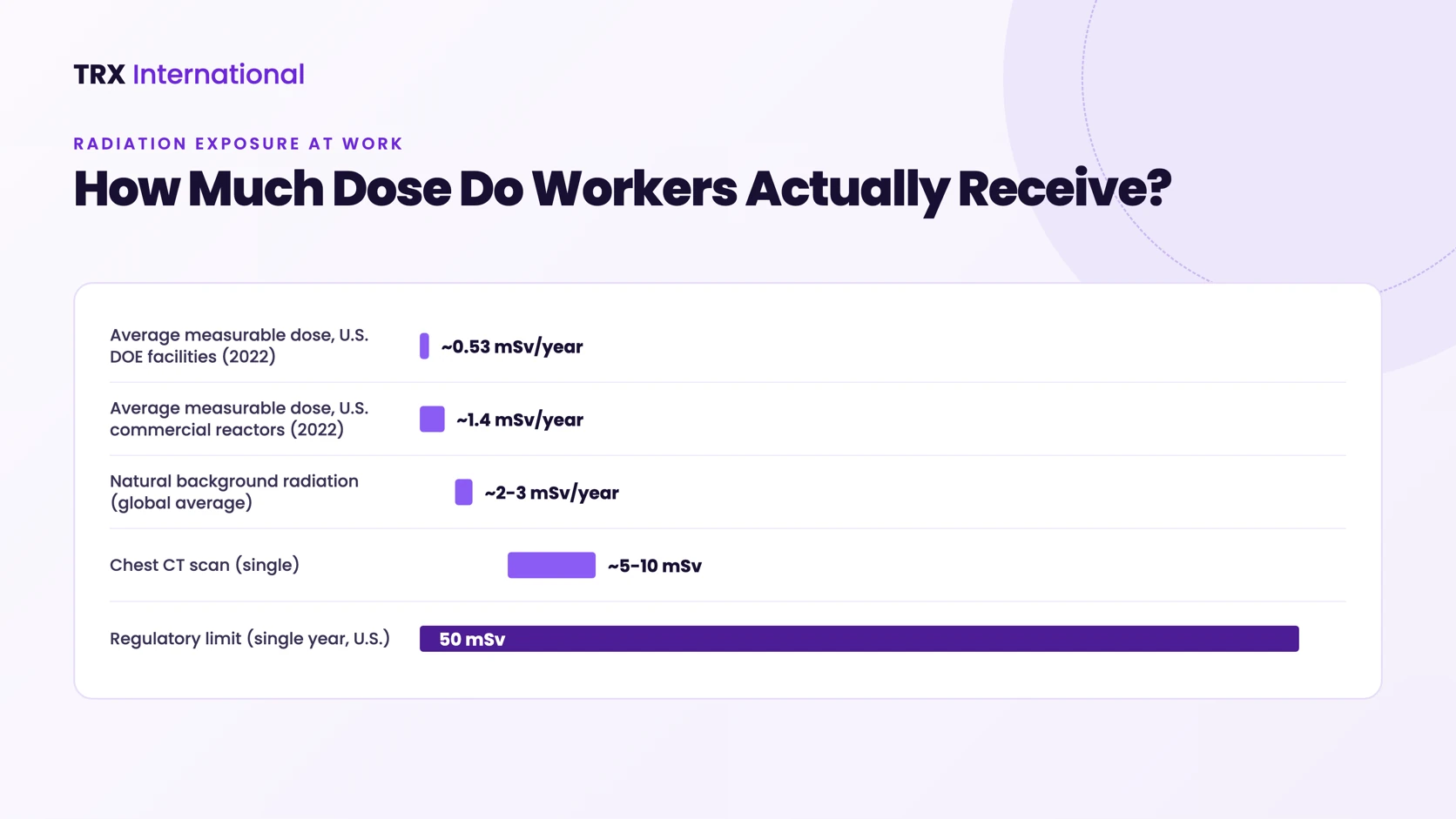
A quick primer on dose: we measure radiation exposure in millisieverts (mSv). Global average background radiation from natural sources sits around 2 to 3 mSv per year. A single chest CT scan adds roughly 5 to 10 mSv.
Now, nuclear workers. The ALARA principle, which stands for As Low As Reasonably Achievable, governs radiation exposure limits in nuclear facilities. It means plant teams actively plan work to minimise dose through shielding, distance, time limits, and remote tools.
The results speak for themselves:
| Measurement | Dose |
|---|---|
| Average measurable dose, U.S. commercial reactors (2022) | ~1.4 mSv/year |
| Average measurable dose, U.S. DOE facilities (2022) | ~0.53 mSv/year |
| Natural background radiation (global average) | ~2-3 mSv/year |
| Chest CT scan (single) | ~5-10 mSv |
| Regulatory limit (single year, U.S.) | 50 mSv |
Higher-dose tasks do exist. Working inside containment during refuelling outages, handling spent fuel, or servicing control rod drive mechanisms requires specifically trained workers. These workers carry personal dosimeters and get rotated to keep individual doses low. Nuclear workers wear personal dosimeters to monitor radiation exposure levels in real time, and anyone entering a designated radiological zone must use them. Workers can review their cumulative dose history at any point.
The collective dose per reactor unit for U.S. light-water reactors averages around 550 person-mSv per year, spread across all workers. That's a low number given the scope of maintenance and outage work involved.
Regulators and Rules: Who Sets the Safety Limits?
Nuclear safety doesn't run on trust. It runs on independent regulators with the authority to shut plants down.
The International Atomic Energy Agency, established in 1957 as a United Nations body, prescribes safety procedures and incident reporting standards for the global nuclear industry. The IAEA Convention on Nuclear Safety entered into force in 1996, creating binding obligations for countries operating nuclear power plants. The International Commission on Radiological Protection (ICRP) sets the science-based dose recommendations that national regulations are built on.
Regulatory bodies such as the U.S. Nuclear Regulatory Commission oversee safety and compliance in nuclear facilities. The NRC conducts inspections and performance reviews of nuclear plants. It's an independent federal agency with licensing authority, enforcement powers, and public reporting obligations. The US NRC mandates a core damage frequency of 1 in 10,000 years for operating reactors.
Comparable regulators exist in every country with commercial nuclear power: ONR (UK), ASN (France), CNSC (Canada), NRA (Japan), among others. Nuclear plants must comply with technical requirements set by these regulatory bodies.
Key occupational dose limits:
- 20 mSv per year averaged over five consecutive years (i.e., regulatory dose limits are set at 100 mSv per 5 years for workers)
- 50 mSv maximum in any single year
- 1 mSv for the remainder of pregnancy after declaration
- 500 mSv/year equivalent dose limit for skin or extremities
Beyond radiation, regulators also oversee conventional industrial safety, emergency preparedness, security (physical and cyber), and the IAEA prescribes safety procedures covering all these domains. The NRC requires licensees to demonstrate that nuclear energy facilities employ multiple layers of engineering controls and safety measures to mitigate risks.
Layers of Protection: Defence-in-Depth at a Nuclear Power Plant
Nuclear power plants use a defense-in-depth safety approach. The idea is simple: stack multiple independent barriers so that if one fails, the next one catches the problem. No single failure should be able to cause a serious release of radioactive material.
Physical Barriers
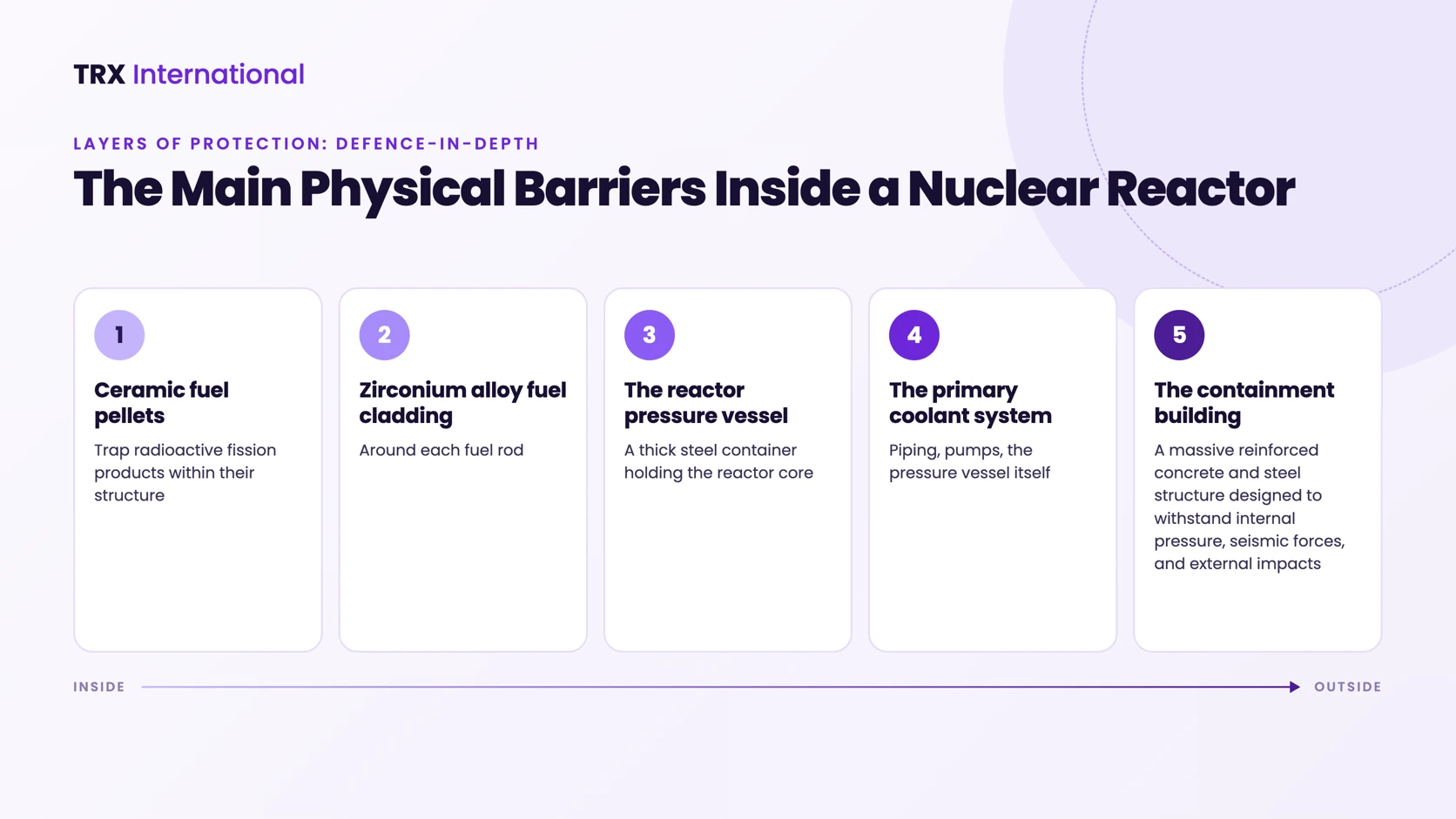
The main physical barriers inside a nuclear reactor, starting from the inside out:
- Ceramic fuel pellets that trap radioactive fission products within their structure
- Zirconium alloy fuel cladding around each fuel rod
- The reactor pressure vessel, a thick steel container holding the reactor core
- The primary coolant system (piping, pumps, the pressure vessel itself)
- The containment building, a massive reinforced concrete and steel structure designed to withstand internal pressure, seismic forces, and external impacts
Engineered Safety Systems
Emergency core cooling systems, redundant pumps and valves, backup diesel generators, and battery banks all exist to remove excess heat from the reactor core if normal cooling fails. These systems are designed to keep the nuclear reactor core cooled even during events like loss of offsite power, earthquakes, or equipment failures.
Modern nuclear reactor designs aim for a core damage frequency of 1 in 10 million years. Nuclear plants have a 1 in 10 million core damage frequency. That's the target. The safety margins designed to protect the general public also protect workers, who spend far more time on site than local residents.
Modern reactors have a negative reactivity coefficient for safety, meaning that if the reactor core temperature rises, the reaction slows down automatically. Most reactors in the current operating fleet incorporate this feature. Advanced reactors and SMRs often add passive safety features that rely on gravity and natural circulation rather than human intervention.
Short-Term Health Risks for Nuclear Power Plant Workers
Short-term (or "acute") health effects are those appearing within hours to weeks of exposure. These are distinct from long-term risks like cancer.
Acute radiation syndrome generally requires a single dose above roughly 1,000 mSv. Typical annual nuclear worker doses are under 10 mSv, often under 2 mSv. That's a gap of several hundred times. Historic serious radiation exposures at nuclear plants occurred mostly during earlier years of research or military reactors and during accidents, not in modern commercial power reactors operating under strict regulatory limits.
The realistic short-term hazards workers actually face:
- Heat stress during maintenance inside containment or turbine halls
- Falls and mechanical injuries from working at height or handling heavy equipment
- Electrical shocks during maintenance on plant systems
- Chemical exposure from water treatment or decontamination agents
- Psychological stress during high-intensity outage periods
Emergency preparedness protocols include regular drills covering various potential incidents, which helps staff stay ready without actual risk.
Routine monitoring confirms that radiation levels during normal commercial operation are far below anything causing immediate health symptoms. For comparison, interventional radiology staff in hospitals often receive a few mSv per year from their work, putting them in a similar range to many nuclear plant roles.
Long-Term Health Risks: Cancer, Leukemia and Other Conditions
This is where the science gets more complex. Long-term epidemiological studies track whether cumulative low dose radiation exposure leads to small increases in cancer risk or other diseases over decades among nuclear workers.
Large pooled studies exist. The INWORKS cohort followed roughly 310,000 radiation-monitored workers across France, the UK, and the USA. The average cumulative bone marrow dose was about 16 mGy. The study found a statistically significant association between radiation dose and leukemia mortality, but the absolute numbers were tiny: about one excess death per 10,000 workers over 35 years.
The 15-Country Study tracked approximately 407,000 workers across more than 5.2 million person-years. The average cumulative dose among studied workers was roughly 19.4 mSv. Even at those levels, the excess relative risk for cancer mortality was small.
Conditions frequently assessed include:
- All-cancer mortality
- Leukemia and lymphoma
- Thyroid cancer
- Mesothelioma (workers had a 5.53-fold higher risk for mesothelioma, though this is heavily confounded by asbestos use in nuclear facilities during earlier years of plant construction)
- Circulatory diseases (cumulative radiation exposure correlates with circulatory disease risk, an area of growing research interest)
Many modern nuclear plant workers accumulate far less than 100 mSv over a full career, thanks to ALARA practices, frequent rotation, and improved shielding. Compared to risks from smoking, obesity, or high-pollution workplaces, occupational radiation exposure appears to be a relatively minor contributor to cancer risk.
Regulators use these studies to continuously update dose limits and monitoring requirements. The risk is real but small, and current nuclear safety standards are built on decades of conservative epidemiological evidence.
What About Residents Living Near Nuclear Plants?
This article focuses on workers, but many readers also worry about communities near nuclear facilities. Public dose limits are much stricter than occupational limits, typically 1 mSv per year above natural background. Actual measured public doses near nuclear plants are usually a fraction of even that limit.
Some meta-analyses have reported small increases in certain health conditions near nuclear plants. Residents within 30 km had a 5% increased all-cancer risk in some datasets. Thyroid cancer risk increased by 17% for nearby residents in certain studies. Leukemia risk increased by 9% for residents living close to plants.
These findings come with significant caveats: high uncertainty, mixed results across studies, potential biases, and difficulty separating radiation effects from other environmental factors.
Cancer registry studies around well-regulated plants in the U.S. and Europe often find no clear increase in overall cancer rates among nearby residents. Where suggested increases appear, regulatory bodies and public health agencies investigate, driving stricter operating procedures and environmental monitoring.
Workers have more exposure than the general public but also far more monitoring. The high safety margins in reactor design and operational safety procedures protect both staff and residents.
Learning from Major Nuclear Accidents: How Worker Safety Has Improved
Nuclear power has only three significant accidents in 70 years of commercial operation: Three Mile Island (1979), Chernobyl (1986), and Fukushima Daiichi (2011). Chernobyl and Fukushima are the only nuclear accidents causing public radiation exposure of any significant scale.
The occupational impacts varied enormously:
- Chernobyl: dozens of emergency workers died from acute radiation sickness. The reactor had no containment building of Western design, and the reactor design had known instability issues.
- Fukushima: no immediate radiation deaths among workers, but significant dose uptakes and enormous psychological strain. The accident involved three reactors losing cooling after a tsunami exceeded the plant's flood defences.
- Three Mile Island: partial meltdown, but the containment building held. No measurable health impact on workers or the public.
None of these occurred in modern Western-design reactors with today's regulatory regimes. But they triggered global reforms.
Post-accident improvements include:
- Filtered venting systems to prevent uncontrolled releases
- Hardened backup power and flood/seismic protections
- Improved severe reactor accident management guidelines
- Enhanced emergency response training and drills
- EU "stress tests," WANO peer reviews, and IAEA safety standard updates
For workers, this translates into more drills, better emergency equipment, clearer decision-making chains, and a culture that prioritises conservative action when parameters look abnormal. Nuclear power plants implement rigorous safety protocols to protect workers from radiation and industrial hazards as a direct result of these lessons.
Advanced Reactors and SMRs: What They Mean for Worker Safety
Advanced reactors and small modular reactors (SMRs) are designed with worker and public safety as a primary constraint, not an afterthought.
Advanced reactors use passive safety systems for emergencies. These systems rely on gravity-fed cooling, natural circulation, and negative reactivity coefficients. If something goes wrong, the reactor stabilises or shuts down without active systems or human intervention. Advanced reactors are designed to be self-adjusting and fail-safe.
New reactor designs reduce core melt accident likelihood by an order of magnitude compared to the current operating fleet. The AP1000 reactor design features passive safety and modular construction. NuScale-type SMRs and high-temperature gas-cooled reactors using TRISO fuel can withstand very high temperatures without fuel failure. Advanced reactors can operate with fuels that withstand higher temperatures than conventional uranium oxide pellets.
What this means for staffing:
- Simpler plant layouts may reduce the number of people needing regular access to high-dose areas
- Advanced digital control rooms improve operator awareness
- Factory-built modular components reduce on-site construction hazards
- Advanced fuels like accident-tolerant fuel rods and coated fuel particles minimise radioactive fission products release even in worst-case accident scenarios
These new reactor designs build on existing nuclear safety while keeping long-term career risk for operators at least as low as today's light-water reactors. For most roles, they'll likely be even lower.
Non-Radiological Risks: Industrial Hazards in a Nuclear Plant
Day-to-day, most safety incidents at nuclear plants are conventional industrial events, not radiation-related.
Common hazards include:
- Working at height (scaffolding, crane operations)
- Heavy lifting and moving loads
- High-pressure systems (steam, coolant)
- Rotating machinery in turbine halls
- Confined spaces
- Chemical handling for water treatment and decontamination
Nuclear plants apply strict industrial safety controls across all of these: lockout/tagout for electrical systems, rigorous permit-to-work processes, personal protective equipment requirements, and behavioural safety programmes. Personal protective equipment is essential for preventing contamination and injuries in hazardous work areas.
Compared with other industries, nuclear does well. One study found that nuclear's outage maintenance illness and injury rates were more than 80% lower than fossil fuel, hydro, or renewables during comparable maintenance tasks. That's a significant gap. The nuclear industry's culture of questioning, checking, and planning carries over to every type of work on site, not just radiological tasks.
Specific measures include strict access control, tooling checks, contamination control at plant boundaries, and mandatory safety briefings before complex jobs. A strong industrial safety regime is part of nuclear safety culture, not something separate from it.
Work Environment: Shift Patterns, Stress and Mental Health
A typical plant operates 24/7. Control room operators, maintenance crews, and security staff all work shifts, including nights and rotating rosters. That takes a toll.
Fatigue and human performance issues can contribute to errors. Regulators recognise this and require fatigue management programmes, maximum duty hours, and minimum rest periods. Nuclear power plants are divided into security zones with restricted access to manage exposure and ensure safety, which also means access scheduling and shift planning are tightly managed.
On-site measures include:
- Structured shift handovers (often scripted)
- Two-person verification for safety-critical actions
- Mandatory rest times between shifts
- Periodic medical and psychological fitness assessments for licensed operators
Many utilities now offer mental health support, employee assistance programmes, and resilience training. The work environment can be intense, particularly during outages when hundreds of extra workers arrive and schedules compress.
TRX International advises candidates on typical rota patterns, overtime expectations, and site culture so you can choose roles that align with your wellbeing priorities. The difference between a well-run site and a pressured one is often felt most in the work environment, not in radiation numbers.
Training, Licensing and Continuous Professional Development
High training standards are one of the strongest protections for nuclear workers and the public. You don't walk onto a nuclear plant and start turning valves on day one.
Initial training for plant operators, technicians, and engineers typically includes:
- Classroom theory on reactor systems and nuclear physics
- Systems-specific training on the actual plant equipment
- Radiation protection and contamination control
- Safety culture orientation
- Emergency procedures and drill participation
Control room staff train on full-scope simulators. These replicate the plant's control room exactly and allow operators to practise abnormal and accident scenarios without any risk to the actual reactor. Loss of coolant, station blackout, seismic events: they run through them all.
Licensed roles (Reactor Operator and Senior Reactor Operator under U.S. NRC rules, or equivalent national schemes) require written exams, performance evaluations, simulator testing, and periodic requalification. Workers undergo continuous training and are encouraged to report unsafe conditions without fear of retaliation.
Ongoing professional development includes refresher safety training, new procedure rollouts, advanced reactor systems courses, and leadership development. Candidates entering from adjacent sectors like oil and gas, defence, or petrochemicals should expect intensive retraining. TRX International can help you prepare for that transition.
Typical Nuclear Plant Jobs and Their Risk Profiles
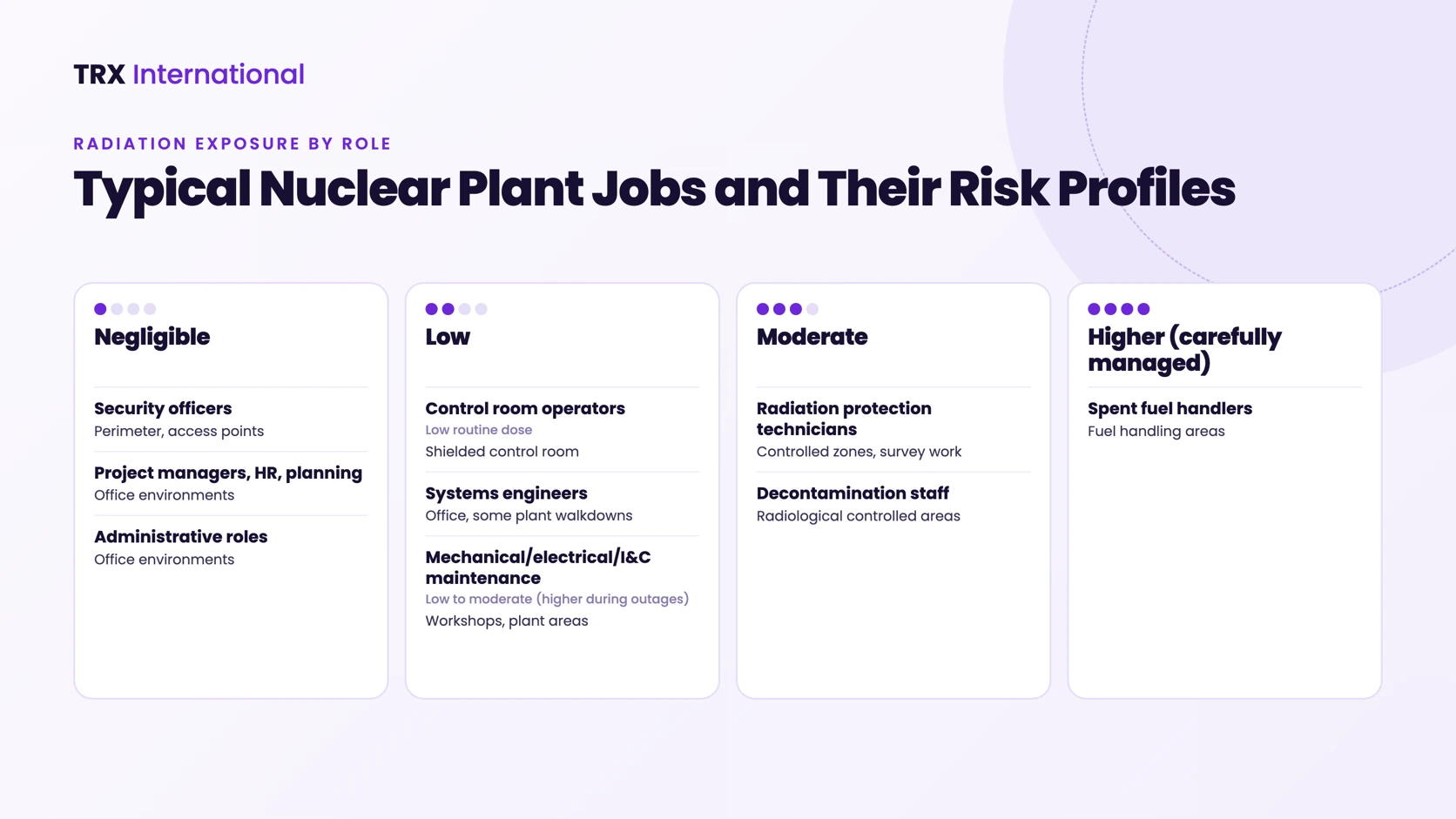
Not all nuclear jobs carry the same exposure or risk. Some are office-based. Others involve regular time in controlled areas. Here's a rough breakdown:
| Role | Radiation Exposure | Typical Setting |
|---|---|---|
| Control room operators | Low routine dose | Shielded control room |
| Systems engineers | Low | Office, some plant walkdowns |
| Radiation protection technicians | Moderate | Controlled zones, survey work |
| Mechanical/electrical/I&C maintenance | Low to moderate (higher during outages) | Workshops, plant areas |
| Decontamination staff | Moderate | Radiological controlled areas |
| Spent fuel handlers | Higher (carefully managed) | Fuel handling areas |
| Security officers | Negligible | Perimeter, access points |
| Project managers, HR, planning | Negligible | Office environments |
| Administrative roles | Negligible | Office environments |
Many commercial roles, like project management, design engineering, and planning, involve almost no radiation exposure at all. Even hands-on nuclear jobs typically carry lower long-term health risk than equivalent roles in fossil fuel plants or heavy construction, because the safety controls are stricter and the monitoring is better.
TRX International routinely discusses risk appetite and preferred work environments with candidates to match them to suitable positions. Your comfort level matters.
Nuclear Safety Culture: "Questioning Attitude" and Human Performance Tools
Nuclear safety culture means safety comes before schedule, cost, or convenience. Every time. That's not a slogan. It's enforced.
Core attributes expected on site:
- Questioning attitude: any worker can (and should) stop work if something doesn't look right
- Conservative decision-making: when in doubt, choose the safer option
- Rigorous communication: three-way communication protocol (tell, repeat, confirm)
- Personal accountability: everyone owns safety, regardless of rank
Human performance tools used daily include pre-job briefs, peer checks, procedure adherence requirements, and stop-work authority for all employees. International organisations like WANO and INPO review plants' safety culture and operational performance, feeding back lessons from events worldwide.
A strong safety culture is the primary reason nuclear power plants rank among the safest industrial workplaces, despite the potential hazards of nuclear reactors and nuclear energy. If you're interviewing for a nuclear role, ask specifically about the plant's safety culture, event reporting systems, and recent improvements. TRX International can help you frame those questions.
How New Workers Are Protected: Induction and Probation Periods
Starting a new job at a nuclear plant can feel high-stakes. The induction process is designed to address that.
Typical site induction covers:
- Plant layout, alarms, and muster points
- Basic radiation safety and dose limits
- PPE requirements for different zones
- Access control and badging systems
- Local rules specific to that nuclear plant
New hires shadow experienced colleagues and are restricted from certain tasks until fully qualified. During the first 6 to 12 months, supervision is tighter. Radiation protection teams pay special attention to new staff and contractors, making sure they understand dosimetry readings and contamination control procedures.
Contractors brought in for outages also receive site-specific inductions before accessing radiological controlled areas or working near fuel handling systems. This structured onboarding is one reason accident and exposure rates stay low even during the busiest and most complex work periods.
Security, Terrorism and Cyber Threats: Implications for Staff Safety
Nuclear plants are among the most hardened civilian facilities on the planet.
Physical security includes multiple perimeter fences, armed response forces, vehicle barriers, bullet-resistant control centres, and protected vital areas around the reactor and spent fuel pools. Nuclear plants are divided into security zones with restricted access.
Post-2001 security upgrades added intrusion-scenario training, coordinated drills with national security agencies, and regular threat assessments. Staff may occasionally participate in security exercises or lockdown procedures.
Cyber security follows its own defense-in-depth model: reactor control and safety systems run on segregated networks, with strict access controls, monitoring, and incident response plans. These digital systems are physically isolated from external networks.
Structural analysis shows containment buildings can withstand severe external events, including large aircraft impact in some designs. Successful malicious attacks causing worker harm are considered extremely unlikely. The security infrastructure protects both the public and workers, contributing to operational safety across the site.
Safety in Decommissioning and Waste Management Roles
Not all nuclear power plant work involves operating reactors. Decommissioning and waste management represent major long-term employment areas, and the safety profile is different.
Specific challenges include:
- Dismantling activated components that have become radioactive material after years of neutron exposure
- Handling contaminated materials in older facilities with legacy systems
- Working with less complete documentation than modern plants sometimes provide
Controls used in decommissioning: segmentation underwater, heavy shielding, remote tooling and robotic systems, stringent contamination control, and detailed dose budgeting for each task. Long-lived waste is immobilised, shielded, and stored in engineered facilities with monitored worker access.
Countries with mature decommissioning programmes (UK, Germany, Sweden) show low accident and exposure rates when modern techniques are applied. The work requires careful planning, but it's operated safely under current regulatory standards.
TRX International recruits for decommissioning and waste projects and can help candidates understand the specific risk profile compared to operating plant roles.
How Nuclear Energy Safety Compares with Other Energy Industries
Measured per unit of electricity generated, nuclear power has among the lowest accident and mortality rates of any energy source. Nuclear energy produced 2,653 TWh of electricity in 2021 without carbon emissions, making it one of the largest clean energy contributors globally.
Here's how it stacks up against other industries:
- Coal: high chronic health burden from air pollution, mining accidents, dust exposure. Nuclear power prevents hundreds of deaths annually that would otherwise occur from coal mining accidents alone.
- Oil and gas: higher rates of acute industrial accidents, blowouts, fires, and falls compared to nuclear power plants.
- Hydroelectric: rare but catastrophic dam failures have historically caused large sudden loss of life. Commercial nuclear plants have never produced a comparable event.
- Renewables: wind and solar have low fatality rates too, making nuclear safety broadly comparable when modern standards are considered.
Nuclear's perceived risk is much higher than its measured occupational risk. That gap between perception and reality is one of the industry's biggest communication challenges.
Career Planning: Balancing Reward, Risk and Purpose
Many professionals are drawn to nuclear plants for good pay, job security, and the opportunity to support low-carbon nuclear energy. But they want clarity on safety before committing.
You can evaluate offers by:
- Reviewing the plant's safety performance data (often publicly available through regulator websites)
- Asking about WANO performance indicators and recent inspection findings
- Inquiring about incident rates and near-miss reporting culture
- Understanding the rota pattern and overtime expectations before signing
Lifestyle factors matter too. Consider the location of the nuclear power plant, shift patterns, commuting versus relocation, and project stability (new build versus life extension versus decommissioning).
Professionals who've transitioned from oil and gas, defence, or petrochemicals to nuclear frequently report improved safety standards and job satisfaction. For most technical professionals, the risk of working at a well-regulated nuclear plant is low and often lower than comparable industrial roles.
How TRX International Supports Safe Nuclear Careers
TRX International is a specialist recruitment partner for the global nuclear industry with deep understanding of nuclear safety and regulatory environments.
What we do for candidates:
- Screen employers: we assess client organisations for strong safety records, robust safety culture, and compliance with national regulators before recommending roles
- Clarify role profiles: we discuss exposure expectations, typical dose ranges, work environment details, and security clearance requirements upfront
- Support relocation: we guide international candidates toward regions with mature regulatory frameworks and well-established nuclear programmes
- Cover the full spectrum: we recruit across nuclear power plants, advanced reactors, decommissioning projects, nuclear medicine, and research reactors
Our blog and resources share current insights on nuclear safety trends, SMR deployments, workforce needs, and practical career guidance for engineers, operators, and project professionals.
Ready to explore nuclear career opportunities? Contact TRX International to discuss roles that match your skills, your ambitions, and your expectations for a safe work environment.
Conclusion: So, How Safe Is It to Work at a Nuclear Power Plant?
The evidence points in one direction. Modern nuclear plants operate with occupational safety statistics comparable to or better than most mainstream industrial sectors. Radiation doses for the typical plant worker sit far below regulatory limits, and defence-in-depth engineering makes serious possible accidents extraordinarily unlikely. Workers are carefully monitored, continuously trained, and protected by layers of physical barriers, engineered systems, and a culture that puts safety above everything else.
No industrial job is risk-free. But nuclear power plants have spent more than 60 years building an exceptionally conservative safety regime, grounded in data, shaped by lessons from past events, and enforced by independent regulatory bodies.
That combination of strong safety culture, good compensation, stable demand, and the chance to contribute to clean power generation is why thousands of professionals choose nuclear careers every year. The nuclear industry keeps growing, and the safety record keeps improving.
For appropriately trained professionals working at well-regulated nuclear facilities, employment at a nuclear power plant is a safe and responsible career choice. TRX International is ready to help you take the next step.
Frequently Asked Questions
How much radiation do nuclear power plant workers get each year?
Nuclear workers at U.S. commercial reactors received an average measurable dose of roughly 1.4 mSv in 2022. That is about 3% of the 50 mSv legal limit for a single year.
What are the biggest everyday safety risks at a nuclear power plant?
The biggest day-to-day risks aren't radiation. They're conventional industrial hazards such as working at height, heavy lifting, high-pressure systems, electrical hazards and fatigue from shift work, controlled through lockout/tagout, permit-to-work processes and PPE.
Does working at a nuclear power plant increase your risk of cancer?
Large studies of nuclear workers find very small increases in certain cancer risks tied to cumulative low dose exposure. In the INWORKS cohort, the leukemia finding amounted to about one excess death per 10,000 workers over 35 years.
Which jobs at a nuclear power plant have the highest radiation exposure?
Spent fuel handlers have the highest exposure, which is carefully managed, followed by radiation protection technicians and decontamination staff. Security officers, project managers, HR, planning and administrative roles have negligible exposure.
What are the legal radiation dose limits for nuclear plant workers?
Workers are limited to 20 mSv per year averaged over five consecutive years, with a maximum of 50 mSv in any single year. Separate limits apply to declared pregnancies (1 mSv) and to skin or extremities (500 mSv a year).
How are new employees kept safe when they start at a nuclear plant?
New hires complete a site induction covering plant layout, radiation safety, PPE and access control. They shadow experienced colleagues, are restricted from certain tasks until fully qualified, and work under tighter supervision for the first 6 to 12 months.
Elina Koskinen writes for TRX International on nuclear careers and professional development. Her guides help candidates at every stage, from graduates entering the industry to experienced engineers planning their next move, with practical advice on CVs, interviews, salaries and career progression.