Are Nuclear Energy Careers Recession Proof? A Practical Guide for Engineers and Employers
Nothing is 100% recession proof, but nuclear comes close. Compare the most stable nuclear roles, long-term demand drivers and steps to protect your career.
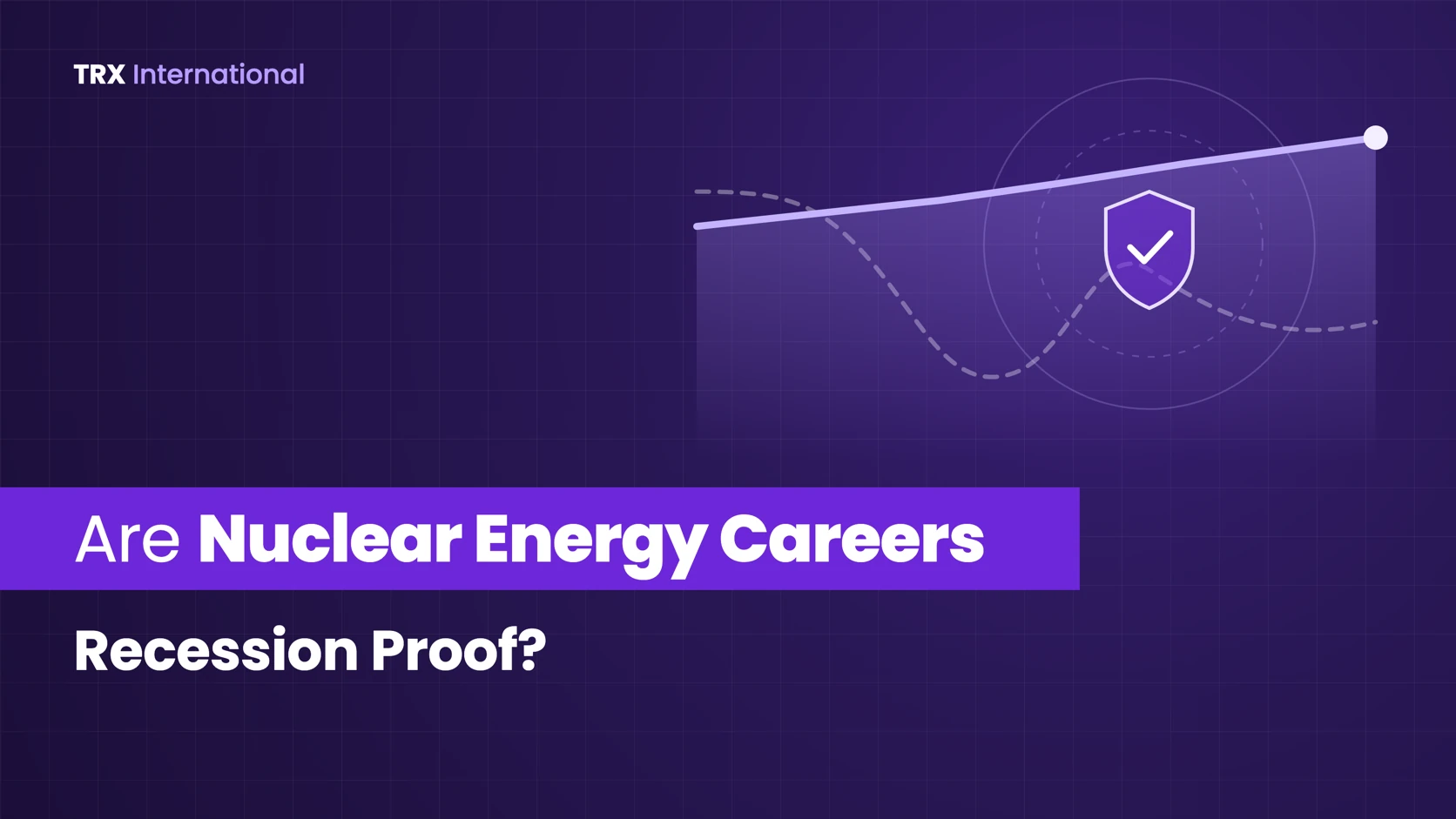
Are Nuclear Energy Careers Really Recession Proof? (Answer This First)
The honest answer: nothing is 100% recession proof. But nuclear energy careers come remarkably close. The nuclear industry has shown stronger resilience through economic downturns than most engineering sectors, including oil and gas, automotive, and yes, even software engineering. That's not hype. That's decades of data.
Nuclear power is classified among essential services because the electricity grid doesn't get a day off. National security doesn't pause for a bad GDP quarter. During both the 2008-2009 financial crisis and the 2020-2021 COVID collapse, nuclear plant operations continued with minimal workforce disruption. Electricity demand remains stable during economic recessions, and the people keeping reactors running stayed employed while other sectors hemorrhaged jobs.
Let's clarify terms. "Recession proof" doesn't mean "guaranteed job for life." It means slower hiring instead of mass layoffs, long project timelines that outlast downturns, and regulated revenues that don't crash with spot market prices. This article is written from TRX International's perspective as a specialist nuclear recruitment partner working with utilities, EPCs, research labs, and nuclear medicine providers worldwide.
Here's what we'll cover:
- Why the nuclear industry resists recessions structurally
- Which nuclear roles hold up best (and which don't)
- How nuclear compares to software engineering and other "safe" fields
- Long-term demand drivers like SMRs and climate policy
- Practical steps for professionals and employers
Why the Nuclear Industry Is More Resilient in Recessions
Most cyclical sectors, think automotive manufacturing or oil exploration, contract fast when spending drops. Nuclear energy behaves differently, and the reasons are structural.
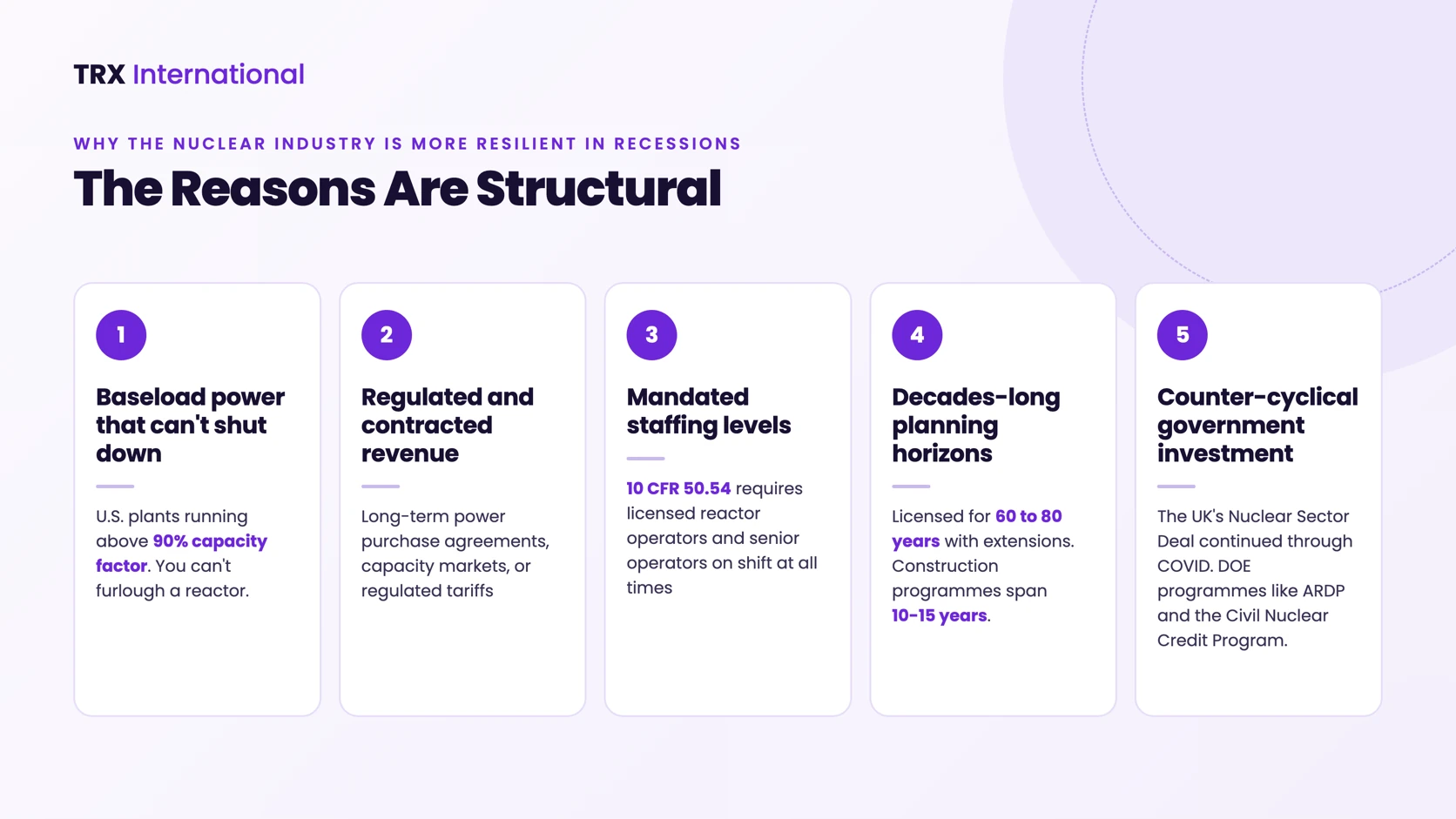
- Baseload power that can't shut down. Nuclear power provides baseload electricity, with U.S. plants running above 90% capacity factor. A nuclear power plant operates 24/7 and requires continuous maintenance and regulatory compliance. You can't furlough a reactor.
- Regulated and contracted revenue. Many plants operate under long-term power purchase agreements, capacity markets, or regulated tariffs. This makes nuclear closer to tariff proof than merchant generators exposed to volatile market conditions.
- Mandated staffing levels. NRC regulations under 10 CFR 50.54 require licensed reactor operators and senior operators on shift at all times. Nuclear jobs are subject to strict federal and international oversight. Security, radiation protection, and quality roles can't be trimmed without violating law.
- Decades-long planning horizons. Nuclear power plants are licensed to operate for decades, often 60 to 80 years with extensions. Construction programmes span 10-15 years. Decommissioning generates thousands of jobs over another decade or more. A single bad quarter doesn't derail these timelines.
- Counter-cyclical government investment. Government support can protect nuclear facilities during economic uncertainty. The UK's Nuclear Sector Deal continued through COVID. The U.S. Department of Energy supports the construction of new reactors through programmes like ARDP and the Civil Nuclear Credit Program, collectively representing billions in appropriations through FY2024-2025 and beyond.
Each nuclear power plant can employ up to 800 workers, and nuclear salaries are 50% higher than other generation sources. That combination of job volume and pay stability is hard to find elsewhere.
Nuclear Energy as an Essential Service
Essential services are those a country cannot function without: water treatment, healthcare, grid operations, national defense. Nuclear fits squarely in that category.
During COVID-19 lockdowns, nuclear plant staff were designated key workers in both the USA and UK. On-site teams were sequestered to ensure continuous operation. That doesn't happen for discretionary sectors. Hospitality, retail, and automotive manufacturing saw furloughs and layoffs at scale. Nuclear plant staffing stayed intact.
The dependencies run deep. Hospitals need stable electricity for critical care and imaging. Data centres require uninterrupted power. Military installations depend on nuclear energy for deterrent support, naval propulsion, and the nuclear fuel cycle. These critical links make large-scale workforce cuts politically and strategically impossible.
Consider the contrast: during 2008-2009, commercial aerospace saw sharp order cancellations and workforce layoffs. Nuclear plant operations staff? Largely unaffected. The facility keeps running because the demand for electricity doesn't disappear when the economy contracts.
How Nuclear Energy Creates Jobs and Sustains Local Economies
Nuclear energy creates jobs at every stage of its lifecycle, and the economic multiplier effect is significant.
- Construction peaks are massive. Building a nuclear power plant costs billions of dollars and employs thousands. The expansion project at Plant Vogtle supported up to 9,000 workers at peak construction. The construction of new reactors created 800 permanent jobs in 2023 once those units entered operation.
- Operations sustain communities for generations. Nuclear power plants can employ up to 800 workers each in permanent operations and maintenance roles. Nuclear generates nearly 775 billion kilowatt-hours annually in the U.S.
- The numbers add up nationally. The nuclear industry supports nearly half a million jobs in the U.S. when you count direct employment, supply chain, and contractors. Employment in nuclear energy grew even as overall electric power generation employment declined.
- Local economies depend on plants. Operating budgets fund nearby fabrication shops, specialist consultancies, and trades contractors. Municipal tax bases stabilize. These supplier relationships persist through recessions because operating costs in nuclear are dominated by people and specialized services, not commodity inputs like fossil fuels.
- Decommissioning extends the runway. Shutdown plants still need staff for waste management, decontamination, and dismantling over 10-20 years.
- Replacing coal with nuclear or SMRs in existing industrial regions can preserve and upskill a skilled workforce strategy, keeping communities economically viable through the energy transition.
Nuclear power plant salaries are 50% higher than other generation sources, and that wage premium flows directly into local economies. This matters during a recession. It's the difference between a town that weathers the storm and one that doesn't have enough money to keep its schools open.
Recession Resilience by Role: Which Nuclear Careers Hold Up Best?
Not every nuclear career carries equal stability. Some roles are nearly untouchable during downturns. Others feel the squeeze.
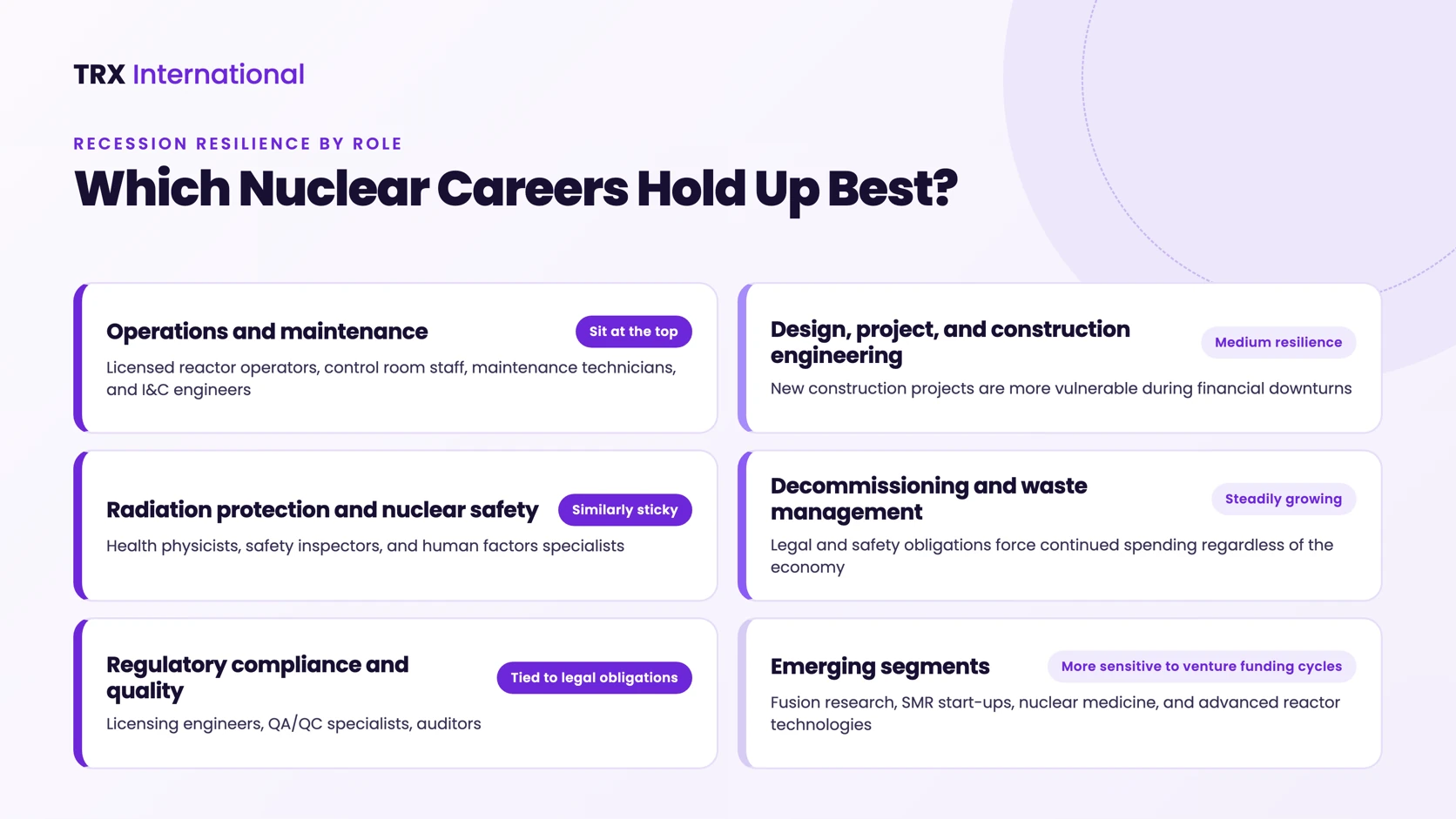
Operations and maintenance roles sit at the top. Licensed reactor operators, control room staff, maintenance technicians, and I&C engineers are protected by regulatory minimum staffing requirements. Replacing skilled nuclear workers requires extensive training and security clearances, so employers don't cut these positions lightly. The retraining cost alone is a powerful deterrent.
Radiation protection and nuclear safety professionals, including health physicists, safety inspectors, and human factors specialists, are similarly sticky. Their work is mandated by regulators and doesn't pause for GDP declines. Specialized roles in nuclear energy often include reactor operators and safety engineers for exactly this reason. High barriers to entry exist in the nuclear energy industry due to specialized skills.
Regulatory compliance and quality roles (licensing engineers, QA/QC specialists, auditors) are tied to legal obligations. The NRC, ONR, and ASN don't relax inspection schedules during recessions.
Design, project, and construction engineering carries medium resilience. Civil and mechanical engineering roles on major projects like SMR deployments are in high demand during active phases, but new construction projects in nuclear energy are more vulnerable during financial downturns. Financing tightens, and project initiation may be postponed.
Decommissioning and waste management is steadily growing. Legal and safety obligations force continued spending regardless of the economy. The DOE's Office of Environmental Management had roughly 45% vacancy in mission-critical positions as of late FY2025. The work isn't optional. The people just aren't there yet.
Emerging segments like fusion research, SMR start-ups, nuclear medicine, and advanced reactor technologies can be more sensitive to venture funding cycles but benefit from strong government and healthcare demand. The nuclear industry experiences talent shortages even amid broader employment declines.
Nuclear vs Software Engineering and Other "Recession Proof" Fields
Software engineering has long been seen as the safe bet. Then 2022-2023 happened. Tens of thousands of software engineers at major tech firms lost their positions while nuclear utility headcounts barely moved. (Turns out "move fast and break things" also applies to job security.)
The structural difference matters. Nuclear sits alongside water, healthcare, and grid operations as essential infrastructure with non-discretionary demand. Software outside of essential sectors depends heavily on advertising revenue, subscription models, or venture capital, all of which dry up during recessions.
Revenue protection also differs. Regulated or contract-based pricing insulates nuclear plants from short-term demand collapse. An ad-funded software platform? Not so much.
That said, there's growing overlap. The nuclear industry has increasing demand for software skills: digital twins, I&C modernization, cybersecurity, and predictive analytics for plant performance. Engineers who blend software engineering with nuclear domain knowledge sit in a strong position regardless of the economy.
Who might prefer nuclear: professionals who value meaningful work, stability, and comfort with regulation. Who might prefer volatile high-growth sectors: those chasing upside and willing to accept periodic layoffs. Both are valid. Just know what you're signing up for.
Long-Term Outlook: Climate Policy, SMRs and Future-Proofing Your Career
Decarbonization targets to 2050 and beyond create sustained demand for nuclear professionals. This isn't speculative. It's policy.
- The EU taxonomy recognized nuclear as sustainable in 2022. France and the UK have committed to new reactor programmes through the 2030s. The US Inflation Reduction Act provides tax incentives for existing and advanced reactors.
- Small modular reactors, microreactors, and advanced Gen IV designs create project pipelines extending well past any single economic cycle. OECD countries had secured roughly $15.4B in public and private SMR funding by early 2025. The U.S. DOE allocated up to $800M for utility deployment of grid-scale Gen III+ SMRs. New reactor designs aim to reduce construction timelines significantly. Accident tolerant fuels could gain widespread use by 2025, further improving plant economics.
- Nuclear medicine, isotope production, and fusion research (ITER, private companies) diversify career options for nuclear-skilled professionals into adjacent areas including health and pharmaceuticals.
- Risks remain: political swings, project-specific cost overruns, and competition from renewables. But a diversified nuclear ecosystem of large plants, SMRs, decommissioning, and nuclear medicine cushions individual project shocks.
The nuclear workforce is facing significant generational turnover due to retirements. Globally, about 25% of nuclear workers are over 55. That's not a threat for people entering the industry. That's an opportunity.
How Professionals Can Build a Recession-Resilient Nuclear Career
You can make your own engineering career more or less resilient through deliberate choices.
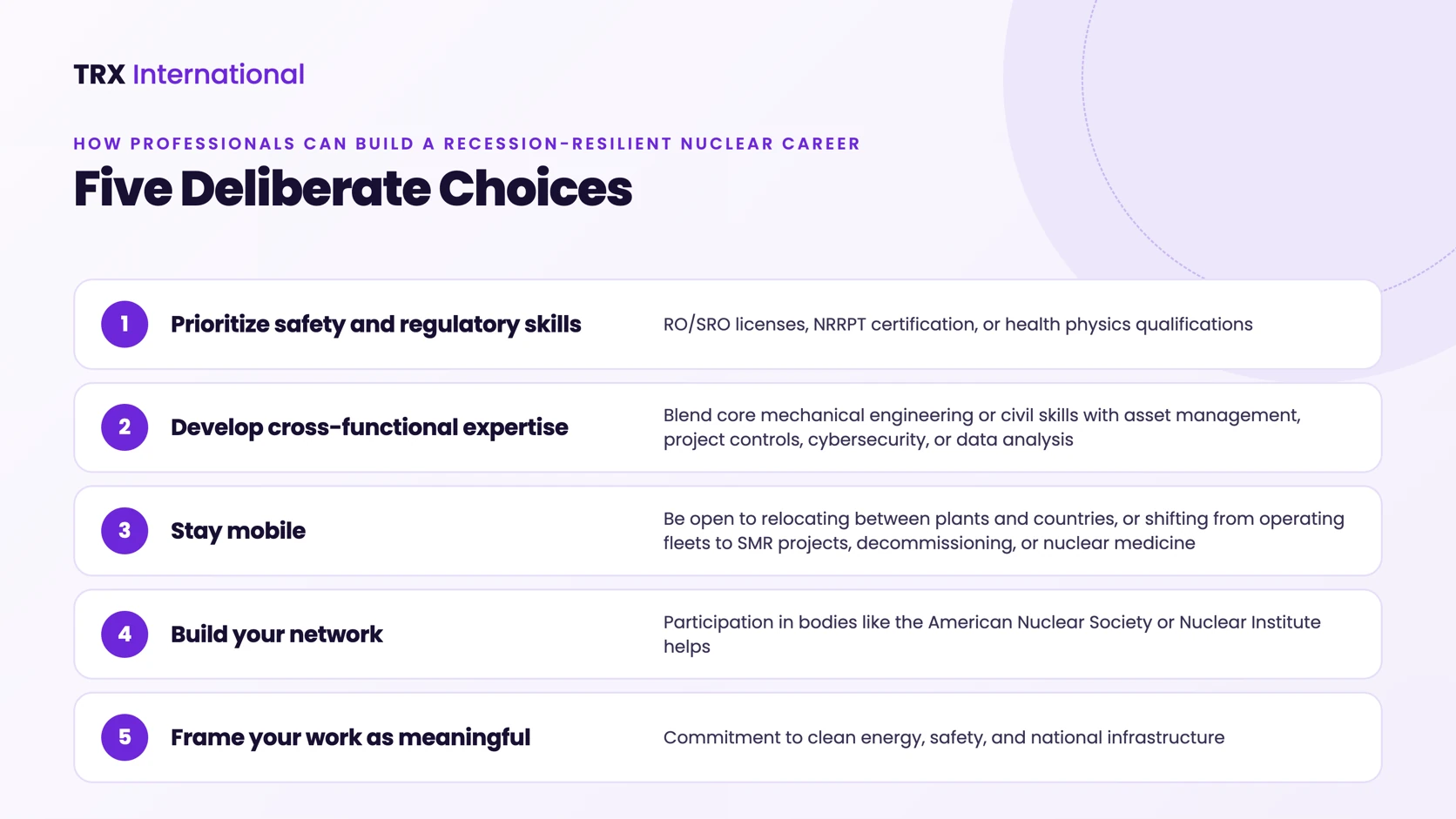
- Prioritize safety and regulatory skills. Pursue credentials like RO/SRO licenses, NRRPT certification, or health physics qualifications. These are in demand in any economic climate, at any experience level, and make you among the highest paid professionals in the energy sector.
- Develop cross-functional expertise. Blend core mechanical engineering or civil skills with asset management, project controls, cybersecurity, or data analysis. Check what skills employers want now.
- Stay mobile. Be open to relocating between plants, countries (USA, UK, Canada, Ontario, and beyond), or shifting from operating fleets to SMR projects, decommissioning, or nuclear medicine.
- Build your network. Participation in bodies like the American Nuclear Society or Nuclear Institute helps. Professionals who maintained active networks fared better during past downturns.
- Frame your work as meaningful. Commitment to clean energy, safety, and national infrastructure translates into strong employer investment in training, education, and retention. Potential employers in nuclear value this.
TRX International regularly advises candidates on market hotspots, day rates, and in-demand skills across regions. It's worth a conversation if you're planning your next move.
How TRX International Supports Employers with Skilled Workforce Strategy
TRX International works as a specialist recruitment partner helping nuclear organisations develop recession-resilient workforce strategies, not just fill vacancies.
- We support utilities, EPCs, research institutions, and nuclear medicine providers in building long-term talent pipelines for SMRs, life-extension projects, and decommissioning across every country where nuclear operates.
- Our approach balances permanent and contract staffing to give employers flexibility during economic uncertainty without compromising safety or regulatory commitments.
- Practical services include global talent search, relocation support, security clearance assistance, benchmarking of salaries and operating costs, and advice on structuring roles to attract top nuclear engineers and software engineers into the business.
- We track regional labour markets, from UK new build to US fleet operations to European SMR programmes, to help companies plan ahead based on real industry trends rather than guesswork.
If you're a hiring manager or HR leader with upcoming projects or critical roles to fill, talk to TRX International. The development of your workforce pipeline starts before the next recession, not during it.
Conclusion: How "Recession Proof" Is Nuclear, Really?
Nuclear energy is not magically immune to recessions. But it stands out among engineering and energy sectors for its combination of essential service status, long project timelines, and regulated revenue structures. The general public may not think about where their electricity comes from during a downturn. The people who keep the lights on don't have that luxury, and that's precisely why their jobs are more stable.
The advantages are real: the nuclear industry creates jobs at every lifecycle stage, supports nearly half a million positions in the U.S. alone, pays 50% above sector averages, and aligns with climate and energy security policies that extend decades into the future. Remaining uncertainties, political shifts, individual project economics, construction spending delays, are genuine but manageable through diversification of skills and geography.
For professionals: nuclear offers one of the more stable career paths in engineering for the next 20-30 years if you invest in the right skills and stay adaptable. For employers: partnering with a specialist like TRX International strengthens your ability to attract and retain critical talent through any economic cycle. The life of a recession-proof career starts with the choices you make today.
Frequently Asked Questions
Did nuclear power plant workers lose their jobs during the 2008 recession?
Largely no. During the 2008-2009 financial crisis, nuclear plant operations continued with minimal workforce disruption, while commercial aerospace saw sharp order cancellations and layoffs. Electricity demand remains stable during economic recessions.
Which nuclear energy jobs are the most secure during an economic downturn?
Operations and maintenance roles such as licensed reactor operators, control room staff and I&C engineers sit at the top, protected by regulatory minimum staffing requirements. Radiation protection, nuclear safety, regulatory compliance and quality roles are similarly stable.
Are nuclear construction and new build jobs affected by recessions?
They can be. Design, project and construction engineering carries medium resilience, because new construction projects are more vulnerable during financial downturns. Financing tightens, and project initiation may be postponed.
Is a nuclear career more stable than a software engineering career?
Generally, yes. In 2022-2023, tens of thousands of software engineers at major tech firms lost their positions while nuclear utility headcounts barely moved. Nuclear is essential infrastructure with regulated or contract-based revenue.
Why is demand for nuclear professionals expected to grow over the long term?
Decarbonization targets to 2050, new reactor programmes, SMRs and advanced Gen IV designs create project pipelines that extend past any single economic cycle. With about 25% of nuclear workers globally over 55, retirements are opening roles too.
What qualifications make a nuclear career more resilient to a recession?
Safety and regulatory credentials such as RO/SRO licenses, NRRPT certification or health physics qualifications are in demand in any economic climate. Blending engineering skills with project controls, cybersecurity or data analysis also helps.
Elina Koskinen writes for TRX International on nuclear careers and professional development. Her guides help candidates at every stage, from graduates entering the industry to experienced engineers planning their next move, with practical advice on CVs, interviews, salaries and career progression.