Nuclear Batteries: Turning Nuclear Waste into Power for Extreme Environments
A nuclear battery turns radioactive decay into power for decades without recharging. See how it works, where it's used and the careers it's creating.
A battery that runs for decades on radioactive waste sounds like science fiction. It's not. Here's what nuclear batteries actually do, how they work, and why they're creating new career paths.
What Is a Nuclear Battery and Why It Matters Now
Nuclear batteries operate differently than traditional chemical batteries. Instead of storing electrical energy through chemical reactions, they convert energy released by radioactive decay into electricity. They don't contain a miniature reactor. They don't need recharging, because nuclear batteries cannot be recharged and run continuously until the isotope decays. And they can potentially store more energy per unit mass than chemical batteries.
This new technology has grabbed serious attention in 2024 and 2025. Ohio State University published results from a gamma ray prototype. China's Betavolt announced a coin-sized device. Science YouTube channels and videos across every content platform have racked up millions of views and comments on the topic (don't miss those if you subscribe to any nuclear engineering channel). Nuclear energy already contributes to 20% of US energy production, and nuclear batteries could extend that influence into entirely new applications.
TRX International follows these developments closely because they're generating demand for nuclear engineers, materials scientists, radiation specialists, and regulatory professionals we help place every day.
Key takeaways:
- Nuclear batteries deliver continuous power for decades or even centuries
- They use radioactive decay, not fission chain reactions
- Applications include space missions, deep-sea sensors, medical implants, and remote infrastructure
- Different isotopes determine the lifespan and energy output of a nuclear battery
How Nuclear Batteries Work: From Gamma Rays to Electricity
There are three main types of nuclear battery. Betavoltaic devices use beta particles hitting a semiconductor to generate electron-hole pairs directly. Radioisotope thermoelectric generators (RTGs) use thermal conversion, which involves using heat from radioactive decay to generate electricity via thermocouples. And the newest approach, developed by a research team at Ohio State University, uses gamma rays from nuclear waste.
The Ohio State University Gamma Ray System
Here's the process, step by step. Isotopes like cesium-137 and cobalt-60 in spent nuclear fuel release energy as gamma rays. Those gamma rays strike scintillator crystals (GAGG, in OSU's case), which absorb the radiation and re-emit it as light. Solar cells coupled to the scintillator then convert that light into electricity. The battery absorbs harmful gamma rays from nuclear waste and turns them into usable power. That's non-thermal conversion: it captures emitted particles directly to generate electricity without needing a heat gradient.
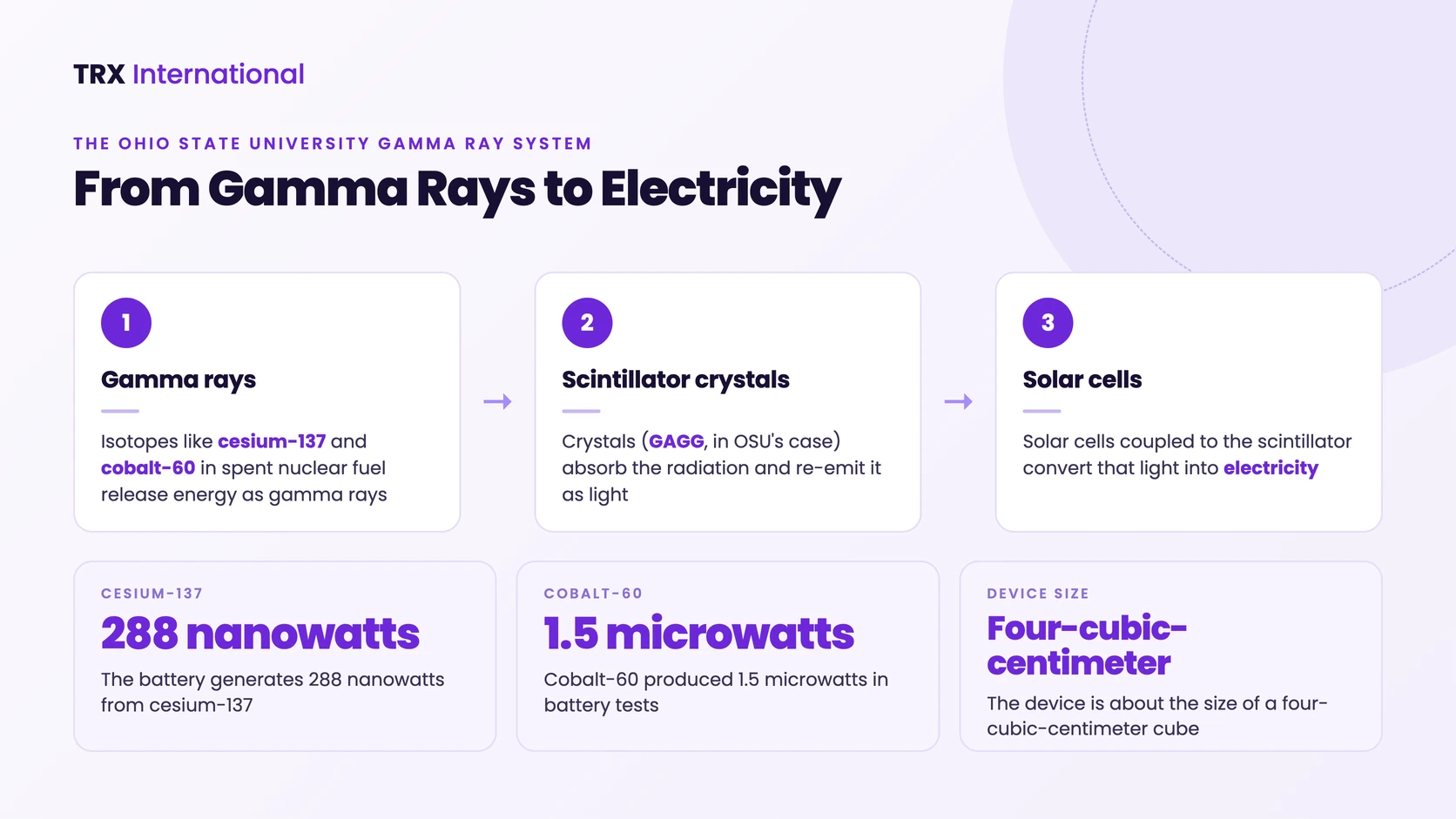
The results? The battery generates 288 nanowatts from cesium-137. Cobalt-60 produced 1.5 microwatts in battery tests. The device is about the size of a four-cubic-centimeter cube. Nuclear batteries typically produce very low power output, so they're not suitable for high-drain devices like smartphones or electric vehicles. But for autonomous sensors and low-power electronics, that's enough.
Expected lifetimes link directly to isotope half-lives. Cesium-137's half-life is roughly 30 years. Nickel-63 lasts about 100 years. Carbon-14 stretches to 5,730 years. For a device you can't service for decades, that performance matters.
Nuclear Waste as a Long-Lived Energy Source
High-level nuclear waste from reactors contains isotopes like Cs-137, Co-60, and Sr-90, most of which sit in dry cask storage or await geological repositories. Repurposing these isotopes into an energy source does three things: it can reduce the radiological hazard of waste streams, create economic value from what's currently a cost centre, and improve public perception of nuclear energy in daily life.
The Ohio State University research team developed a battery using nuclear waste, specifically targeting isotopes already present in spent fuel. The battery is suitable for nuclear waste storage facilities, where it could power monitoring sensors for decades without maintenance. Startups like Project Omega are developing Sr-90 battery boxes for spacecraft backup power, while Arkenlight in the UK is commercialising carbon-14 diamond devices.
Safety and containment are critical concerns for nuclear battery design and use. Gamma emitters require shielding. Encapsulation must prevent any release of material. Regulatory bodies (the NRC, IAEA, ONR) oversee licensing, transport, and store requirements for sealed sources. Nuclear batteries are affected by strict regulations regarding their materials and disposal.
- Proliferation risk: isotopes like Co-60 and Cs-137 could theoretically be misused, so export controls and security protocols apply
- Transport rules: packaging, labelling, and routing of radioactive devices follow strict international standards, with rights and responsibilities defined by law
This circular approach, turning waste into working power, fits cleanly into broader clean-energy and sustainability goals. It's the kind of advertising for nuclear's future that the industry actually needs.
Applications in Extreme Environments
Nuclear batteries excel in applications requiring long-term power without frequent maintenance. Anywhere you can't swap a battery every few years, these devices make sense.
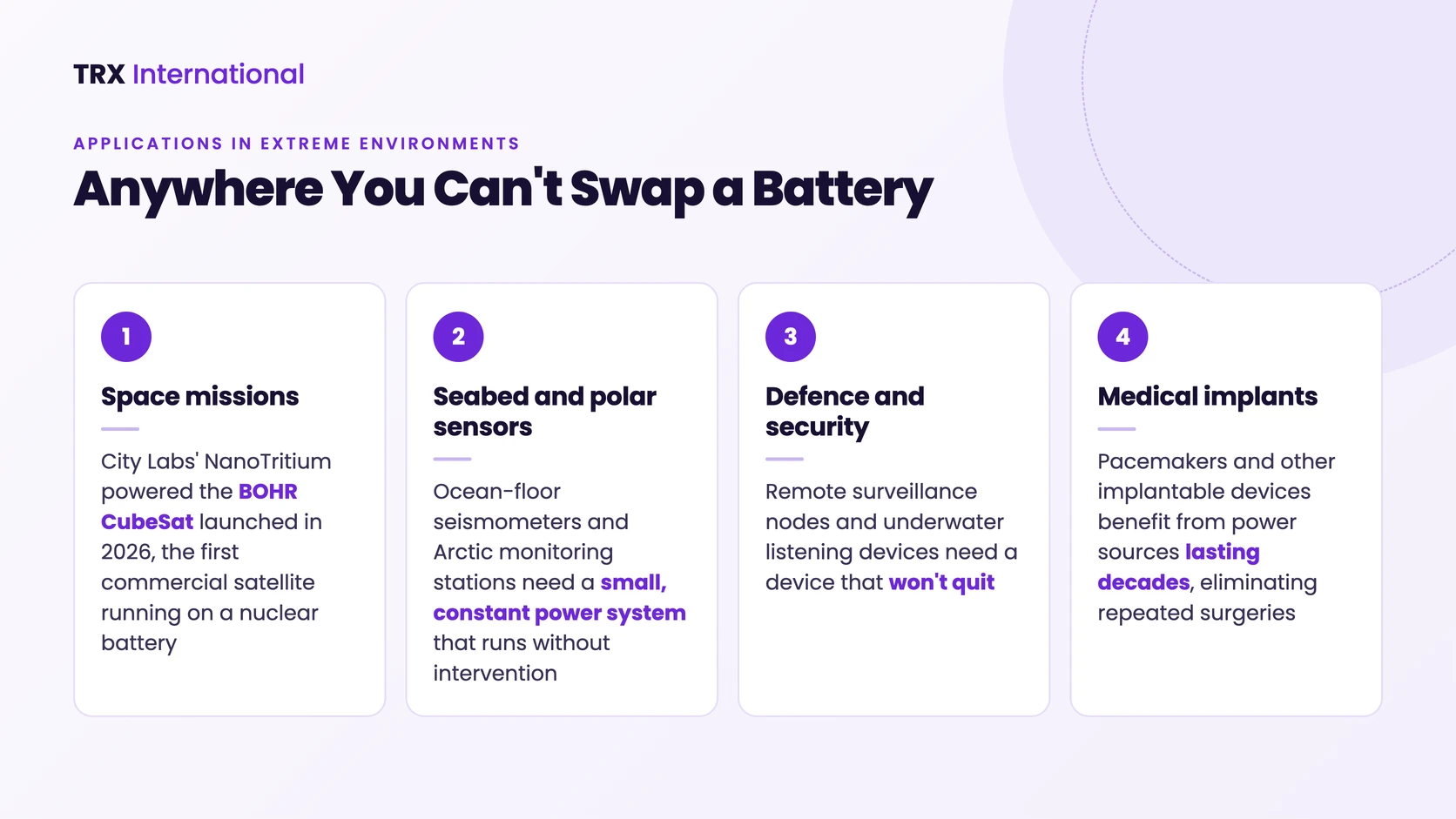
- Space missions: nuclear batteries can operate in extreme environments like space. City Labs' NanoTritium powered the BOHR CubeSat launched in 2026, the first commercial satellite running on a nuclear battery. They're valuable for deep-space exploration and remote sensing applications where solar cells receive too little light.
- Seabed and polar sensors: ocean-floor seismometers and Arctic monitoring stations need a small, constant power system that runs without intervention. Nuclear batteries fit that order perfectly.
- Defence and security: remote surveillance nodes and underwater listening devices need a device that won't quit. Keep in mind, the department handling these test deployments often can't send a team to swap batteries.
- Medical implants: pacemakers and other implantable devices benefit from power sources lasting decades, eliminating repeated surgeries.
Nuclear batteries operate reliably in harsh environments where traditional batteries fail. They're insensitive to vacuum, high radiation, pressure, and extreme temperature swings. Chemical batteries degrade under those conditions. Nuclear batteries just keep running.
Looking ahead, smart-infrastructure applications (sensors embedded in bridges, tunnels, or nuclear waste repositories) could follow once costs drop.
Careers, Skills and Talent for the Nuclear Battery Era (TRX International Perspective)
Commercialisation of nuclear batteries is creating roles that barely existed five years ago. The engineering talent required spans research, manufacturing, and deployment.
Key technical profiles developing now:
- Radiation-effects specialists who understand how scintillator crystals and semiconductors degrade
- Nuclear materials science and shielding engineers
- Semiconductor and scintillator researchers (diamond, SiC, perovskite fabrication)
- Safety case and licensing experts familiar with sealed-source regulations
- Systems engineers for space and subsea integration
Crossover opportunities exist for professionals from traditional nuclear power, fusion, SMR programmes, nuclear medicine, and aerospace.
TRX International helps by matching candidates to these emerging roles, advising on security clearances and export-control requirements, and supporting relocation to research hubs globally.
- On your CV, emphasise radiation protection training, contamination control, electronics in harsh environments, and quality assurance experience
- Regulatory compliance and safety culture credentials stand out to hiring managers in this space
If your organisation is developing nuclear battery technology, TRX International can connect you with specialists who have the exact combination of nuclear, semiconductor, and safety credentials you need.
Challenges, Risks and Future Outlook for Nuclear Batteries
Nuclear batteries hold real promise, but the path from prototype to product still has gaps.
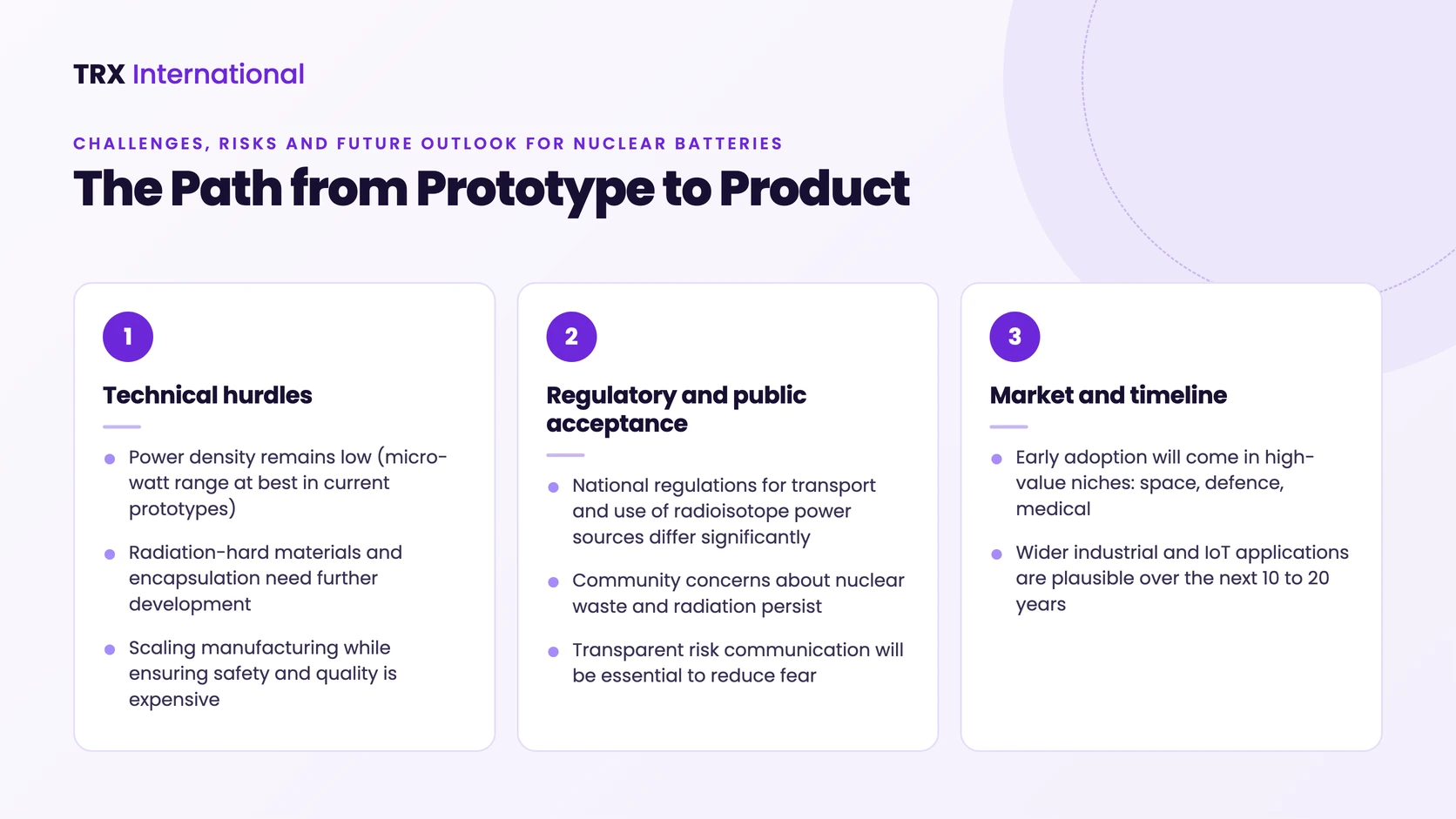
Technical hurdles:
- Power density remains low (micro-watt range at best in current prototypes)
- Radiation-hard materials and encapsulation need further development
- Scaling manufacturing while ensuring safety and quality is expensive
Regulatory and public acceptance:
- National regulations for transport and use of radioisotope power sources differ significantly
- Community concerns about nuclear waste and radiation persist
- Transparent risk communication will be essential to reduce fear
Market and timeline:
- Early adoption will come in high-value niches: space, defence, medical
- Wider industrial and IoT applications are plausible over the next 10 to 20 years
- Advances in SMRs and waste management could supply more feedstock isotopes, created through reactor operation and fuel reprocessing
Nuclear batteries won't replace grid-scale generation or the battery in your phone. What they will do is fill a gap that nothing else can: reliable, generated power in places where nobody's coming back to change a battery for 50 years. For nuclear professionals with the right skills, that's a career worth watching.
Frequently Asked Questions
How long does a nuclear battery last before it stops producing power?
Expected lifetimes link directly to isotope half-lives. Cesium-137's half-life is roughly 30 years, nickel-63 lasts about 100 years and carbon-14 stretches to 5,730 years, and the battery runs continuously until the isotope decays.
Can a nuclear battery power a smartphone or an electric vehicle?
No. Nuclear batteries typically produce very low power output, so they're not suitable for high-drain devices like smartphones or electric vehicles. They suit autonomous sensors and low-power electronics instead.
How does a nuclear battery turn nuclear waste into usable electricity?
In the Ohio State University design, cesium-137 and cobalt-60 in spent nuclear fuel release gamma rays. Scintillator crystals absorb that radiation and re-emit it as light, which solar cells then convert into electricity.
Can nuclear batteries be recharged once their radioactive isotope runs out?
No. Nuclear batteries cannot be recharged. They run continuously until the isotope decays, which is why the choice of isotope determines both the lifespan and the energy output of a nuclear battery.
Are nuclear batteries safe, and how is their radiation contained?
Safety and containment are critical design concerns. Gamma emitters require shielding, encapsulation must prevent any release of material, and regulators such as the NRC, IAEA and ONR oversee licensing, transport and storage of sealed sources.
What new jobs are being created by nuclear battery technology?
Commercialisation is creating demand for radiation-effects specialists, nuclear materials science and shielding engineers, semiconductor and scintillator researchers, safety case and licensing experts, and systems engineers for space and subsea integration.
Thomas Redfern writes about nuclear new-build and major projects for TRX International. He covers sector news, reactor programmes and SMR developments, analysing what each shift means for the industry’s workforce and the specialist skills it will need next.