Can IT Professionals Transition into the Nuclear Energy Sector?
Yes, IT professionals can move into nuclear energy. See which skills transfer, which roles to target and the training that closes the gap. Start planning.
Yes. And the nuclear industry is actively looking for you.
The nuclear energy sector employs over 70,000 professionals in the U.S. alone, and that number is climbing. Globally, nuclear employment hit roughly 1.2 million in 2024, up 6% year-on-year. Nuclear careers today stretch far beyond traditional nuclear engineering jobs. Cybersecurity, data analytics, software development, and infrastructure roles are growing fast inside nuclear power plants and across the wider energy sector. The 2022 energy price shocks, EU/US/UK net-zero targets, and renewed build programmes (Hinkley Point C, Sizewell C, Vogtle Units 3 & 4, planned SMR fleets in Canada and Eastern Europe) have created a demand surge that traditional pipelines can't fill alone.
This article is written from TRX International's perspective as a specialist nuclear recruitment partner. We'll map typical IT backgrounds to specific nuclear career paths, show which gaps to close, and explain how recruiters in the nuclear industry actually evaluate candidates from other industries.
Why the Nuclear Industry Needs IT Professionals Now
Nuclear power sits at the centre of clean energy strategies worldwide. Nuclear jobs are projected to grow significantly with new reactor technologies, and the nuclear industry is expanding rapidly with major projects underway. That growth creates more jobs, and not just for engineers.
Here's what's driving IT demand:
- Nuclear facilities are prioritizing the transition from analog to digital systems. The nuclear energy sector is modernizing due to reactor lifespan extensions and digitalization, which means control room software, plant networks, and data infrastructure all need skilled professionals.
- There is high demand for cybersecurity in nuclear facilities to protect critical infrastructure. The U.S. Nuclear Regulatory Commission (NRC) sets guidelines for cybersecurity programs in nuclear power plants under 10 CFR 73.54. The EU's NIS2 Directive and the UK's ONR impose similar expectations.
- Data analytics is becoming increasingly important for predictive maintenance in nuclear power. Nuclear plants process large volumes of sensor data to enhance operational efficiency.
- Small modular reactors are driving innovation through digital twins, AI-powered modelling, and advanced control software.
A single nuclear power plant employs 500 to 800 workers. Each one is essentially a critical energy generation facility that runs 24/7. Without digital systems, modern nuclear engineering, operations, radiation protection from radiation exposure, and regulatory compliance cannot function safely. Nuclear power creates about 25% more jobs per unit of electricity than wind, and nuclear jobs pay, on average, 50% higher than other electricity generation jobs. The financial case for transition is strong.
Key IT Skill Sets That Transfer Well into Nuclear Careers
Think of this as a skills mapping exercise. Many of your technical skills are directly transferable with additional nuclear context layered on top. The skills nuclear employers are looking for overlap with IT more than most candidates expect.
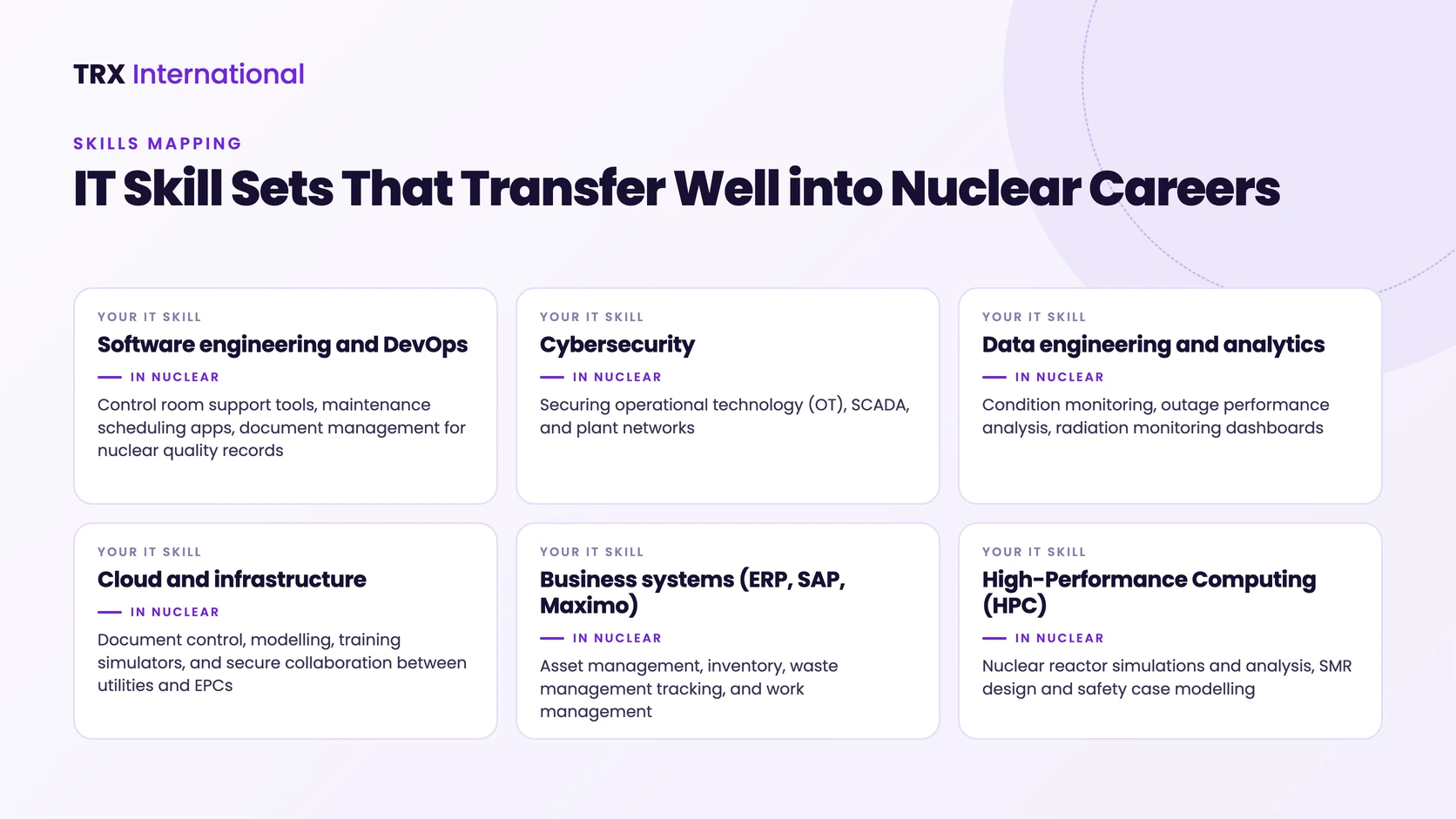
- Software engineering and DevOps: control room support tools, maintenance scheduling apps, document management for nuclear quality records. Configuration management and change control are already second nature to you.
- Cybersecurity: securing operational technology (OT), SCADA, and plant networks. Knowledge of OT is crucial in nuclear information technology roles. Defence-in-depth for safety systems mirrors concepts you'll know from enterprise security.
- Data engineering and analytics: condition monitoring, outage performance analysis, radiation monitoring dashboards. A data analyst using Power BI in manufacturing can adapt those skills to dose tracking and outage KPIs.
- Cloud and infrastructure: hybrid solutions for document control, modelling, training simulators, and secure collaboration between utilities and EPCs.
- Business systems (ERP, SAP, Maximo): asset management, inventory, waste management tracking, and work management across nuclear power plants and decommissioning projects.
- High-Performance Computing (HPC): HPC is essential for nuclear reactor simulations and analysis, particularly for SMR design and safety case modelling.
Tools you'll recognise: Python, C#, SQL, Power BI, SIEM platforms, IAM solutions, OT networking protocols (Modbus, DNP3, OPC UA). Project management skills from other sectors transfer well to nuclear. Skills in governance and risk management are highly relevant too. Nuclear roles require strong analytical skills and systems thinking, both of which are standard in IT work.
Which Nuclear Jobs Can IT Professionals Target Without Prior Nuclear Experience?
Some nuclear engineering jobs need specialised degrees. Many nuclear roles don't. Here are concrete positions that often accept candidates from IT or adjacent sectors:
- Cybersecurity Analyst / OT Security Engineer: protecting nuclear power plant safety systems and ensuring compliance with regulatory cybersecurity mandates.
- Data Analyst / BI Developer: supporting plant performance, outage planning, and radiation protection reporting.
- Application Support Engineer: maintaining plant information management systems, document control, or maintenance management software.
- Project Controls / PMO Analyst: schedule risk analysis, cost tracking, and stakeholder dashboards during nuclear construction or refurbishment. During peak construction phases, these roles multiply.
- Digital Twin / Simulation Support: working with teams that model reactor behavior and validate AI/ML integration for SMR projects.
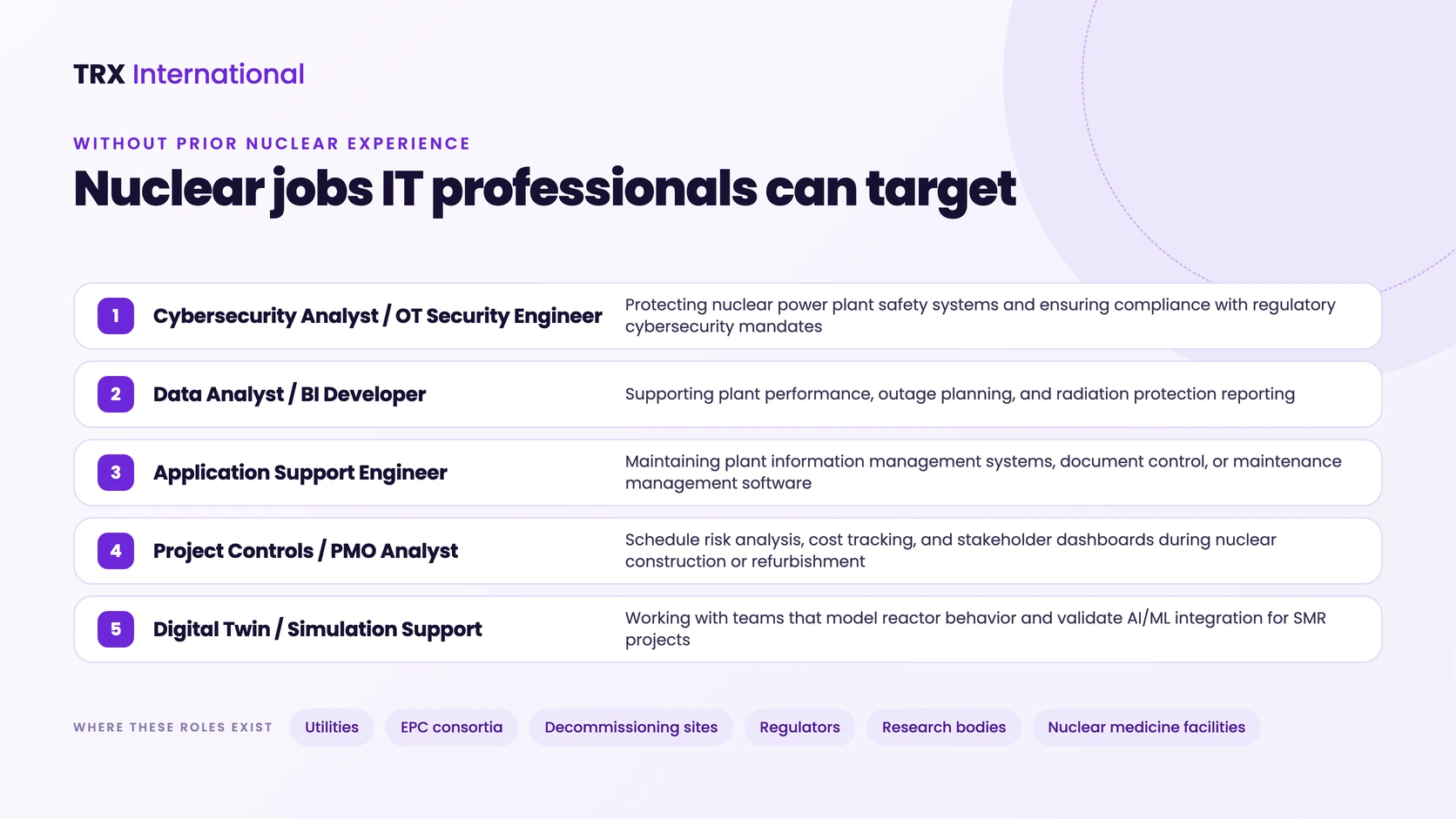
These roles exist at utilities, EPC consortia, decommissioning sites like Sellafield (with massive data and documentation needs), regulators, research bodies, and nuclear medicine facilities. Nuclear employers seek candidates with crisis management experience and backgrounds in high-pressure environments. Nuclear employers increasingly recruit from oil, gas, and construction sectors too, so IT professionals from any other type of regulated operation are well-positioned. Nuclear workers earn one third more than those in renewables, and nuclear jobs pay 25-30% more than other energy jobs, meaning higher salaries are a real draw. For a full breakdown, see our guide to 13+ types of jobs in the nuclear industry.
Bridging the Gap: Training, Certifications and Nuclear Knowledge
You don't need a full nuclear engineering degree. You need targeted nuclear context. Transitioning to a career in nuclear energy requires an understanding of regulatory and safety landscapes, but short training programs can help bridge skills gaps for nuclear roles.
Nuclear knowledge foundations to acquire:
- Basic nuclear physics and reactor fundamentals (fission, reactor types, fuel cycle)
- Safety culture: ALARA, defence-in-depth, human performance tools
- National regulatory frameworks (ONR in the UK, NRC in the US, ASN in France, CNSC in Canada)
- Nuclear energy professionals often require knowledge of compliance with strict regulatory standards
Concrete training options include nuclear awareness courses from the Nuclear Institute (UK) or American Nuclear Society (US), cybersecurity-focused OT/ICS modules from Pacific Northwest National Laboratory, and government-funded Skills Bootcamps around major sites. Community colleges near nuclear clusters also offer relevant programmes. 60% of new clean energy jobs will require post-secondary education by 2030, so credentials matter.
Certifications that complement an IT background for nuclear jobs:
- Cyber roles: CISSP, CISM, GIAC, IEC 62443 alignment
- Project-related positions: PRINCE2, PMP
- Radiation protection specialists: NRRPT certification (for roles with direct radiation safety responsibilities)
- Nuclear quality: NQA-1 / ISO 19443 awareness
The Department of Energy and various national labs also fund fellowships for candidates with educational backgrounds in nuclear-adjacent fields. TRX International can help you select impactful, employer-recognised training rather than over-investing in long, unfocused courses.
How to Position Your IT Background for a Nuclear Career
Recruiters and hiring managers in the nuclear sector look for safety mindset, reliability, and evidence of dealing with complex, high-consequence systems. Experience in high-pressure environments is valuable for nuclear roles. Working in the nuclear energy sector often involves strict safety and change management protocols, so frame your IT achievements accordingly.
Practical steps:
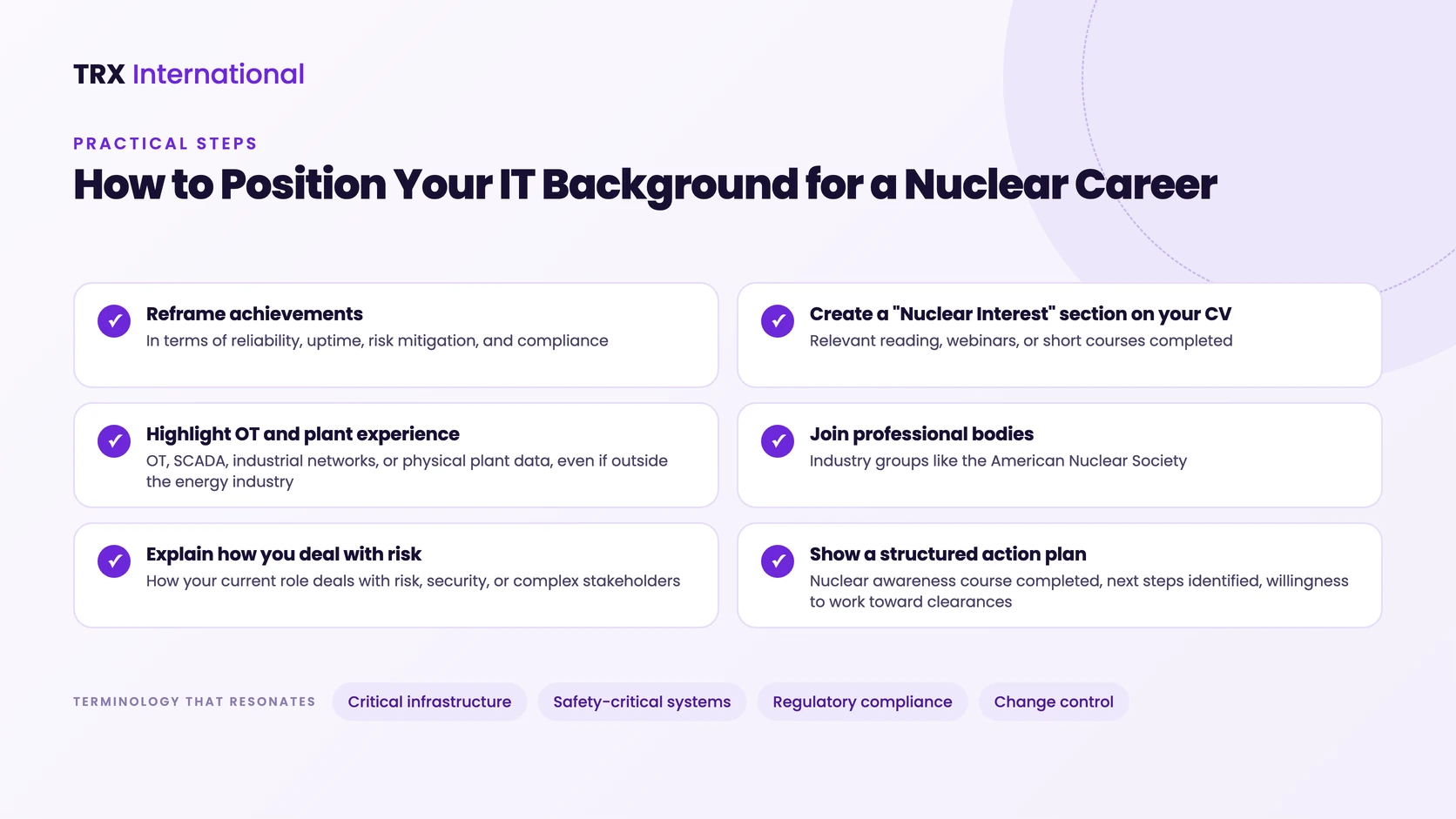
- Reframe achievements in terms of reliability, uptime, risk mitigation, and compliance ("reduced downtime by 40%," "improved audit pass rate," "hardened endpoint security across 2,000 nodes")
- Use terminology that resonates with nuclear employers: "critical infrastructure," "safety-critical systems," "regulatory compliance," "change control"
- Create a dedicated "Nuclear Interest" section on your CV showing relevant reading, webinars, or short courses completed
- Highlight any experience with OT, SCADA, industrial networks, or physical plant data, even if outside the energy industry
- Join nuclear and energy sector professional bodies. Networking and engagement with industry groups like the American Nuclear Society are beneficial for career transitions
- Prepare concise explanations of how your current role deals with risk, security, or complex stakeholders
- Show a structured action plan: nuclear awareness course completed, next steps identified, willingness to work toward clearances
- Military background? That's gold. Nuclear employers recognise the discipline, clearance readiness, and operational rigor that military candidates bring
Nuclear employers seek candidates with strong safety and risk management skills. Frame your technical expertise and transferable skills through that lens and you'll stand out from candidates who simply list tools.
Working with a Specialist Nuclear Recruiter like TRX International
A specialist nuclear recruitment partner can significantly shorten the transition path. Generic recruiters often don't understand what nuclear employers actually value in IT candidates. TRX International does.
We focus exclusively on nuclear energy, clean energy, and adjacent sectors: power generation, SMRs, fusion research, decommissioning, nuclear medicine. We work with utilities, EPCs, research bodies, and regulators across the UK, Europe, North America, and the Middle East.
How we support IT professionals making the transition:
- Reviewing CVs to highlight transferable skills and align them with nuclear career paths
- Advising on which short courses or qualifications are most valued by current hiring managers
- Guiding candidates through security clearance processes and relocation to major nuclear regions
- Connecting you with roles that match your background, from cybersecurity to project controls to data analytics
Example scenario: an experienced cybersecurity engineer from the financial sector recently transitioned into a nuclear OT security role on a UK new-build project through TRX International's client network. Their experience with regulated, 24/7 operations and governance frameworks made them a strong fit. They completed a short nuclear awareness course, and we handled the rest.
Over the next decade, clean energy expansion and nuclear power projects will generate electricity at scale and will need thousands of digitally capable professionals to develop, operate, and maintain that infrastructure. The labor market is already tight. Job creation in nuclear is accelerating. Your skill sets aren't just welcome in this sector. They're essential to its future.
Contact TRX International for a confidential discussion about your IT background and potential nuclear career options. The vast majority of successful transitions start with a single conversation.
Frequently Asked Questions
Do IT professionals need a nuclear engineering degree to work in nuclear?
No. You don't need a full nuclear engineering degree, you need targeted nuclear context. Short training programmes covering reactor fundamentals, safety culture, and national regulatory frameworks can help bridge the skills gap.
Which nuclear jobs can IT professionals apply for without nuclear experience?
Roles that often accept IT candidates include cybersecurity analyst or OT security engineer, data analyst or BI developer, application support engineer, project controls or PMO analyst, and digital twin or simulation support.
What IT skills transfer best into the nuclear energy sector?
Software engineering and DevOps, cybersecurity for OT, SCADA, and plant networks, data engineering and analytics, cloud and infrastructure, business systems such as SAP and Maximo, and high-performance computing all transfer well with added nuclear context.
Why is cybersecurity in such high demand at nuclear power plants?
Nuclear facilities must protect critical infrastructure as they move from analog to digital systems. In the U.S., the NRC sets guidelines for cybersecurity programs under 10 CFR 73.54, and the EU's NIS2 Directive and the UK's ONR impose similar expectations.
Which certifications help IT professionals move into nuclear cybersecurity roles?
For cyber roles, CISSP, CISM, GIAC, and IEC 62443 alignment complement an IT background. Awareness of nuclear quality standards such as NQA-1 or ISO 19443, plus a nuclear awareness course, adds the nuclear context employers look for.
How should IT professionals tailor their CV for nuclear industry jobs?
Reframe achievements in terms of reliability, uptime, risk mitigation, and compliance, and use terms like "critical infrastructure" and "change control". Add a "Nuclear Interest" section and highlight any OT, SCADA, or industrial network experience.
Elina Koskinen writes for TRX International on nuclear careers and professional development. Her guides help candidates at every stage, from graduates entering the industry to experienced engineers planning their next move, with practical advice on CVs, interviews, salaries and career progression.