A Day in the Life of a Nuclear Plant Engineer: Inside the Control Room and Beyond
See how a nuclear plant engineer spends the day, from 07:30 shift handover and core safety checks to plant walkdowns and outages. Explore the role today.
It's 07:00 on a Tuesday. The control room of a 1,330 MWe pressurized water reactor hums with the quiet focus of operators scanning instrument panels. Steam generators are putting out full thermal load. Boron concentration sits at 820 ppm. Xenon is building after last night's power ramp. Somewhere behind the data, a reactor systems engineer is pulling up overnight logs and preparing to take ownership of the core's behavior for the next ten hours.
That engineer is a nuclear plant engineer, and this is what the job looks like when the theory meets the turbine hall.
A nuclear engineer at an operating nuclear power plant is responsible for keeping the reactor safe, compliant, and productive. The role sits at the intersection of physics, operations, maintenance, and regulatory oversight. Nuclear engineers work across utilities, national labs, and regulatory bodies, but this piece focuses on the people employed at commercial power generation stations, where nuclear energy is America's second largest energy source and a single unit can supply electricity to over a million homes. A nuclear plant engineer plays a role in facility operation and safety compliance that few other engineering disciplines can match.
Here's what you'll learn: what a typical day looks like hour by hour, which tools and calculations fill that day, how training and career progression work, and what TRX International sees when placing candidates into these roles. Understanding a day in the life of a nuclear engineer helps candidates decide if the work fits their strengths, and helps hiring managers present roles honestly.
Meet the Engineer: Background, Plant Type, and Role
Meet Amir. He's a reactor systems engineer at a three-unit PWR station commissioned in 1995, with a gross capacity of roughly 3,900 MWe across all units. The plant targets a capacity factor above 90% and runs on 18-month fuel cycles. Amir reports to the Reactor Engineering Manager and works within the Core Design department. His team collaborates daily with operators, fuel vendors, and licensing staff.
Nuclear plant engineers work closely with multi-disciplinary teams including operators and maintenance staff. Nuclear facility operations require collaboration among various engineering disciplines. Amir's accountabilities cover:
- Ensuring core power distribution stays within design limits (axial and radial peaking, hot channel factors)
- Maintaining safety margins: DNBR, shutdown margin, chemical shim compliance
- Fuel cycle planning: burnup modeling, xenon transient management, boron letdown curves
- Outage support: core reload sequencing, startup physics testing, surveillance tests
- Producing technical reports for the regulator, including the core operating limits report
Early Morning: Shift Handover and Overnight Status Review
Arriving and catching up
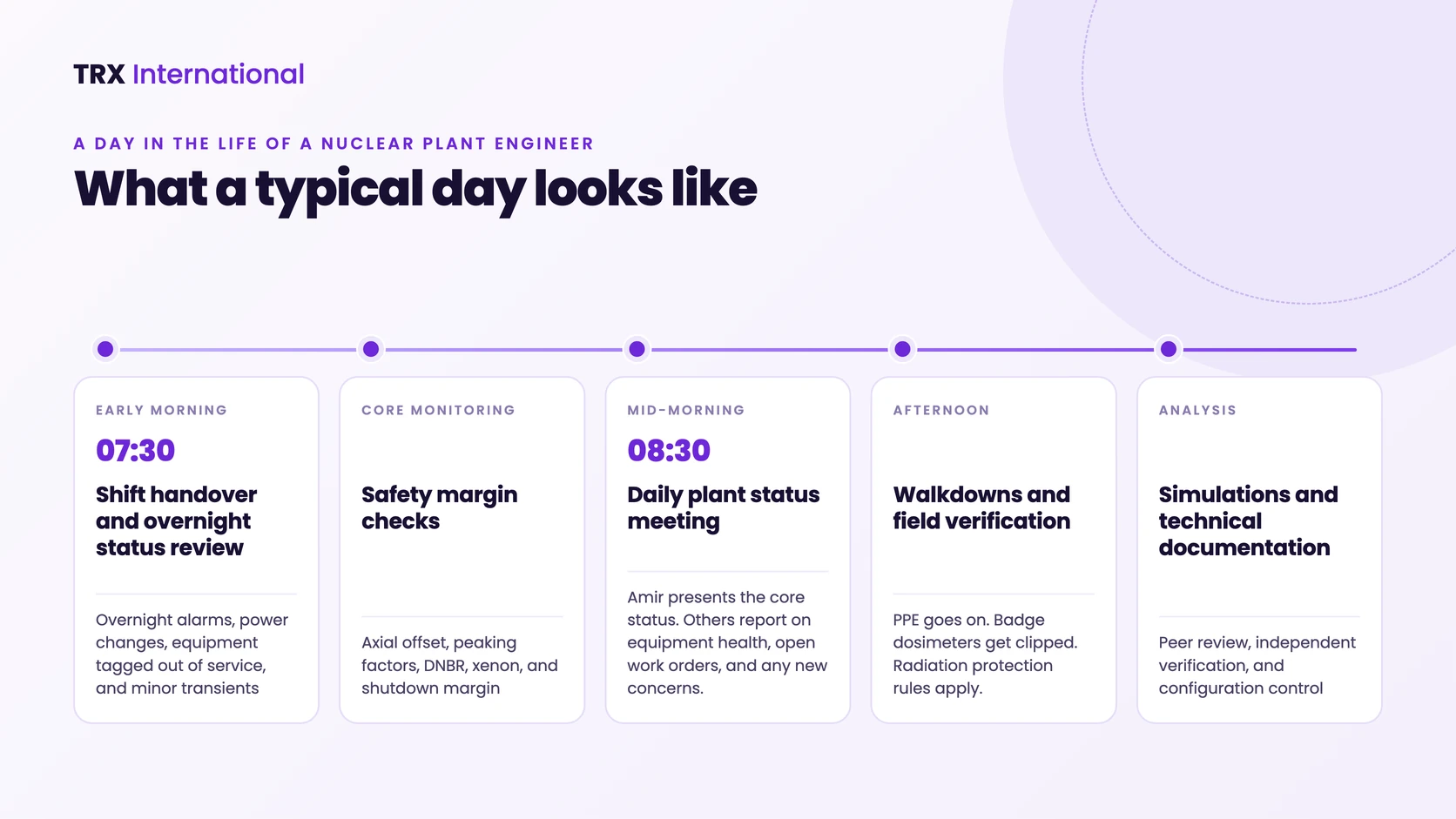
Amir's typical day starts at 07:30. During outages, that shifts earlier. The first task is the morning handover with the night-shift duty engineer and control room operators. They walk through overnight alarms, any power changes, equipment tagged out of service, and minor transients.
What gets checked first
Engineers monitor performance and health of critical plant systems to prevent failures. The data Amir reviews includes core outlet temperatures on both steam generator loops, reactor coolant pressure and flow, boron concentration, xenon trends (is it building or burning out?), reactor power level, and whether any safety limit was approached.
Nuclear plants operate continuously, often following 18 to 24 month fuel cycles, so overnight events matter. The plant historian software (often something like OSIsoft PI) stores every parameter. Amir also checks reactor core monitoring systems and any transient analysis flags his team has set up.
A concrete example: "Unit 2 ramped from 80% to 100% power at 03:00 for grid demand. Xenon suppression margins tightened. Night shift adjusted soluble boron by 10 ppm to hold reactivity margin." That kind of note tells Amir exactly where to focus his morning calculations.
Core Monitoring and Safety Margin Checks
Core monitoring is where a nuclear engineer's physics background meets live reactor data. Amir compares measured in-core neutron flux signals and thermocouple readings against predictions from fuel cycle analyses prepared months earlier. The goal: confirm that power distributions stay within technical specifications.
Daily tasks include calculations for reactor efficiency and safety. Engineers must balance the tension between maintaining production and ensuring safety in operations. Here's what that looks like in practice:
- Reviewing axial offset (the power split between the upper and lower halves of the core) to confirm it tracks within the allowed band
- Checking peaking factors against licensed limits (often ≤ 2.0 for the hot channel factor)
- Verifying DNBR stays above minimum (regulatory limits typically require ≥ 1.3 depending on the plant and fuel design)
- Comparing measured burnup profiles against design predictions from the earlier fuel cycle analysis
- Evaluating the impact of inserting a specific control rod bank during a load-following maneuver; recalculating local peaking and boron adjustments
- Monitoring xenon concentration after any power reduction, since xenon absorbs neutrons and can cause spatial oscillations if not managed
- Validating shutdown margin: confirming the reactor can be scrammed with adequate reactivity margin at the current rod configuration
Nuclear engineers perform core designs for nuclear reactors, and those designs set the expectations Amir checks against every day. When live data deviates from prediction, that's the signal to dig deeper.
Mid-Morning: Meetings, Coordination, and Problem-Solving
Daily plant status meeting (08:30)
The first scheduled meeting pulls together the operations shift supervisor, system engineers covering feedwater, coolant, and emergency systems, maintenance planners, and radiation protection staff. Amir presents the core status. Others report on equipment health, open work orders, and any new concerns.
Engineers collaborate regularly to solve complex problems. Effective troubleshooting in nuclear engineering involves root-cause analysis and engineering evaluations, not guesswork. An example: the feedwater pump on Unit 1 is showing an upward vibration trend. The system engineer proposes monitoring it for another 48 hours. Amir flags that if the pump trips during a power maneuver, the core's response depends on the remaining feedwater capacity, and asks whether the safety analysis covers the degraded condition.
Problem solving in real time
Nuclear safety is a responsibility that shapes every conversation. A small primary system leak detected during a morning walkdown triggers an ad hoc huddle. The team evaluates leak rate against technical specification limits, decides on additional monitoring frequency, and documents the evaluation for regulatory purposes. The discussion translates complex nuclear engineering concepts into practical terms: "If the leak rate doubles, we must reduce power within four hours per tech spec 3.4.13."
Afternoon in the Plant: Walkdowns and Field Verification
Many nuclear engineers regularly leave the office to walk the plant. PPE goes on. Badge dosimeters get clipped. Radiation protection rules apply.
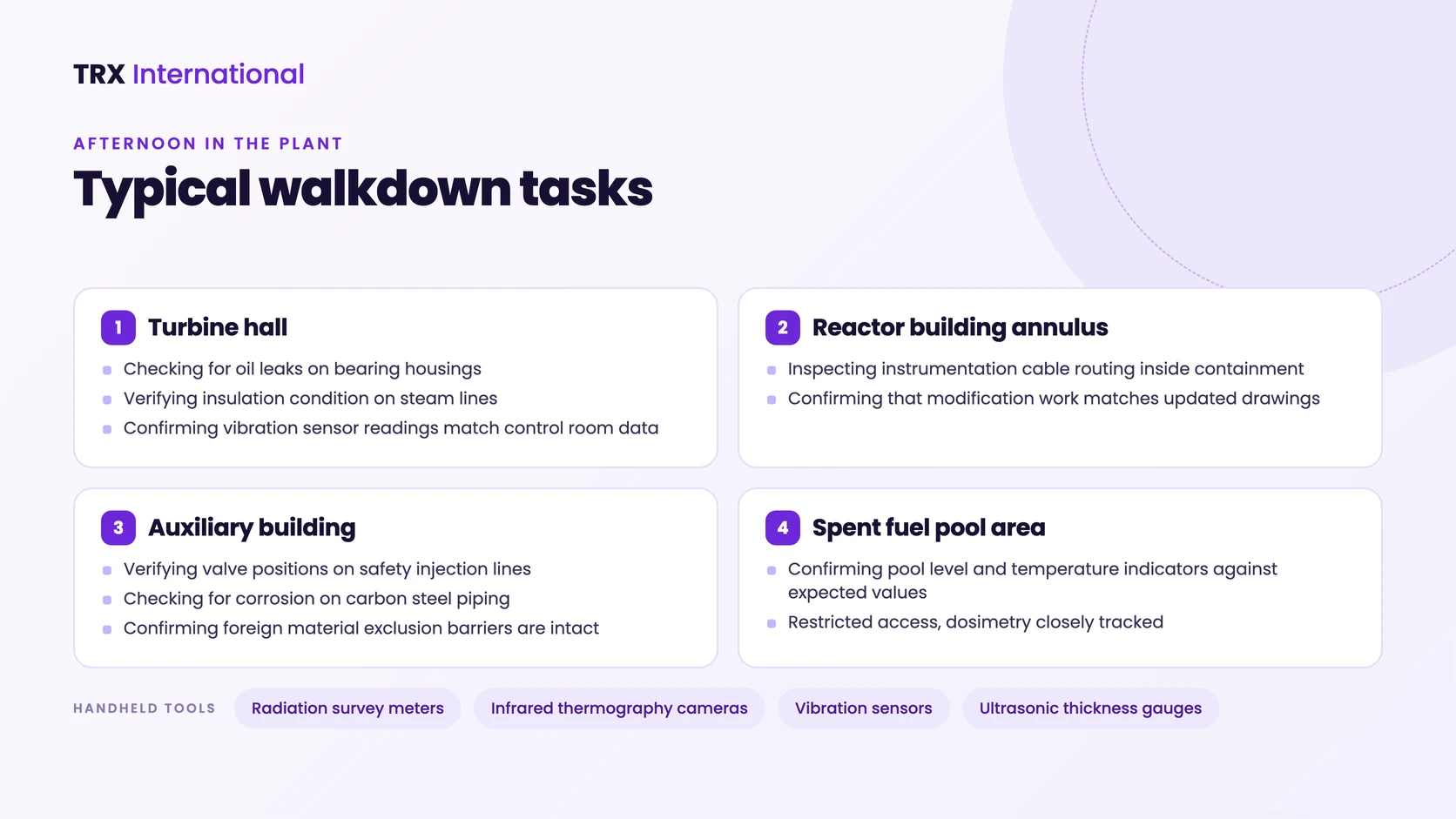
Plant engineers perform regular walkdowns to inspect equipment for safety and performance issues. Engineers face challenges related to aging infrastructure and securing replacement parts, which makes visual inspection and condition monitoring critical. Typical walkdown tasks include:
- Turbine hall: checking for oil leaks on bearing housings, verifying insulation condition on steam lines, confirming vibration sensor readings match control room data
- Reactor building annulus: inspecting instrumentation cable routing inside containment, confirming that modification work matches updated drawings
- Auxiliary building: verifying valve positions on safety injection lines, checking for corrosion on carbon steel piping, confirming foreign material exclusion barriers are intact
- Spent fuel pool area: confirming pool level and temperature indicators against expected values (restricted access, dosimetry closely tracked)
Handheld tools include radiation survey meters, infrared thermography cameras for thermal anomalies, vibration sensors, and ultrasonic thickness gauges for pipe wall measurements. Technicians and safety inspectors often accompany the walkdown.
Analysis, Simulations, and Technical Documentation
A large fraction of the day sits at a computer. Amir runs analyses and updates documentation, particularly for safety-significant changes.
The software tools vary by plant and country, but common types include:
- Neutronics codes for reactivity calculations and core power shape predictions
- Thermal-hydraulic transient codes like RELAP, TRACE, or CATHARE for modeling loss-of-coolant scenarios and heat flux transients
- Finite-element tools for stress analysis on reactor components
- Python and MATLAB scripts for automated trending, data analysis, and sensor comparison
- Excel workbooks for ad hoc calculations and shift-by-shift tracking
Nuclear engineers run over a thousand simulations for safety analysis across a fuel cycle. For example, Amir's current small project involves assessing the effect of taking a safety injection pump out of service for 24 hours. He must determine the impact on emergency core cooling margin and confirm no loss of safety function occurs. Nuclear engineers conduct research to optimize plant performance alongside this compliance work.
Engineers must follow extensive regulatory requirements and maintain accurate documentation. Every calculation note, engineering change package, and technical justification goes through peer review, independent verification, and configuration control. Some documents require submission to the Nuclear Regulatory Commission or equivalent regulatory body. There's no shortcut through that process.
Outages and Refuelling: When the "Typical Day" Disappears
The typical day vanishes during a refuelling outage, which occurs every 18 to 24 months and lasts roughly 30 to 40 days (the US fleet median is around 32 days). The nuclear engineering environment is characterized by high operational pressure during outages.
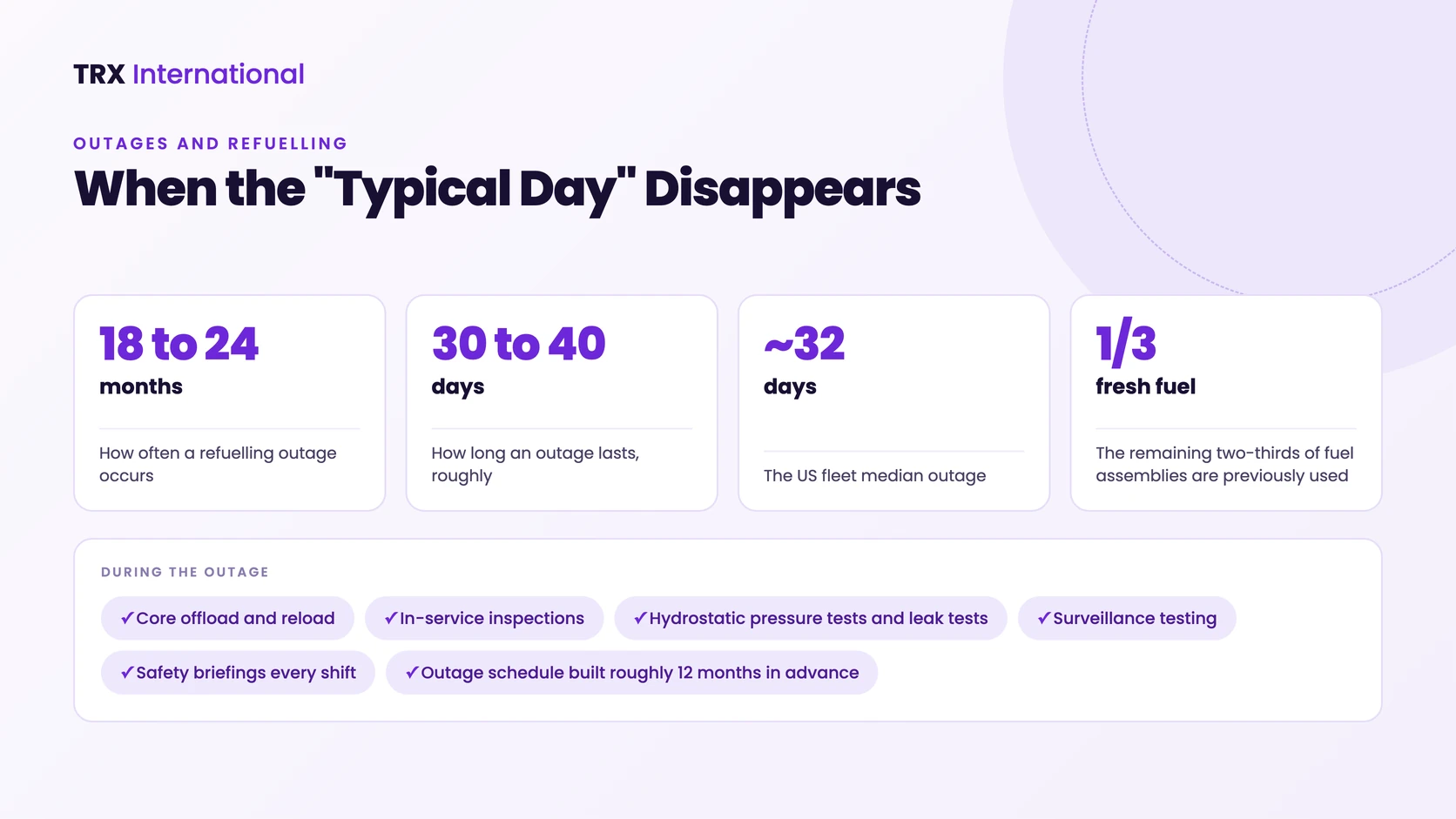
- Core offload and reload: verifying fuel assembly serial numbers, confirming placement in the core map, checking burnable absorber locations. Approximately two-thirds of fuel assemblies in a core are previously used; the remaining third is fresh nuclear fuel
- A nuclear plant engineer's work includes planning outages and maintenance cycles efficiently; the outage schedule is built roughly 12 months in advance
- In-service inspections on reactor vessel head welds, steam generator tubes, and pressure boundary components using non-destructive examination teams
- Primary system hydrostatic pressure tests and leak tests before restart
- Surveillance testing: pump start-stop tests, flow and heat-balance verification
- Safety briefings every shift, foreign material exclusion controls around the open reactor vessel, and strict work permits for all containment activities
- Coordination with vendors, contractors, and sometimes regulatory inspectors present on site
- Significant decisions in nuclear plants must prioritize safety and compliance with procedures, even when the outage schedule is tight and every hour of downtime costs the utility revenue
Skills, Tools, and Mindset of Successful Nuclear Engineers
- Strong fundamentals in physics, thermodynamics, reactor kinetics, and fluid dynamics
- Knowledge of materials behavior under irradiation (fuel cladding, vessel steel, concrete biological shielding)
- Daily use of plant-specific core monitoring software, data historians, digital control systems, and document management platforms
- Coding tools like Python or MATLAB for data analysis and automated trending
- AI tools like Hive that optimize reactor lifecycle processes are entering the workflow at some plants
- Calm decision-making under pressure: during a transient or unplanned trip, the reactor systems engineer supports the control room with real-time analysis
- Meticulous documentation: a mislabelled valve that would reverse flow in a safety injection line is the kind of catch that prevents an operational event. Attention to detail here is not a soft skill; it's a job requirement.
- Ability to challenge assumptions regardless of hierarchy. If the data says the model is wrong, you say so.
- Continuous learning is essential for nuclear engineers to maintain qualifications and knowledge. Requalification, simulator exercises, and regulatory training happen on a recurring schedule.
- Nuclear plant engineers blend rigorous regulatory oversight and analytical problem solving every day. Other tasks like procedure updates and vendor correspondence fill the gaps.
Education, Training Pathways, and Early-Career Progression
Some operating engineers only need a bachelor's degree in nuclear engineering, mechanical engineering, or a related field. Nuclear engineers often require significant coursework in math and physics regardless of the degree title. A master's degree is required for design or research nuclear engineers, and graduate education is essential for most nuclear engineering positions overall.
There's another path. High school graduates can train through the U.S. Navy Nuclear Power Program, and the Navy is a major employer of nuclear engineers. Many plant operators and engineers entered the industry this way.
Training at a utility includes full-scope plant simulators, structured qualification programs with system-by-system sign-offs, mentored on-the-job learning, and formal radiological protection and emergency response courses. Plant-based engineers develop differently from those at research facilities or regulatory bodies, who spend more time on safety analysis models and policy rather than daily core monitoring.
A plausible career path over 5 to 10 years: start as a junior systems engineer performing trending and supporting maintenance. After two to three years, lead small modifications and support control room decisions. Around the five-year mark, move into senior reactor engineer, project manager, or shift technical advisor. TRX International helps candidates at every stage, from entry-level job searches to senior roles across utilities, SMRs, and fusion projects.
Work-Life Balance, Rewards, and Challenges
Standard working hours run 8 to 10 hours on weekdays. During outages, 12-hour days and weekend shifts are common. NRC guidance restricts safety-related personnel to no more than 16 hours in any 24-hour period, which puts a ceiling on the worst stretches.
The emotional weight is real. You're responsible for managing nuclear energy safety, and the decisions you make affect core integrity and public safety. The satisfaction comes from delivering reliable, low-carbon power generation to the grid. The stress comes from unplanned trips, tight outage schedules, and equipment surprises.
Nuclear engineering offers stable and secure employment opportunities. Plant lifetimes are long; many 1980s-era reactors are pursuing license extensions to 60 or 80 years. No new nuclear power plants have been built in the U.S. since 1978, but demand for nuclear engineers to operate existing plants remains steady. Nuclear engineering jobs are available in utilities and research facilities across the country and the world. Compared to oil and gas or renewables, nuclear roles involve stricter regulation and a slower pace of technological change, but the stakes are higher and the safety culture deeper. Compensation reflects that. Sites can be remote, which is worth factoring in.
Future of the Role and How TRX International Can Help
The life of a nuclear engineer is shifting. SMR reactor companies are designing plants that will need smaller operations teams but more digital monitoring. Digital twins and AI-assisted diagnostics are entering reactor operations. Experienced engineers will work alongside these tools rather than be replaced by them.
Concrete trends shaping the next decade: life extension programs for aging fleets across Europe and North America, new nuclear construction projects in the Middle East and Asia, growth in decommissioning and radioactive materials management, and expanding roles in nuclear medicine. New nuclear power plants under construction globally mean development, commissioning, and startup roles are open now.
TRX International places nuclear engineers across plant operations, SMR startups, regulatory bodies, and international projects. If you're considering a move, whether from the Navy, from a university research lab, or from another power plant, we can match your skills to the right role.
Upload your CV, contact our nuclear recruitment team, or explore career insights on our blog. The day in the life of a nuclear plant engineer is part physics, part coordination, part field work. That mix keeps the job interesting for decades, and the nuclear industry needs people who find that appealing.
Frequently Asked Questions
What does a nuclear plant engineer do on a typical day?
A typical day starts around 07:30 with a shift handover and an overnight status review. It then moves through core monitoring and safety margin checks, the daily plant status meeting, plant walkdowns, and analysis and documentation work.
What hours do nuclear plant engineers work during normal operations and outages?
Standard working hours run 8 to 10 hours on weekdays. During outages, 12-hour days and weekend shifts are common, and NRC guidance restricts safety-related personnel to no more than 16 hours in any 24-hour period.
How does a refuelling outage change a nuclear plant engineer's daily routine?
The typical day disappears. Outages occur every 18 to 24 months and last roughly 30 to 40 days, filled with core offload and reload, in-service inspections, pressure tests, and surveillance testing under high operational pressure.
What degree do you need to become a nuclear plant engineer?
Some operating engineers only need a bachelor's degree in nuclear engineering, mechanical engineering, or a related field. Design and research roles require a master's degree, and the U.S. Navy Nuclear Power Program is another path.
What software tools do nuclear plant engineers use for daily analysis?
Common tools include neutronics codes, thermal-hydraulic transient codes like RELAP, TRACE, or CATHARE, finite-element stress tools, Python and MATLAB scripts, and Excel workbooks. Plant historian software such as OSIsoft PI stores every parameter.
What does career progression look like for a nuclear plant engineer?
Many start as junior systems engineers performing trending and supporting maintenance. After two to three years they lead small modifications, and around the five-year mark they move into senior reactor engineer, project manager, or shift technical advisor roles.
Elina Koskinen writes for TRX International on nuclear careers and professional development. Her guides help candidates at every stage, from graduates entering the industry to experienced engineers planning their next move, with practical advice on CVs, interviews, salaries and career progression.