Authorized Nuclear Inspector Careers: Guide to Roles, Training and ASME Section III
An authorized nuclear inspector certifies ASME Section III components. Learn the endorsements, National Board course, pay and career path to get started.
Introduction to Authorized Nuclear Inspectors
The Authorized Nuclear Inspector (ANI) is the person who stands between a nuclear component and the reactor it's destined for, confirming that every weld, material certificate, and pressure test meets the ASME Boiler and Pressure Vessel Code. The Authorized Nuclear Inservice Inspector (ANII) does something similar, but for components already inside operating plants, verifying ongoing integrity under ASME Section XI. Both roles carry serious regulatory weight: without their sign-off, a reactor pressure vessel, steam generator, or Class 1 piping system doesn't get certified. Period.
This guide is written for engineers, QC inspectors, NDE specialists, and nuclear professionals who are considering a move into authorized nuclear inspection work. You'll find a clear breakdown of what ANIs and ANIIs actually do day to day, the ASME Section III and Section XI requirements they work against, how to get trained and endorsed, and what the career path looks like in terms of salary, progression, and global demand.
The timing matters. Life-extension projects are underway at dozens of U.S. reactor units, with 52 units pursuing license renewals or power uprates. France is building new EPRs. The UK's nuclear workforce has grown from roughly 61,000 in 2021 to about 102,000 in 2026, driven by Hinkley Point C and SMR programmes. Canada's refurbishments at Bruce, Darlington, and Pickering, plus new SMR deployment, are creating even more demand. All of these projects need qualified authorized nuclear inspectors and nuclear inservice inspectors. TRX International, as a specialist nuclear recruitment partner, places ANI, ANII, and related talent with utilities, OEMs, EPCs, and authorized inspection agencies worldwide, helping candidates find roles that match their experience and endorsements.
What Is an Authorized Nuclear Inspector (ANI) and Nuclear Inservice Inspector (ANII)?
A qualified authorized nuclear inspector is an individual recognized under ASME Code and National Board criteria who holds the authority to inspect and certify components built under ASME Section III of the ASME BPV Code. They carry specific endorsements (the "N" symbol, and sometimes "NA" or "NPT") and must be employed by an ASME-accredited authorized inspection agency (AIA). ANIs serve as independent third-party quality assurance professionals in nuclear energy, providing the technical independence that regulators require.
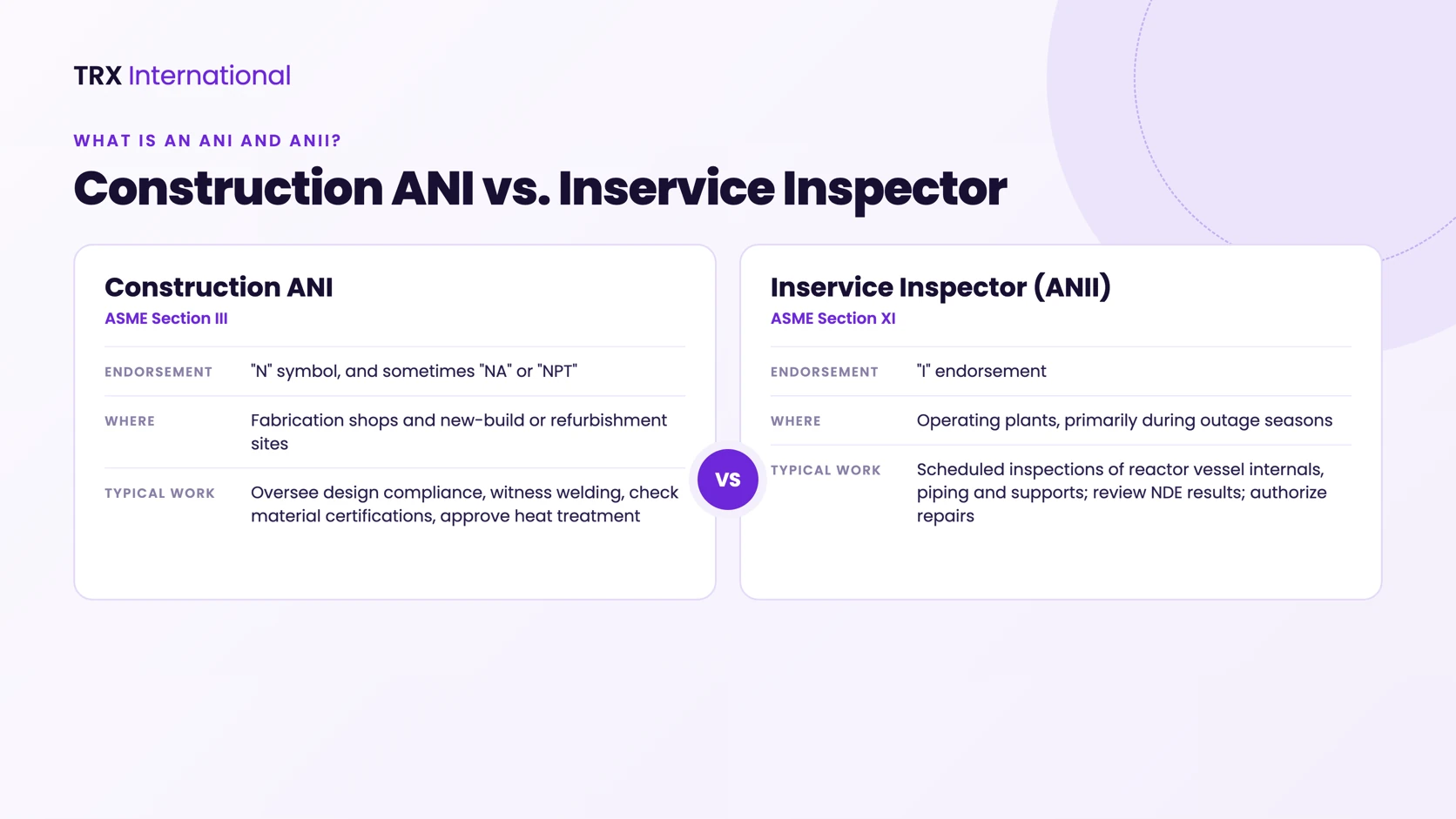
An authorized nuclear inservice inspector holds the "I" endorsement and works under ASME Section XI. Their focus is on components already in service: inspecting welds for aging degradation, authorizing repair and replacement activities, monitoring for embrittlement and stress corrosion cracking, and verifying fitness for continued operation.
Nuclear safety relies on independent oversight provided by ANIs. Their work helps protect public and environmental safety in nuclear operations. Here's what the job actually involves:
Construction ANI (Section III) vs. Inservice Inspector (Section XI)
- Construction ANIs operate in fabrication shops and on new-build or refurbishment sites. They oversee design compliance, witness welding, check material certifications, approve heat treatment, and ensure correct application of quality assurance requirements. They verify compliance with ASME codes during the construction of nuclear components.
- Inservice inspectors work at operating plants, primarily during outage seasons. They perform scheduled inspections of reactor vessel internals, piping, and supports. They review NDE results, authorize repairs, and ensure documentation supports license renewal or life extension.
Typical Employers and Projects
ANIs are employed by authorized inspection agencies to ensure technical independence. They're also found at nuclear utilities, component manufacturers, EPCs, and third-party inspection firms. Major programmes currently deploying ANIs and ANIIs include Vogtle Units 3 & 4 (USA), Hinkley Point C (UK), and Barakah (UAE). SMR reactor companies in Canada and the UK are also creating new demand.
Key Responsibilities
- Reviewing design specifications, stress reports, and calculations for pressure boundary components classified under ASME classes (Class 1, 2, 3, MC, CS)
- Witnessing critical manufacturing processes including pressure tests and nondestructive examinations
- Verifying material traceability: certified material test reports (CMTRs), impact/Charpy tests, permitted material sources
- Inspecting nuclear components and assessing their compliance with regulatory standards
- ANIs review and monitor the quality assurance program of manufacturers or constructors
- Approving repair and replacement activities and maintaining Code data reports
- ANIs have a critical role in identifying and reporting safety deficiencies in nuclear operations, ensuring accurate and timely reporting of any issues found
- Performing ASME/NB shop and field inspection services at assigned clients' facilities
- ANIs help ensure nuclear facilities adhere to safety regulations and prevent operational hazards
Authority and Code Symbol Stamps
The authorized nuclear designation ties directly to ASME Code symbol stamps. The "N" stamp marks components built to Section III. The "NPT" covers parts and appurtenances. The "NA" applies to certain assemblies. Only ANIs from approved AIAs can validate Code compliance. If a non-authorized inspector signs off, the component can't legally carry the ASME Code symbol, which affects customs clearance and regulator acceptance.
The ANI can halt work if nonconformances or code violations are found during inspections. That authority is the reason the role exists.
ASME Section III, Div. 1 and Other Key Code Requirements
Section III, Division 1: The Construction Code
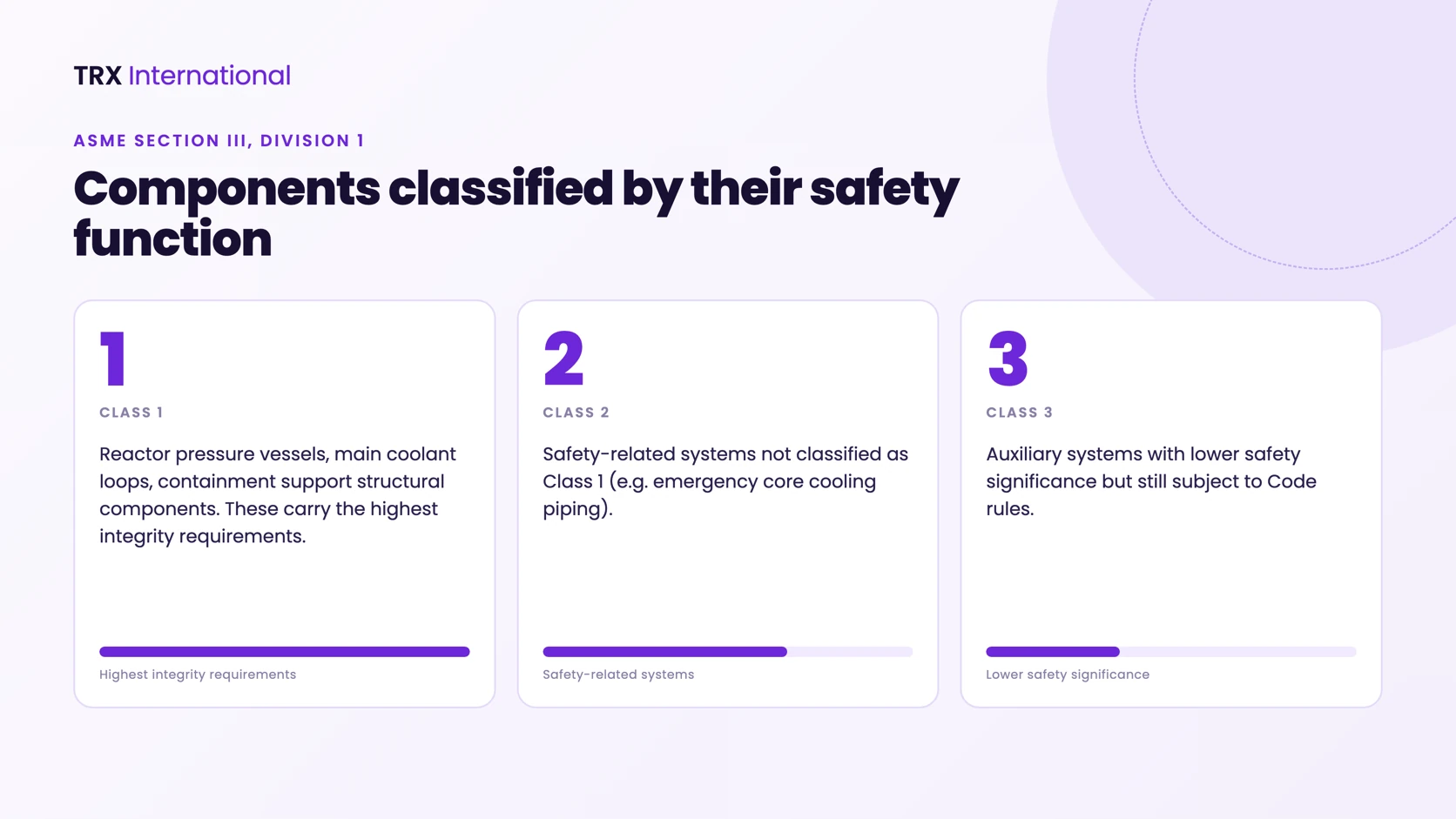
ASME Section III, Division 1 is the primary construction code for nuclear facility components. It covers design, fabrication, material selection, welding, examination, and testing of components classified by their safety function:
- Class 1: Reactor pressure vessels, main coolant loops, containment support structural components. These carry the highest integrity requirements.
- Class 2: Safety-related systems not classified as Class 1 (e.g. emergency core cooling piping).
- Class 3: Auxiliary systems with lower safety significance but still subject to Code rules.
ANIs working under Section III Div. 1 must understand design pressure and temperature limits, stress intensification factors, fatigue analysis, fracture toughness requirements, and the applicable sections of the Code for each component class. Material science knowledge is not optional here.
Section XI: Inservice Inspection
The authorized nuclear inservice inspector must also have strong knowledge of Section XI, which governs preservice and periodic inspections, repair or replacement programs, NDE schedules, examination categories (visual, volumetric), and acceptance criteria. They need to understand applicable code cases and how they interact with regulatory body obligations: the NRC in the United States, ONR in the UK, or CNSC in Canada, depending on the jurisdiction.
How ANIs Apply the Code in Practice
Here's a concrete example. During construction of a Class 1 main coolant piping run, an ANI will:
- Verify that the welding procedure specification (WPS) is approved under ASME Section IX
- Witness welder qualification testing
- Monitor nondestructive examination per Section V (ultrasonic testing of weld thickness, radiography of critical joints)
- Ensure heat treatment records are complete and correct
- Check that the design meets NB-2500 (Class 1) stress requirements
- Review fabrication drawings against design specifications
- Sign off completed welds at hold points
- Witness hydrostatic testing and verify results
- ANIs verify material test reports and compliance with ASME standards before components are certified
- Issue the Code symbol stamp after confirming full compliance
Understanding of codes like ASME QAI-1 is also important. QAI-1 establishes qualifications for ANIs, ANII supervisors, and authorized inspection agencies. It covers construction (Division 1), inservice (Section XI), and concrete (Division 2) endorsements.
Other Standards ANIs Encounter
| Standard | Purpose |
|---|---|
| ASME Section V | Reference codes and standard methods for nondestructive examination (RT, UT, PT, MT) |
| ASME Section IX | Welding and brazing qualifications: procedure, welder performance testing |
| ASME Section II | Materials: chemical and mechanical properties, authorized material specifications |
| ASME Section III, Div. 2 | Concrete containment structures (inspectors may hold a "C" endorsement) |
| National Board Inspection Code | Registration, data reports, and jurisdictional requirements |
ANIs don't need to memorize every line of every standard. But they do need strong working knowledge of how these documents interact, and they need to know when to reference them. That technical skill is what separates an inspector who can do the job from one who can do it well.
Training, Authorized Nuclear Inspector Course and Qualifications
Getting Into the Role
Most ANIs come from backgrounds in welding engineering, mechanical engineering, metallurgy, QC inspection, or NDE (Level II or III). Some start as shop inspectors for boiler and pressure vessel manufacturers or as nuclear QA/QC inspectors. Others cross over from the petrochemical or oil & gas sectors, where pressure vessel industry experience and familiarity with ASME Section VIII give them a head start.
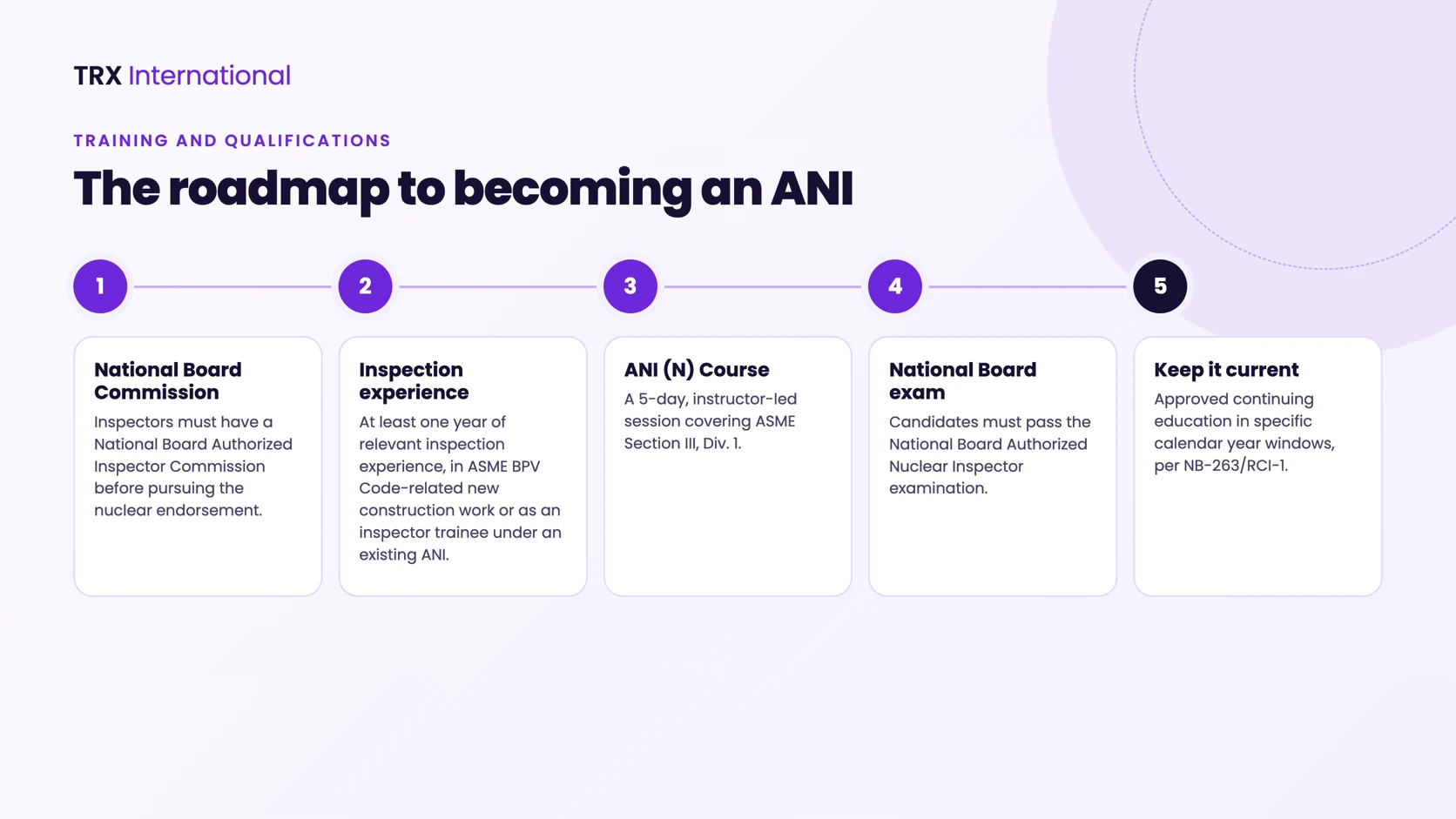
The path isn't quick, but it's well defined. Here's the roadmap.
The Authorized Nuclear Inspector Course
The National Board offers several authorized nuclear inspector course options:
- Authorized Nuclear Inspector (N) Course: A 5-day, instructor-led session covering ASME Section III, Div. 1. Content includes component classification (Class 1, 2, 3, MC, CS), design and stress limits, welding and brazing qualifications, nondestructive examination methods, impact testing, and Code data report requirements. The course combines classroom instruction, Code case studies, and written examinations.
- Authorized Nuclear Inservice Inspector (I) Course: Covers ASME Section XI, inservice inspection methods, acceptance criteria, repair and replacement activities, and field repair procedures.
- Authorized Nuclear Inspector Concrete (C) Course: Focused on Section III, Division 2 and ACI standards for concrete containment structures.
The Authorized Nuclear Inspector Course runs until October 24 this year, and four sessions of the Authorized Nuclear Inspector Course are scheduled next year. The National Board has increased class frequency due to demand, with over 100 students expected in N courses. Pricing runs approximately $1,900 USD for in-person and $2,500 USD for virtual sessions.
Completion of the Authorized Nuclear Inspector Course is necessary for certification. To become an ANI, candidates must pass the National Board Authorized Nuclear Inspector examination.
Prerequisites You'll Need
- Inspectors must have a National Board Authorized Inspector Commission before pursuing the nuclear endorsement. This is non-negotiable.
- At least one year of relevant inspection experience is required, either in ASME BPV Code-related new construction work or as an inspector trainee under an existing ANI.
- Knowledge of ASME BPV Code is essential for inspectors, particularly applicable sections of Sections III, V, and IX.
- An "I" endorsement is preferred for inspectors planning to work on inservice inspection activities.
- For the concrete "C" endorsement, past experience in concrete construction or inspection of nuclear containment structures is necessary.
- Familiarity with ASME boiler and pressure vessel standards, particularly Section VIII or Section I, is a common prerequisite.
These requirements are detailed in the National Board's NB-263/RCI-1 document, which also governs continuing education and endorsement maintenance.
Keeping Your Endorsement Current
Once endorsed, you don't get to coast. Inspectors who hold N or I endorsements must complete approved continuing education in specific calendar year windows. The National Board's NB-263/RCI-1 document specifies which training categories apply to each endorsement.
An inspector who continually enhances knowledge through self study, internal training, and approved continuing education stays marketable. Technology changes matter too: advanced NDE methods like phased array UT and digital radiography are increasingly expected. TRX International helps candidates identify these training opportunities and plan their endorsement timeline so they can apply industry knowledge where it's needed most and maintain knowledge of the latest Code revisions.
Day-to-Day Work, Career Prospects and How TRX International Can Help
What a Typical Day Looks Like
An authorized nuclear inservice inspector on an operating plant during a refuelling outage starts the morning reviewing the owner's inspection plan and coordinating with QA and engineering teams. The day involves walkdowns, witnessing NDE on reactor vessel internals or pipe welds, checking inspection hold points, reviewing documentation against NBIC and jurisdictional requirements, and logging inspection reports. Work happens inside containment, sometimes in elevated areas or near radiation zones. Health physics training and security clearance are standard requirements.
An ANI on a construction or refurbishment site has a different rhythm. The morning might start with reviewing fabrication drawings and QA documentation, followed by witnessing weld procedure qualification testing, monitoring heat treatment, verifying that parts carry proper CMTRs, and attending hydrostatic testing. Coordination with design engineers is constant. Hold points must be enforced. The inspector ensures accurate documentation at every stage, always working in a positive and productive manner with fabrication teams and engineering staff.
Both roles require standard software suites for documentation and reporting, and both demand timely reporting of all inspection activities.
Work Environments and Project Types
- Fabrication shops: Metal fabrication facilities manufacturing Class 1 components (reactor pressure vessels, steam generators). ANIs here follow established company policies and established policies for quality control.
- Active reactor sites: Outage seasons (spring and autumn in the US and Europe) drive heavy demand for nuclear inservice inspectors. Work assignments can be intense, with extended hours.
- Megaprojects: Long-term construction programmes like Sizewell C, Hinkley Point C, or SMR deployment offer multi-year roles.
- Canadian refurbishments: Bruce, Darlington, and Pickering programmes need both construction and inservice inspection professionals.
Salary Expectations
Authorized Nuclear Inspectors earn $46 to $50 per hour at firms like Bureau Veritas, which offers certification services. Bureau Veritas, a global organization and world leader in testing and inspection, posts roles requiring N and R endorsements, with I endorsement preferred. The broader nuclear inspector market in the U.S. shows an average around $109,534 per year, with experienced ANIs and ANIIs commanding premium rates due to scarcity and regulatory responsibility.
Pay varies by region, employer type (utility vs. contractor), and whether you're on a permanent or contract basis. The highest-paying nuclear roles tend to cluster around specialized inspection and engineering functions. Sound business practice for candidates: negotiate based on your endorsement portfolio and project complexity, not just years of experience.
Career Progression
Long-term paths from ANI and ANII roles include:
- Authorized Inspection Supervisor: Overseeing teams of ANIs on major programmes
- Code and Standards Specialist: Working on ASME committee activities, Code revisions, applicable code cases development
- Nuclear QA Manager: Leading quality assurance programs at utilities or OEMs
- Regulatory Inspector: NRC, ONR, or CNSC positions
- Consulting: Supporting SMR licensing, fusion demonstrator projects, decommissioning, or nuclear consulting engagements
These job classifications and career paths reflect how the industry expects to promote persons based on endorsement level, inspection experience, and industry knowledge. Personnel actions related to hiring, promotion, and work assignments are determined by qualifications, not non job related characteristics. Employers in this space are committed to equal employment opportunity and being an equal opportunity employer, where individuals are treated equally regardless of national origin, citizen status, marital status, sexual orientation, or protected veteran status. Equal opportunity and exciting employment opportunities exist across all levels of the profession.
How TRX International Supports Your Career
TRX International can help you at every stage of the ANI/ANII career path:
- Gap analysis: Mapping your current endorsements against target roles, identifying whether you need the N, I, or C endorsement first
- Training guidance: Helping you locate and enroll in the right authorized nuclear inspector course, secure exam dates, and plan your continuing education
- Role matching: Connecting you with ANI, authorized nuclear inservice inspector, and related roles at utilities, AIAs, OEMs, and EPCs worldwide, including work on current nuclear projects in the US, UK, Canada, Europe, and the Middle East
- Practical support: Assisting with security clearances, relocation, and the contract vs. permanent decision, plus advising on bureau veritas federal obligations or other AIA-specific client compliance requirements
- Staying current: Keeping you informed about ASME revisions, new regulatory frameworks, changes to NB-263 continuing education requirements, and jurisdictional requirements that affect your endorsement
TRX places candidates in a dynamic environment where the need for authorized nuclear inspection professionals is growing faster than the supply. The nuclear industry needs more qualified inspectors than it has. That gap is your opportunity.
Visit our careers page site to explore current ANI and ANII vacancies, or send your CV to TRX International for tailored job recommendations. We'll match you with roles that fit your endorsements, experience, and career goals, and keep you notified when new positions open at assigned clients and stellar team environments across the globe.
Frequently Asked Questions
What is the difference between an ANI and an ANII?
An Authorized Nuclear Inspector (ANI) inspects and certifies components built under ASME Section III. An Authorized Nuclear Inservice Inspector (ANII) holds the "I" endorsement and works under Section XI on components already in service at operating plants.
What qualifications do you need to become an authorized nuclear inspector?
You need a National Board Authorized Inspector Commission, at least one year of relevant inspection experience, and knowledge of ASME Sections III, V and IX. You then complete the Authorized Nuclear Inspector Course and pass the National Board examination.
How long is the National Board authorized nuclear inspector course?
The Authorized Nuclear Inspector (N) Course is a 5-day, instructor-led session covering ASME Section III, Division 1. It combines classroom instruction, Code case studies and written examinations.
What types of companies hire authorized nuclear inspectors and inservice inspectors?
ANIs must be employed by an ASME-accredited authorized inspection agency (AIA). They are also found at nuclear utilities, component manufacturers, EPCs and third-party inspection firms, on new-build, refurbishment and outage work.
How much does an authorized nuclear inspector earn in the US?
Authorized Nuclear Inspectors earn $46 to $50 per hour at firms like Bureau Veritas. The broader US nuclear inspector market averages around $109,534 per year, with experienced ANIs and ANIIs commanding premium rates.
Do authorized nuclear inspectors need continuing education to keep their endorsement?
Yes. Inspectors who hold N or I endorsements must complete approved continuing education in specific calendar year windows. The National Board's NB-263/RCI-1 document specifies which training categories apply to each endorsement.
Eleanor Whitfield writes for TRX International on careers in nuclear safety, regulation and quality assurance. Her articles break down specific roles, the qualifications and security clearances they require, and how professionals build expertise in one of the most tightly governed industries in the world.